2004 BGG rank #12704

Diaballik

2 players 20 min Ages 8+ 2.1/5 complexity 5.6/10 rating

About this game

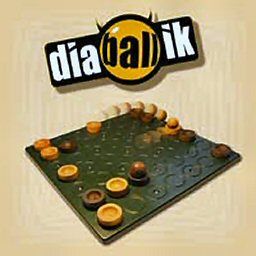
Diaballik is an abstract strategy game for 2 players. The game attempts to simulate a sport whereby 2 teams are simultaneously trying to get their ball to the opposite teams starting goal line. The board depicts a 7×7 grid. Each player starts with 7 ball holders along their edge of the board and their ball in the middle holder. Players subsequently take turns completing the following actions: Moving an empty ball holder orthogonally (up to 2 times); and/or Making a ball "pass" by moving the ball from on holder to another along lateral (horizontal) or diagonal line. Pass are not limited in length as long as no opponent pieces are in the way. First person to send their teams ball to a holder on the opponents starting line wins. It's worth noting that an impenetrable wall of ball holders results in an automatic loss to the player who created the wall. Nominated for the 2006 As d'Or Game of the Year. Online Play Boîte à jeux (turn-based) Available on iPad (via iTunes Apps Store) since the june 21st 2011 (2 players local game, or 1 player vs AI) Strategiespiel nach den Prinzipien von Mannschaftssportarten, mit Bewegung und Pässen. Ziel des Spiels ist es seine Kugel auf die Startlinie des Gegners zu bringen. Um dies zu erreichen muss jeder Spieler Angriffe und Verteidigungen spielen. Hinter einem einfachen Mechanismus verbirgt sich ein dynamisches Strategiespiel, welches bis zum letzten Augenblick spannend bleibt, da überraschende Wendungen immer möglich sind. Giseh Verlag

What it feels like

Grid Movement Point to Point Movement Abstract Strategy Sports

Game intelligence

Learn the game

100% knowledge coverage

Setup

1. Each player places all of their pieces on their own starting line (the row closest to them). 2. The ball is placed on the middle piece of each player's starting line. 3. Players face each other across the board. Optional Variant Setup (fig. 2): Before play begins, each player places 2 of their pieces on the opponent's starting line instead of their own.

Turn flow

On their turn, a player performs at least 1 and up to 3 actions total, chosen from the following, in any order: (1) First Move — move a non-ball-carrying piece one step orthogonally to an adjacent square; (2) Second Move — move a (possibly the same) non-ball-carrying piece one step orthogonally to an adjacent square; (3) Pass — the ball carrier passes the ball in a straight line (orthogonally or diagonally) to another friendly piece, with no distance limit, provided no opponent piece blocks the passing line. The ball carrier itself may never move. A player must take at least one action per turn.

Scoring and victory

The first player to achieve a winning condition wins the game outright. There is no point scoring. Target score: N/A — first to meet a win condition wins immediately Scoring sources: Passing the ball to a friendly piece on the opponent's starting line, Opponent creates an Anti-Play situation and you announce it with at least 3 of your pieces touching the blocking line

Source: Rulebook

Rules to know

The most useful rules for getting a first game right.

General

Win by passing the ball to a friendly piece on the opponent's starting line.

The objective of Diaballik is to be the first player to pass the ball to one of your own pieces that is located on your opponent's starting line (the row where the opponent began the game). The ball must be actively passed there — simply moving a piece there is not sufficient.

Setup

Each player places all pieces on their own starting line with the ball on the middle piece.

In the standard setup, each player places all of their pieces in a single row on their own starting line (the row of the board closest to them). The ball is given to the middle piece in that row. The two players' starting lines are on opposite ends of the board, and players face each other.

Setup

Variant: each player begins with 2 pieces already on the opponent's starting line.

In the variant setup (fig. 2), before the game begins each player places 2 of their pieces on the opponent's starting line rather than their own. The remaining pieces (and the ball carrier) are placed on the player's own starting line as normal. This variant changes the opening positional dynamics significantly.

Turn structure

Each player performs at least 1 and up to 3 actions per turn, in any order.

On their turn, a player must perform at least 1 action and may perform up to 3 actions total. The available actions are: First Move, Second Move, and Pass. These actions may be taken in any order the active player chooses. The player cannot skip their entire turn — at least one action must be executed.

Movement

Move a non-ball-carrying piece one step orthogonally (first move action).

As one of their up to 3 actions, a player may move one of their pieces (which is not currently carrying the ball) one step to an orthogonally adjacent position (up, down, left, or right). This is designated as the 'first move' action. Diagonal movement is not allowed for piece movement.

Movement

Move a non-ball-carrying piece one step orthogonally (second move action); the same piece may be moved twice.

As one of their up to 3 actions, a player may move one of their pieces (which is not currently carrying the ball) one step to an orthogonally adjacent position (up, down, left, or right). This is designated the 'second move' action. Importantly, the same piece that was moved in the first move action may be moved again in the second move action, allowing a piece to advance two squares in a single turn.

Special

The ball carrier passes the ball in a straight orthogonal or diagonal line to a friendly piece; no distance limit; line must be free of opponent pieces.

As one of their up to 3 actions, the player whose piece is carrying the ball may pass the ball in a straight line — either orthogonally (horizontally or vertically) or diagonally — to another of the player's own pieces. There is no limit on the distance of the pass. However, the entire passing line (every square between the ball carrier and the receiver, exclusive of start and end) must be free of any opponent pieces. Friendly pieces do not block the passing line. After the pass, the receiving piece becomes the new ball carrier.

Restriction

The ball carrier cannot move using a move action.

The piece currently holding the ball is the ball carrier. The ball carrier is completely prohibited from moving to an adjacent square using either the first move or second move actions. Only non-ball-carrying pieces may be moved. The ball carrier can only change position by having the ball passed away from it (thus another piece becomes the carrier), after which it is free to move on a subsequent action.

Strategy briefing

Advance the ball carrier's receiver, not the carrier

Because the ball carrier cannot move (ball_carrier_cannot_move), your movement actions should focus on positioning other pieces to create a clear passing lane toward the opponent's starting line, then pass into that advanced piece.

Use both move actions on one piece for rapid advancement

Since the same piece can be moved twice in a single turn (action_move_second), you can advance a single receiver two squares closer to the opponent's line per turn, accelerating your scoring threat without spending actions on multiple pieces.

Order actions to maximize flexibility

Actions can be taken in any order (turn_action_limit). Consider passing the ball early in your turn so the former carrier becomes free to move, effectively giving you two moveable pieces for the remaining move actions instead of one.

Block passing lanes to slow the opponent

Opponent passes are blocked by your pieces on the passing line (action_pass). Positioning your pieces to cut diagonal and orthogonal lanes forces the opponent to spend extra move actions repositioning around your blockers.

Avoid creating a blocking line — but threaten one carefully

Forming a continuous blocking line loses the game if the opponent has 3+ pieces touching it (anti_play_rule). However, maintaining a near-complete line can pressure the opponent while keeping a deliberate gap to avoid the loss condition.

Variant setup: check for an immediate first-turn win

In the variant setup, you start with 2 pieces on the opponent's line (setup_variant). Before your first move, check whether your ball carrier has a clear orthogonal or diagonal passing lane to either of those pieces. If so, you may be able to win on turn 1.

Common questions and edge cases

Can the ball carrier move after passing the ball away during the same turn?

Yes. Once the ball is passed to another piece, the original carrier is no longer the ball carrier and is free to move. If move actions remain in the turn, the former carrier may use them to move orthogonally.

Can the same piece be moved two squares in a single turn?

Yes. A single non-ball-carrying piece may be moved once with the First Move action and again with the Second Move action in the same turn, effectively advancing it two squares. The moves do not need to be in the same direction.

Can the ball be passed if an opponent's piece stands between the ball carrier and the target?

No. The passing line must be completely free of opponent pieces. If any opponent piece occupies a square on the straight line between the ball carrier and the intended receiver, the pass is illegal. Friendly pieces do not block passes.

A player moves one of their pieces onto the opponent's starting line. Do they win?

No. Simply moving a piece onto the opponent's starting line does not win the game. The player wins only when they successfully pass the ball to a friendly piece that is already on the opponent's starting line.

An opponent creates a blocking line, but only 2 of your pieces are adjacent to it. Can you announce Anti-Play?

No. Announcing Anti-Play requires that at least 3 of your pieces are orthogonally adjacent (face to face) to the blocking line. With only 2 pieces touching the line, the Anti-Play condition is not met and you cannot invoke it.

Can the Pass action be used as the winning move, even if it is the player's first, second, or third action of the turn?

Yes. The Pass action can be taken at any point in the turn (first, second, or third action) in any order. If the pass delivers the ball to a friendly piece on the opponent's starting line, the game ends immediately regardless of how many actions remain.

In the variant setup, if a player already has 2 pieces on the opponent's starting line at game start, can the game be won on the very first turn?

Potentially yes. If the ball carrier can draw a clear passing line (unobstructed by opponent pieces) to one of the 2 friendly pieces already on the opponent's starting line, a pass to that piece wins the game immediately — even on the first turn.

Ask About This Game

Similar games