1999 BGG rank #4948

Elk Fest

2 players 15 min Ages 8+ 1.1/5 complexity 5.8/10 rating

About this game

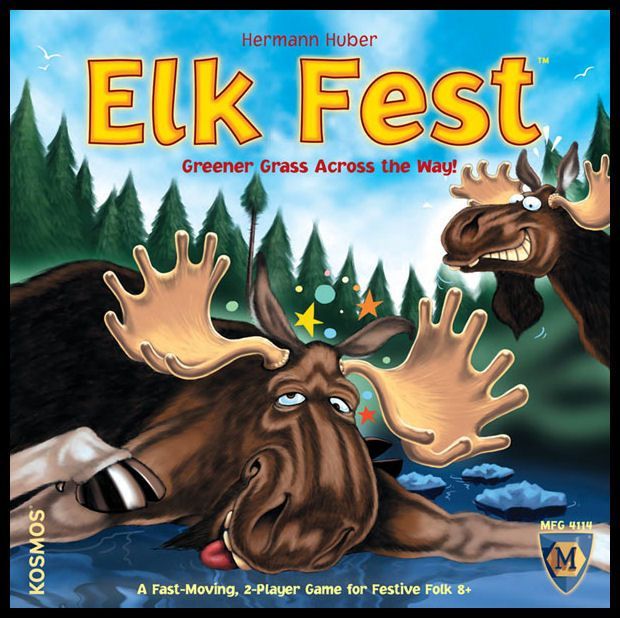
Part of the Kosmos two-player series, Elk Fest or Elchfest is a two player dexterity game in which players attempt to navigate their moose across a river along a series of stones. Players take turns flicking 2 stones, represented by disks, and moving their moose along said stones. Care must be taken when moving ones moose as if the front and back hooves of the moose do not rest atop of the stones the players turn immediately ends, the moose is returned to its previous position, and the opposing player may flick 3 stones. The winner is the first person to move their moose to the opposing river bank! Game description from the publisher: Two elk (Jule and Ole) stare at each other across a river. Longing for the greener grass where the other elk is, they set out to beat each other to the opposite bank! In Elk Fest, move your elk to the other bank by flicking wooden disks across the table and balancing your elk on them. Can your elk get to the greener grass across the river? Good grazing is just a stone's flick away! Boazu is a Nordic edition from 2024 featuring reindeer but identical rules.

What it feels like

Race Modular Board Flicking Animals Action / Dexterity Rivers

Game intelligence

Learn the game

100% knowledge coverage

Setup

1. Before the first game, stick 4 rubber tabs on the bottom of each riverbank to prevent slipping.\n2. Players sit on opposite sides of a smooth playing surface. One player takes Jule (light elk) and the light riverbank; the other takes Ole (dark elk) and the dark riverbank.\n3. Each player places their riverbank on the table. The publisher recommends a spacing of about 50 cm / 18 inches between the two banks — the farther apart, the longer the game.\n4. Each player places their elk on their own riverbank. Elks may face any direction.\n5. Each player lays their 3 stepping-stones in a row to the RIGHT of their riverbank, spaced so they can be flicked without colliding.\n6. Before play begins, players must agree whether a player is allowed to cross to the other side of the table during their turn in order to flick stones from any direction.

Turn flow

On each turn, a player may flick stepping-stones AND move their elk in any order — before, during, or after flicking. Normally each player makes TWO stone flicks per turn (except the very first player on their opening turn, who makes ONE flick, and except after certain disasters, when the non-offending player earns THREE flicks). During the opening turns, a player must flick all 3 of their starting stones away from their riverbank before they can flick any other stones. Once all starting stones are in play, a player may flick any free stone (one not currently supporting an elk) regardless of which player originally owned it. A player may flick the same stone twice or two different stones once each. At any point in the turn, the player may advance their elk forward along the stepping-stones. The turn ends immediately if the player causes any elk to fall or knocks a stone off the table.

Scoring and victory

Standard game: first player to reach the opposite riverbank wins outright. Victory Points variant: player with fewest total flicks across all agreed rounds wins. Scoring sources: Reaching the opposite riverbank first (standard win), Fewest total stone flicks across rounds (victory points variant)

Source: Rulebook

Rules to know

The most useful rules for getting a first game right.

Setup

Attach rubber tabs to riverbanks before first game.

Before the first game, stick 4 of the provided rubber tabs onto the bottom of each riverbank (8 tabs total). This prevents the riverbanks from sliding around on the table during play.

Setup

Players sit opposite each other; each takes an elk, a riverbank, and 3 stones.

The two players sit on opposite sides of a smooth playing surface. One player takes Jule (the light-colored elk) and the matching light riverbank plus 3 stepping-stones. The other takes Ole (the dark elk) and the matching dark riverbank plus 3 stepping-stones.

Setup

Riverbanks are placed on the table; recommended spacing is ~50 cm / 18 inches.

Both players place their riverbanks on the table facing each other. The farther apart the banks are, the longer the game will last. The publisher recommends a spacing of approximately 50 cm (18 inches).

Setup

Elks start on their own riverbank, facing any direction.

Each player places their elk on their own riverbank at the start of the game. It does not matter which direction the elk faces.

Setup

Each player lays their 3 starting stones in a row to the RIGHT of their riverbank.

At setup, each player places their 3 stepping-stones in a row to the RIGHT of their own riverbank. The stones should be spaced far enough apart that they can be flicked without immediately colliding with one another.

Setup

Players must agree before the game whether crossing to the other side of the table is allowed.

Before the game begins, both players must agree on a house rule: may a player physically cross to the other side of the table during their turn in order to flick stepping-stones from any direction? This must be settled before play starts.

Turn structure

The youngest player goes first and makes only ONE flick on their opening turn.

The youngest player takes the first turn. On this opening turn only, that player makes just ONE stone flick. After this, all subsequent turns (for both players) consist of TWO stone flicks, unless a disaster rule applies.

Turn structure

From the second turn onward, each player makes TWO stone flicks per turn.

After the first player's opening one-flick turn, every subsequent turn consists of two stone flicks. The player may flick the same stone twice, or two different stones one time each. Flicking and elk movement can be interleaved in any order within the turn.

Strategy briefing

Stone Placement Accuracy

Your primary goal is to position stones so your elk can chain multiple moves in one turn. Per the elk movement rule, an elk can move as many times as it can reach neighboring stones — so a well-placed stone can yield several elk steps in a single turn without spending extra flicks.

Disrupting the Opponent

Once your 3 starting stones are in play, you can flick your opponent's free stones away from their elk. Knocking a useful stone out of position forces them to spend flicks repositioning it — but be careful not to knock a stone from under their elk, as that ends your turn and grants them 3 flicks.

Avoiding Disasters

Flicking too hard is doubly costly: your turn ends immediately AND your opponent gets 3 flicks next turn. Controlled, precise flicks are always better than powerful ones. This is especially critical when flicking near a table edge.

Interleaving Moves and Flicks

Because elk movement and stone flicking can happen in any order, you can advance your elk to a new stone, then flick the stone you just vacated forward to extend your path — effectively leapfrogging your own stones.

Opening Phase Efficiency

You must flick all 3 of your own starting stones before gaining access to the full table. During your first few turns, aim to flick starting stones forward and in line with each other so your elk can immediately begin chaining steps.

Victory Points Variant — Efficiency Over Speed

In the points variant, every flick costs a point regardless of outcome. Wasted flicks (e.g., flicks that don't meaningfully advance your path) are directly penalizing. Prioritize quality over quantity: one perfectly placed stone that lets your elk take three steps is worth more than three mediocre flicks.

Common questions and edge cases

Can a player flick a stone that their own elk or the opponent's elk is standing on?

No. A stone is only 'free' (and therefore flickable) if no elk's hooves are currently resting on it. Occupied stones cannot be flicked.

A player flicks a stone and it knocks another stone out from under the opponent's elk. What happens?

The offending player's turn ends immediately (Elk Gets Wet rule). The elk is returned to its previous position as nearly as possible. The opponent then earns THREE flicks on their next turn.

After flicking, the elk can now reach two stones in succession. Can it move twice in one turn?

Yes. There is no limit on elk movement within a turn. As long as after each individual step the elk's hooves can reach a neighboring stone or riverbank, the elk may keep moving.

Can a player move their elk first and then flick a stone, or must all flicking happen before elk movement?

There is no required order. A player may move the elk before flicking, between flicks, or after all flicking is done — in any combination within the same turn.

A stone is knocked off the table. Where is it returned?

The stone is returned to the right-hand side of the riverbank of the player who caused it to fall off. The opponent then earns THREE flicks on their following turn.

Can a player flick the opponent's stones during the opening of the game?

No. During the opening turns, each player must first flick all 3 of their own starting stones away from their riverbank. Only after all 3 of a player's own starting stones have been flicked may that player flick any free stone (including the opponent's).

The elk's front hooves are on the far riverbank but its rear hooves are still on a stone. Does the player win?

Yes. The win condition requires only that the elk's front hooves be firmly set on the opposite riverbank. The rear hooves may still be on a stepping-stone. The game ends immediately at that point.

If both an elk falls AND a stone flies off the table on the same turn, does the opponent still get three flicks?

Yes. Any disaster (elk falls or stone off table) that ends the offending player's turn grants the non-offending player THREE flicks on their following turn. Both disaster types carry the same penalty.

Ask About This Game

Similar games