1990 BGG rank #2424

Eurorails

2–6 players 180–240 min Ages 10+ 2.7/5 complexity 6.2/10 rating

About this game

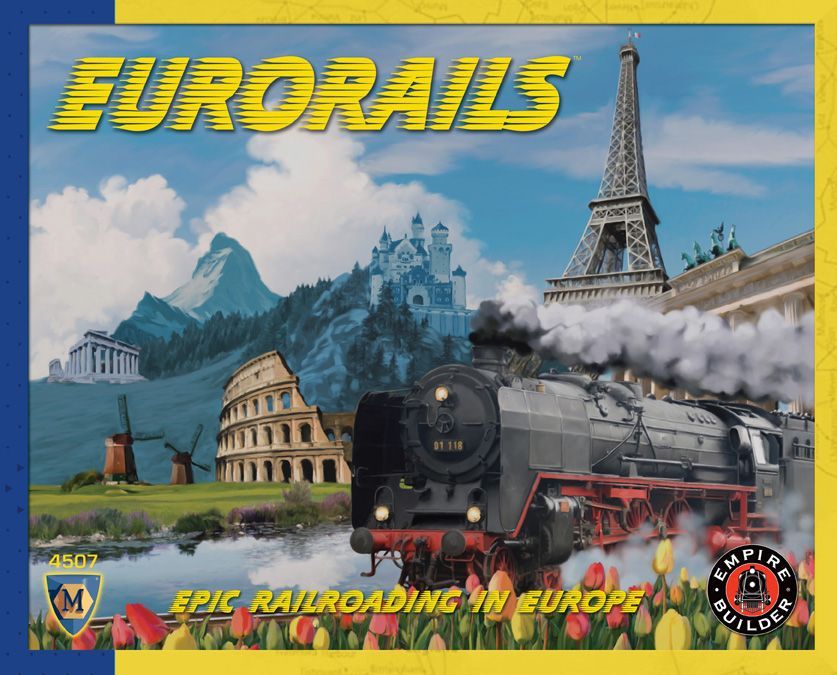
Eurorails is another entry in the Mayfair Games crayon rail games, like Empire Builder and India Rails. Its puzzle-piece board forms a map of Europe broken down into dots. Players use different-colored crayons to draw rail from dot to dot, building their rail system. A large deck of cards is used to determine how much money will be generated by picking up a particular commodity and delivering it to the listed city, with the payoffs being related to how far away the source is from the destination. As players generate more money, they build successively larger and more comprehensive rail systems, hopefully connecting to almost all the major cities. The goal of the game is to generate a set amount of money once you've linked all the major cities.

What it feels like

Pick-up and Deliver Hexagon Grid Network and Route Building Connections Crayon Rail System Transportation Economic Trains

Game intelligence

Learn the game

100% knowledge coverage

Setup

1. Place the Eurorails board in the center of the table. 2. Each player selects a color and takes the corresponding train marker and crayon. 3. Shuffle the demand cards and deal 3 to each player; players keep these in hand as their contract cards. 4. Each player starts with an equal amount of starting money (typically $50M ECU). 5. Players place their train markers at any city of their choice to begin. 6. Determine the first player randomly.

Turn flow

On each turn a player may: (1) Draw new demand/contract cards if desired (discard down to hand limit if needed). (2) Upgrade their train if affordable. (3) Build track by spending money to draw rail lines on the board using their crayon, paying terrain costs per milepost. (4) Move their train up to its movement allowance along any connected rail (their own or others', paying tolls if applicable) and deliver loads to earn money from demand cards. Phases are performed in order each turn.

Scoring and victory

First player to accumulate the target amount of money (typically 250M ECU) while also connecting the required number of major cities with their rail network wins the game. Target score: 250M ECU (plus major city connection requirement) Scoring sources: Completing demand card deliveries — each card pays the printed ECU amount, Efficient routing and train upgrades enabling more deliveries per game

Source: Rulebook

Rules to know

The most useful rules for getting a first game right.

General

All cities on the board, their grid coordinates, and the loads they produce.

The following cities exist on the Eurorails board with their grid coordinates and available loads: - Aberdeen (Scotland): Fish, Oil - Antwerpen (Belgium, F-5): Imports - Árhus (Denmark, H-3): Cheese - Barcelona (Spain, I-10): Machinery - Belfast (Northern Ireland, E-2): Potatoes - Beograd (Serbia, J-10): Copper, Labor, Oil - Berlin (Germany, H/I-5): [major city] - Bern (Switzerland, G-8): Cattle, Cheese - Bilbao (Spain, C-9): Sheep - Birmingham (England, E-4): China, Iron, Steel - Bordeaux (France, D-8): Wine - Bremen (Germany, G-4,5): Machinery - Bruxelles (Belgium, F-5,6): Chocolate - Budapest (Hungary, J-8): Bauxite - Cardiff (Wales, E-4): Coal, Hops - Cork (Ireland, D-3): Sheep - Dublin (Ireland, D-3): Beer - Firenze (Italy, G-10): Marble - Frankfurt (Germany, G-6): Beer, Wine - Glasgow (Scotland, E-2): Sheep - Göteborg (Sweden, H/I-2): Machinery - Hamburg (Germany, H-4,5): Imports - Holland (Netherlands, F-5,6): Cheese, Flowers - Kaliningrad (Russia, J-4): Iron - København (Denmark, H-3): Cheese - Krakow (Poland, J-7): Coal - Leipzig (Germany, H-6): China - Lisboa (Portugal, A-9,10): Cork - Lodz (Poland, J-6): Potatoes - London (England, E-4,5): Tourists - Luxembourg (Luxembourg, G-6): Steel - Lyon (France, F-8): Wheat - Madrid (Spain, C-10): [major city] - Manchester (England, E-3): Cars - Marseille (France, F-10): Bauxite - Milano (Italy, G-9): [major city] - München (Germany, H-8): Beer, Cars - Nantes (France, D-7): Cattle, Machinery - Napoli (Italy, H-12): Tobacco - Newcastle (England, E-2): Oil - Oslo (Norway, H-1): Wood, Oil, Fish - Paris (France, E/F-6): [major city] - Porto (Portugal, B-9): Fish, Wine - Praha (Czech Republic, I-7): Beer - Rome (Italy, G-11): [major city] - Ruhr (Germany, G-5,6): Tourists, Steel - Sarajevo (Bosnia & Herzegovina, I-11): Labor, Wood - Sevilla (Spain, A-11): Cork, Oranges - Stockholm (Sweden, J-2): Iron, Wood - Stuttgart (Germany, G-7): Cars - Szczecin (Poland, I-5): Potatoes - Torino (Italy, F-9): Cars - Toulouse (France, E-9): Wine - Valencia (Spain, D-11): Oranges - Venezia (Italy, H-9): [major city] - Warszawa (Poland, J-6): Ham - Wien (Austria, I-8): Wine - Wroclaw (Poland, I-6): Coal, Copper - Zagreb (Croatia, I-9): Labor - Zürich (Switzerland, G-4): Chocolate

Card play

Players hold demand cards showing which load to deliver to which city for a cash reward.

Each demand card specifies a load type, a destination city, and a payment amount. To earn the payment, a player must carry the matching load from any city that produces it and deliver it to the specified destination city via their train. Players hold a hand of demand cards and may choose which contracts to pursue each game.

Restriction

Players may hold a maximum of 3 demand cards in hand at any time.

A player's hand is limited to 3 demand cards. When drawing new cards, if a player's hand would exceed 3, they must discard down to 3. Players may voluntarily discard demand cards and draw new ones on their turn.

General

Loads are the commodities produced by cities and carried by trains for delivery contracts.

The following load types appear in the game: Potatoes, Wood, Sheep, Wine, Marble, Flowers, Labor, Fish, Oil, Cheese, Machinery, Imports, Beer, Cattle, Coal, Hops, Chocolate, Bauxite, Iron, Steel, Cars, Copper, Tobacco, Wheat, Ham, Cork, Oranges, Tourists, China, Marble. Each city produces specific loads as listed in the city reference. A train picks up a load at a producing city and delivers it to the city named on the matching demand card.

Building

Players spend money to draw track on the board, paying per milepost based on terrain.

On the building phase of their turn, a player may spend money to draw new rail lines on the board using their crayon. Track is drawn milepost by milepost. Each milepost costs a base amount, with higher costs for mountains, water crossings, and other difficult terrain. Track must connect continuously from the player's existing network or a city. Players may not build over another player's track. Track built is permanent for the game.

Movement

Trains move along built rail lines up to their movement allowance per turn.

Each turn, a player may move their train up to its current speed (movement allowance in mileposts) along any connected rail lines. A train may travel on its own track or on another player's track (with a usage fee in some editions). The train may pick up a load at a city where that load is produced and carry it toward a delivery destination.

Building

Players may spend money to upgrade their train to higher speed or capacity.

Players start with a basic train and may spend money on their turn to upgrade to faster or higher-capacity trains. Upgrades increase the number of mileposts the train can move per turn and/or the number of loads it can carry simultaneously. Upgraded trains allow more efficient delivery of contracts.

Resource management

A train picks up a load by moving to a city that produces it.

When a train moves into or through a city that produces a load matching one of the player's demand cards, the player may pick up that load. The load is then carried by the train until it is delivered to the destination city named on the matching demand card, or until the player drops it.

Strategy briefing

Prioritize high-value demand cards early

Demand cards vary in payment value. Focusing on high-ECU deliveries early accelerates progress toward the 250M ECU win condition. Since hand size is limited to 3 cards, cycling through low-value cards quickly to find high-value contracts is important.

Build toward multiple producing cities simultaneously

Many loads (e.g., Sheep from Bilbao, Cork, and Glasgow; Coal from Cardiff, Krakow, and Wroclaw) are produced in multiple cities. Building a network that passes through several producers for the same load type gives flexibility to complete more demand cards without backtracking.

Block competitors with early track placement

Track ownership is permanent and other players cannot build over your track. Placing track through key mountain passes or narrow corridors early can force competitors into longer, more expensive routes.

Upgrade your train to enable multi-load deliveries

Higher train upgrades increase carrying capacity, allowing a single journey to deliver multiple loads. Combined with picking up loads mid-move, this multiplies ECU earned per turn and accelerates the path to 250M.

Plan toward major city connections from the start

The win condition requires both money AND major city connections. Neglecting the network requirement until late game is a common mistake. Build with the connection requirement in mind from the beginning to avoid expensive last-minute track construction.

Use other players' track strategically

Trains may run on any built track. In the early game, it may be more efficient to route along a competitor's existing track rather than building redundant parallel lines, saving money for more targeted construction.

Common questions and edge cases

Can I move my train over another player's track? Do I have to pay?

Yes, trains may move over any built track regardless of who owns it. Whether a usage fee (toll) is owed depends on the edition's rules — check your specific rulebook, but typically no toll is charged in the base game.

Can I pick up a load mid-move and then continue moving to deliver it in the same turn?

Yes. A train may pick up a load at a city during its movement and continue moving to the delivery city in the same turn, as long as the total mileposts traveled do not exceed the train's movement allowance.

Can I both build track and move my train in the same turn?

Yes. A player may build track and move their train in the same turn. Building happens in the building phase and movement in the movement phase. Both actions are available each turn.

When exactly can I draw new demand cards, and can I draw before deciding where to move?

Drawing new demand cards occurs at the start of a player's turn, before building and movement. This allows a player to see their new contracts before deciding how to build or move.

A city produces more than one load type. Can my train pick up multiple loads at once?

A train may carry multiple loads simultaneously if it has the capacity (based on train upgrade level). The player chooses which loads to pick up at a city producing multiple types, up to their train's carrying capacity.

I have enough money but haven't connected enough major cities. Do I win?

No. Both conditions must be met simultaneously: reaching the target ECU amount AND having the required major city connections in your rail network. You must continue playing until both are satisfied at the end of your turn.

Ask About This Game

Similar games