2004 BGG rank #1495

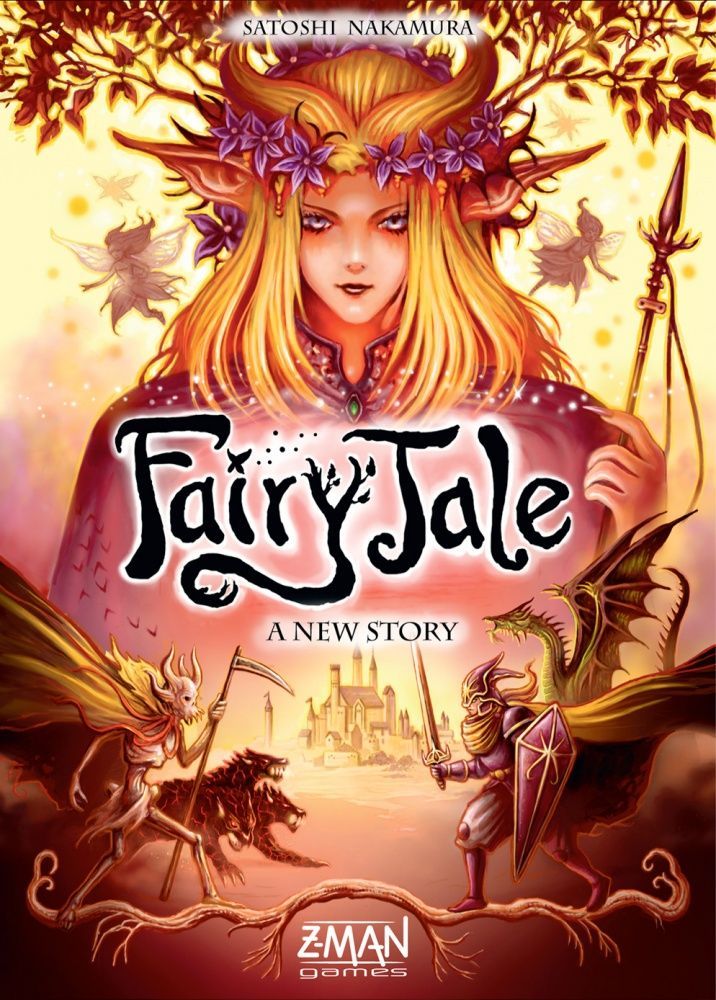
Fairy Tale

2–5 players 30 min Ages 10+ 1.8/5 complexity 6.4/10 rating

About this game

Players use card drafting and simultaneous action selection to score points while interfering with other players' ability to do so. The game consists of four rounds. In each of them, players are dealt five cards. They simultaneously select one each and pass the remainder, repeating until done. Then, they start playing cards simultaneously, playing three and discarding two. When the cards are revealed after each selection, card abilities turn other cards face-up or face-down. At the end of the four rounds there are 12 cards in front of each player. The players each score based on their face-up cards.

What it feels like

Set Collection Closed Drafting Simultaneous Action Selection Hand Management Card Game Fantasy Anime / Manga

Explore these mechanics in Cardboard

Start an original prototype from reusable design patterns—not this game's content.

Open mechanics workbench

Game intelligence

Learn the game

100% knowledge coverage

Setup

1) Shuffle all cards together to form a single deck and place it face-down in the center of the table. 2) Players sit around the table. No further setup is required before the first draft begins.

Turn flow

The game consists of four identical rounds. Each round has two phases: a Draft phase followed by a Play Cards phase. During the Draft phase, 5 cards are dealt to each player; players simultaneously choose 1 card to keep face-down, then pass the remainder to the next player (left in rounds 1 & 3, right in rounds 2 & 4), repeating until no cards remain to pass — each player ends the draft with 5 chosen cards. During the Play Cards phase, players simultaneously choose 1 card from their 5, place it face-down, then all reveal at once and resolve abilities in Hunt → Open → Close order. This is repeated 3 times. The remaining 2 unplayed cards are set aside permanently. After 4 complete rounds (4 drafts + 4 play phases), points are calculated.

Scoring and victory

After the fourth play phase, remove all face-down cards (worth 0). Sum the point values of all face-up played cards. The player with the highest total wins. Scoring sources: Fixed point values on face-up played cards, Variable point values ('*' cards) calculated from other collected cards

Source: Rulebook

Rules to know

The most useful rules for getting a first game right.

General

The player with the highest total points from their face-up played cards wins.

The object of the game is to collect and play cards that accumulate the highest total point value. Only face-up cards are counted at the end of the game; face-down cards are worth zero points and have no effects.

General

Each card has a Name, Points, Number, Type, and an Effect or Ability.

Every card in Fairy Tale contains five pieces of information: (1) Name — the card's name, which may affect total points; (2) Points — the card's point value; if the value is '*', the points are variable and determined by other cards you collect; (3) Number — how many copies of this card exist in the game; (4) Type — the category the card belongs to, referenced by abilities; (5) Effect or Ability — the special ability or effect the card carries, if any.

Turn structure

The game consists of four draft-then-play rounds, followed by final scoring.

The full game sequence is: (1) First Draft → (2) Play Cards → (3) Second Draft → (4) Play Cards → (5) Third Draft → (6) Play Cards → (7) Fourth Draft → (8) Play Cards → (9) Calculate total points. There are exactly four drafting phases and four card-playing phases.

Turn structure

Deal 5 cards to each player; players simultaneously pick 1 card and pass the rest until no cards remain.

Drafting proceeds as follows: (1) Deal five cards face-down to each player from the deck. (2) Each player privately looks at their cards and chooses one they want to keep. (3) The chosen card is placed face-down in front of that player. (4) All remaining cards are passed simultaneously to the next player — to the LEFT in the 1st and 3rd drafts, and to the RIGHT in the 2nd and 4th drafts. (5) Steps 2–4 are repeated until there are no cards left to pass. Each player ends the draft with exactly five chosen cards.

Turn structure

Pass left in drafts 1 & 3; pass right in drafts 2 & 4.

The direction cards are passed during the draft alternates by round. In the 1st and 3rd drafts, all players pass their remaining cards to the player on their LEFT. In the 2nd and 4th drafts, all players pass their remaining cards to the player on their RIGHT. This applies to every pass within that draft round.

Card play

After each draft, players simultaneously play 3 of their 5 drafted cards one at a time; the remaining 2 are discarded.

After a draft, each player holds five chosen cards. The play phase proceeds in three iterations: (1) Each player secretly chooses one card from their hand and places it face-down in front of them. (2) When all players have chosen, all cards are revealed face-up simultaneously. (3) Any abilities on the revealed cards are applied (in Hunt → Open → Close order). This sequence is repeated three times total. After three plays, each player has three played cards (face-up or face-down depending on abilities) and two remaining cards. Those two unused cards are permanently set aside and are no longer used for the rest of the game.

Restriction

The 2 unplayed cards after each play phase are set aside and removed from the game.

After completing the three card plays in a play phase, each player will have exactly two cards left in their hand that were never played. These two cards are set aside and are not used for any purpose for the remainder of the game — they do not score points and their abilities are never triggered.

General

Each player plays exactly 12 cards total across the whole game.

Over the course of the game, each player drafts 5 cards per round × 4 rounds = 20 cards, plays 3 cards per round × 4 rounds = 12 cards, and sets aside 2 cards per round × 4 rounds = 8 cards. At the end of the game, each player will have revealed exactly 12 played cards in total.

Strategy briefing

Card Denial via Drafting

Because all 5 cards in a draft hand are seen before choosing, you can draft a card purely to deny it from opponents — especially powerful Hunt or Close cards — even if it doesn't directly score for you. The alternating pass direction (left/right) makes tracking where strong cards will travel predictable.

Prioritizing Open Abilities for Defense

Since Close and Hunt can flip your cards face-down to zero points, holding cards with Open abilities gives you a recovery mechanism. Playing an Open card after your key cards have been Closed can restore your scoring engine.

Managing the 2 Discarded Cards

Each round you must set aside 2 of your 5 drafted cards permanently. Draft with a plan: prioritize cards that work together and be willing to discard weaker cards. Avoid drafting cards you cannot reasonably play in the 3 available slots.

Timing Close Abilities Strategically

Close is resolved last in the ability order (after Hunt and Open). This means if you play a Close card alongside an opponent's Open card, Open resolves first — potentially un-doing your Close target. Plan Close plays for rounds when opponents are unlikely to have Open cards in hand.

Building Toward '*' Point Cards

Cards with '*' point values have variable scores determined by your other collected cards. Drafting synergistic combinations that maximize '*' card scoring can yield outsized returns. Prioritize the supporting cards early, then draft the '*' card once you know you can fulfill its condition.

Pass Direction Awareness

Knowing that drafts 1 & 3 pass left and drafts 2 & 4 pass right allows you to anticipate which cards will come to you. If a strong card appears in your initial hand and you don't take it, track which opponent receives it. Use this to predict threats and draft defensively.

Common questions and edge cases

A card is Hunted face-down in the current reveal, but another card played at the same time has an Open ability targeting the same card's type. Does Open restore the Hunted card?

Yes. Hunt is resolved first, flipping the targeted card face-down. Then Open is resolved. Since Open can flip face-down cards of the matching type face-up, it can restore a card that was just Hunted — as long as the type matches and the card is among the player's played cards.

A card with an Open or Close ability is Hunted face-down during the current reveal. Do its abilities still trigger?

No. A card that is flipped face-down by Hunt has its abilities suppressed entirely. Even though the card was played in the same reveal round, its Open or Close ability does not apply.

Can a card's Close ability target itself, making the card that triggered Close worth zero points?

Yes. The rules explicitly state that Open and Close can be applied to the cards themselves. A Close ability can flip its own card face-down, which would then make it worth zero points and cause it to lose any further effects.

Can a card's Open ability target itself if it was previously flipped face-down?

Yes. The rules state that Open can be applied to the card itself. However, if the card is face-down due to Hunt (applied in the same reveal), its Open ability would be suppressed by Hunt and could not trigger. If the card was already face-down from a previous round, it cannot be played again, so self-targeting Open on a previously face-down card is only relevant for cards flipped down and then restored within the same or a later reveal.

A card with a '*' point value is face-down at the end of the game. Does it contribute to calculating other cards' '*' values?

No. At the end of the game, all face-down cards are set aside first. They score zero points and have no effects, which means they do not contribute to calculating '*' point values for other cards either.

What is the difference between cards that are 'set aside' after the play phase and cards that are 'face-down'?

Cards set aside after the play phase (the 2 unplayed cards per round) are permanently removed from the game — they never score and their abilities never trigger. Face-down played cards are still 'in play' but score zero and have no effects; they can potentially be flipped face-up by an Open ability in subsequent play iterations within the same round.

Can a Hunt ability target a card that was played in a previous card-play iteration (e.g., a card played in iteration 1 while we are now in iteration 2)?

No. Hunt abilities only affect cards played in the same simultaneous reveal. They cannot reach back to cards played in earlier iterations of the play phase.

Ask About This Game

Similar games