2004 BGG rank #6498

Familienbande

2–4 players 20 min Ages 8+ 1.6/5 complexity 5.7/10 rating

About this game

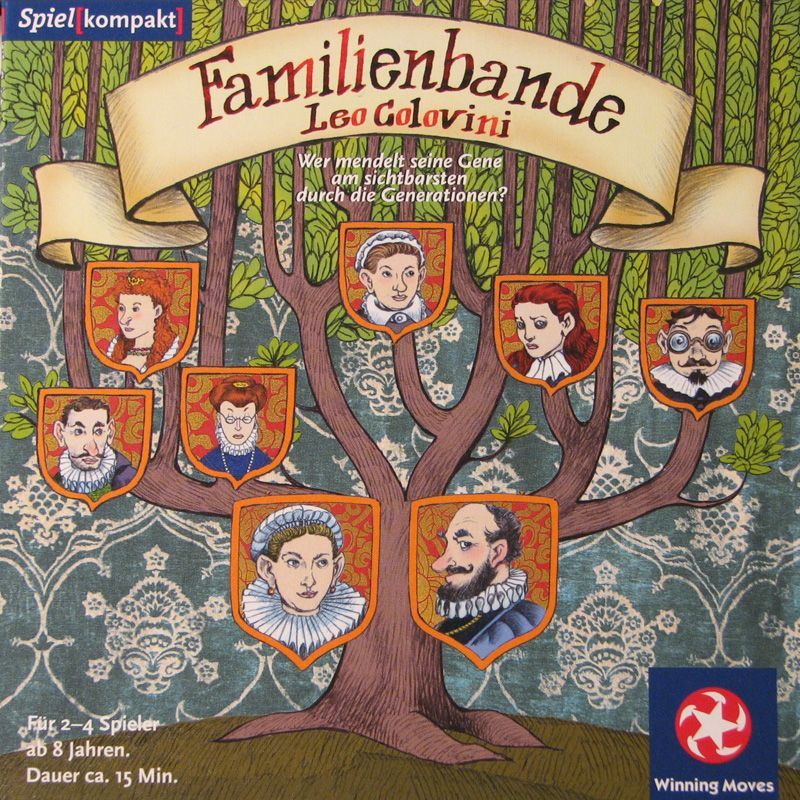
Here is a description of the game from Spielbox: Familienbande is the third game in Winning Moves’ new “Compact Game” series, and is by Leo Colovini. It’s a fast and funny board game that deals with the dynastic succession of royal families. Brides are chosen, heirs are born. Unmistakable traits such as large noses, red hair or cauliflower ears are depicted on the humorously-illustrated cards; these traits must be used to score points and be combined in engagements and births. Incest? Shame on you for thinking of such a possibility! The game is for 2-4 players Ages 8 and up.

What it feels like

Hand Management Card Game Genealogy / Heredity

Explore these mechanics in Cardboard

Start an original prototype from reusable design patterns—not this game's content.

Open mechanics workbench

Game intelligence

Learn the game

100% knowledge coverage

Setup

1. Place the game board in the center of the table.\n2. Each player selects a color and takes all pieces of that color.\n3. Shuffle the card deck and deal the starting hand to each player.\n4. Distribute starting resources as indicated.\n5. Place all scoring markers on the zero space of the score track.\n6. Place remaining cards and tokens within reach.\n7. Determine the starting player (e.g., youngest player goes first).

Turn flow

A player's turn proceeds in the following phases:\n1. **Draw Phase:** Draw cards up to your hand limit, or as specified.\n2. **Action Phase:** Play cards, place pieces, trade, or take other available actions.\n3. **End Phase:** Discard down to hand limit if necessary, then pass the turn clockwise.

Scoring and victory

The player with the most victory points at the end of the game wins. In case of a tie, the tied player who most recently took a turn loses (or another tiebreaker as specified in the rulebook). Scoring sources: Completing family groups, Fulfilling set collection objectives, Special card bonuses, End-game scoring conditions

Source: Rulebook

Rules to know

The most useful rules for getting a first game right.

Setup

General game setup procedure.

Place the game board centrally. Each player chooses a color and takes the corresponding player pieces. Shuffle the card deck(s) and deal the starting hand to each player as specified. Place all resource tokens, scoring markers, and other components within reach of all players. Set the score track markers to zero. Determine the starting player.

Turn structure

On your turn, perform actions in the prescribed order.

On each player's turn, they must follow the turn structure defined in the rulebook: draw cards and/or take resources, then perform their main actions (such as playing cards, placing pieces, or trading), and finally pass the turn to the next player clockwise.

Card play

Play cards from hand to trigger their effects.

On your turn, you may play cards from your hand to the table. Each card has a type, cost, and effect printed on it. Pay any required costs before resolving the card's effect. Cards that have been played are placed in the discard pile unless otherwise stated.

Drawing

Draw cards at the start of or during your turn as specified.

Players draw cards according to the rules for their current phase. Typically, a player draws up to their hand limit at the start of their turn. If the draw deck is exhausted, reshuffle the discard pile to form a new draw deck.

Resource management

Collect and spend resources to pay for actions and cards.

Resources are gained through card effects, board spaces, or other game actions. Resources must be spent to play certain cards or take certain actions. Players may not exceed any stated resource limits. Resources not spent are carried over to the next turn unless otherwise specified.

Scoring

Players score points for completed families, sets, and other achievements.

Points are scored by completing family groupings, fulfilling set collection goals, and meeting special card conditions. Move your scoring marker along the score track whenever you score points. The player with the most points at the end of the game wins.

Endgame

The game ends when a specified trigger condition is met.

The game ends when a player reaches the target score, the draw deck runs out, or another end-game condition defined in the rulebook is triggered. Complete the current round so all players have had an equal number of turns, then proceed to final scoring.

Restriction

Players may not hold more cards than the hand limit.

At the end of your turn, if you hold more cards than the hand limit (as stated in the rulebook), you must discard down to the limit. Discarded cards go to the discard pile.

Strategy briefing

Prioritize Completing Family Groups

Completing full family groups yields immediate bonuses in addition to points. Focusing on finishing groups before opponents can block gives you resource advantages that compound over multiple turns.

Hand Limit Management

Since excess cards are discarded at end of turn, plan your plays so you do not draw cards you cannot use. Avoid drawing up to your limit if you already have playable cards ready.

Trading Opportunism

Trading is only available during specific phases or via card effects. Holding cards that enable trading gives you a strategic flexibility advantage, allowing you to convert unwanted resources at moments opponents cannot.

Common questions and edge cases

A card effect causes me to draw extra cards, pushing me over the hand limit. Do I discard immediately or at end of turn?

Excess cards are discarded at the end of your turn, not immediately when drawn. You may use all drawn cards during your action phase before discarding down to the hand limit.

I complete a family group mid-turn. Do I receive the bonus immediately, or at the end of my turn?

Family group completion bonuses are received immediately when the group is completed, even if this occurs mid-turn. You may use any bonus resources or actions during the remainder of your current turn.

Can I trade with another player during my action phase even if no card specifically allows it?

Trading is only permitted during a designated trading phase or when explicitly enabled by a card effect. If neither condition is met during the action phase, trading is not allowed.

The draw deck runs out while I am drawing cards mid-turn. What happens?

Immediately shuffle the discard pile to form a new draw deck and continue drawing until you have drawn the required number of cards (or the new deck is also exhausted).

Ask About This Game

Similar games