2000 BGG rank #7106

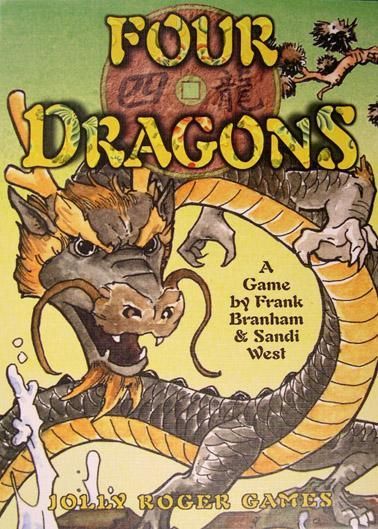
Four Dragons

3–4 players 20–30 min Ages 12+ 2.4/5 complexity 5.7/10 rating

About this game

From the designer Frank Branham: A 4 player partnership trick taking game themed around the Mexican Day of the Dead. (A particular favorite holiday of ours, as Sandi and I were married on that day in Marietta Confederate Cemetery.) It is short (about 30 minutes), and rather brain bending. Dia De Los Muertos (Day Of The Dead) is played over three days as you send animals, then children, then adults on to the afterlife. It is a basic trick taking game, except that most cards have an action with them. You play as a partnership, and if your side wins scoring cards (the dead or food), you exchange a card with your opponent. Other cards allow swaps between partners, asking a question, cancelling other cards and so on. The first time you play, there's a lot of checking the rules, checking the crib sheet, remembering if you exchange cards. You spend more time figuring the game than playing the tricks. But after a couple of hands, it makes sense and you switch to game-playing mode. And here's where it pays. If you enjoy Bridge, you can figure out what your partner signals when they swap a card, or you can read the deck based on what's been played, you will really enjoy Dia De Los Muertos. If you don't like Bridge, or can't figure trick-taking games anyway, steer well clear. It is rather brain-bending. The original game has nice native graphics of the dead abroad and has a variant for 3 players. The re-issue as Four Dragons has an oriental theme. Not to be confused with: Dia de los Muertos (2007) Dia de los Muertos (2016)

What it feels like

Team-Based Game Trick-taking Card Game Deduction

Game intelligence

Learn the game

100% knowledge coverage

Setup

1. Remove all 2s (Food cards) and 4s (Muertos cards) from the deck.\n2. Add back one set of 3 Food cards and 4 Animal cards (used in Hand 1) into the deck.\n3. Shuffle the deck and deal all cards equally to all players.\n4. Teams sit across the table from each other (in the 4-player game).\n5. For Hand 2, add 4 Child cards (Muertos) and 3 Food cards to the non-scoring cards before reshuffling and dealing.\n6. For Hand 3, add 4 Adult cards (Muertos) and 3 Food cards to the non-scoring cards before reshuffling and dealing.\n7. Note: Teams keep all captured 2s and 4s face-up for the entire game across all three hands.

Turn flow

Each hand consists of tricks. The player holding the 6 Start card leads the first trick. On each trick, players in sequence each play one card. The highest-ranking card wins the trick; ties go to the first card played. The winner of a trick leads the next trick. If a player captures scoring cards (2s or 4s) in a trick, they must immediately exchange gifts with the opponent on their right before leading the next trick. Play continues until all 8 cards per player have been played. After three hands, teams total their paired scoring cards to determine the winner.

Scoring and victory

After three hands, each team counts matched pairs of one Muertos card (rank 4) and one Food card (rank 2). Each pair scores 1 point. The team with the highest score wins. Ties are broken first by most total Food cards, then by most total Muertos cards. Scoring sources: Matched pairs of 1 Food card (rank 2) and 1 Muertos card (rank 4) — 1 point per pair, Tiebreaker: most Food cards, Tiebreaker: most Muertos cards

Source: Rulebook

Rules to know

The most useful rules for getting a first game right.

Setup

Players form two teams of two, with partners sitting across from each other.

In the 4-player game, each player sits across the table from his partner. The two players on a team combine all scoring cards (2s and 4s) they capture throughout the game for joint scoring.

Setup

A full game consists of exactly three hands, one for each day of the festival.

The game is played over three hands. Hand 1 uses Animal cards as the Muertos cards (4s). Hand 2 uses Child cards as the Muertos cards. Hand 3 uses Adult cards as the Muertos cards. After each hand, a new set of 3 Food cards and 4 Muertos cards appropriate to the next hand is added to the non-scoring cards before reshuffling.

General

Scoring cards are rank-2 Food cards and rank-4 Muertos cards.

Food cards have rank 2. Muertos cards have rank 4. These are the only cards that score points. All other cards are non-scoring. Scoring cards captured by either partner on a team are combined and kept face-up for the entire game.

Scoring

Each matched pair of 1 Muertos card (rank 4) and 1 Food card (rank 2) scores 1 point.

At the end of the game, each team counts matched pairs consisting of exactly one Muertos card (rank 4) and one Food card (rank 2). Each such pair is worth 1 point. The cards in a pair do not need to have been captured in the same trick or even in the same hand — any Muertos card can be paired with any Food card across the entire game.

Scoring

Ties are broken first by most Food cards, then by most Muertos cards.

If two teams are tied on points at the end of three hands, the team with the most total Food cards (rank 2) wins. If still tied, the team with the most total Muertos cards (rank 4) wins.

Setup

For Hand 1, remove all 2s and 4s from the deck, then add back 3 Food cards and 4 Animal cards.

Before Hand 1: remove all 2s (Food cards) and 4s (Muertos cards) from the standard deck. Add 3 Food cards and 4 Animal cards back into the remaining non-scoring cards. Shuffle the combined deck and deal all cards to players.

Setup

After each hand, add 3 Food cards and 4 new Muertos cards to the non-scoring cards to form the next hand's deck.

After each hand, scoring cards (2s and 4s) captured by players remain with those players face-up for the rest of the game. The non-scoring cards are gathered, and a new set of 3 Food cards and 4 Muertos cards (Child cards for Hand 2; Adult cards for Hand 3) are added. The combined deck is shuffled and dealt again.

Turn structure

The player holding the 6 Start card leads it to begin the first trick of each hand.

At the start of each hand's first trick, the player who holds the card designated as the '6 Start' card must lead that card. This determines who plays first. Subsequent tricks are led by the winner of the previous trick.

Strategy briefing

Pair Scoring Across Hands

Because Food and Muertos cards captured in different hands can still be paired for scoring, you should prioritize capturing whichever type your team is short on in later hands, even if your early-hand haul was lopsided.

Gift Exchange as Intelligence

Winning tricks with scoring cards is a double-edged sword: while you gain scoring cards, the opponent on your right gets to look at a card from your hand and then give you a card of their choice — potentially feeding you a useless card or extracting information. Avoid triggering exchanges when your hand contains highly strategic cards.

Using the Kill 10 Strategically

Because the Kill 10 resolves at the end of the trick, you can play it early and still cancel a rank-10 card an opponent plays later in the same trick. This makes it effective even when played as the lead card.

Spoiled Card to Protect Food Cards

Playing the Spoiled card prevents any Food cards from being played to that trick. This can be used defensively to stop opponents from scoring Food cards, but remember: the winner of any trick with the Spoiled card must exchange gifts, so avoid winning that trick if your hand is strong.

Color Slot Management

Since only one card of each non-black color (pink, blue, green) can be played per trick, carefully tracking which color slots are still open lets you force opponents into discards by filling the last available colored slot before their turn.

Discarding Scoring Cards is Permanent

If a player is forced to discard a scoring card due to color restrictions, that card is removed from the game permanently — it cannot be scored by anyone. This means deliberately filling color slots can deny opponents scoring cards at the cost of an exchange.

Swap Timing

The Swap card has no effect if played on the last trick of a hand, making it a safe discard late in a hand when you want to play it without triggering the partner exchange. Conversely, play it early when you want to pass a weak card to your partner and receive a potentially stronger one.

Tiebreaker Awareness

If the score is close, capturing extra Food cards (rank 2) beyond what you need for pairing is still valuable as a tiebreaker advantage. Muertos cards are the secondary tiebreaker, so they matter less in close games.

Common questions and edge cases

A player plays the Spoiled card (rank 0). Can the next player still play a Food card (rank 2) to the trick?

No. Once the Spoiled card is played, no Food card (rank 2) may be played to that trick by any subsequent player. Any player who would have played a Food card must either play a different legal card or discard.

A player wins a trick that contains the Spoiled card but no Food cards or Muertos cards. Do they still exchange gifts?

Yes. The Spoiled card forces a gift exchange for the trick winner regardless of whether any scoring cards (rank 2 or rank 4) were captured in that trick.

A player plays the Kill 10 (rank 3), and then an opponent plays a rank-10 card afterward in the same trick. Does Kill 10 still cancel that 10?

Yes. The Kill 10 effect resolves at the end of the trick, so it can remove any opponent's rank-10 card played in that trick — including one played after the Kill 10 was played.

Can a player use the Kill 10 card to remove their own partner's rank-10 card from a trick?

No. The Kill 10 may only remove an opponent's rank-10 card. Using it to remove a partner's 10 is explicitly forbidden.

A player plays the Swap card (rank 1) on the very last trick of a hand. Does the swap between partners happen?

No. A Swap played on the last trick of a hand is ignored and has no effect. Partners do not exchange cards.

A player is forced to discard because they cannot legally play a card. The card they discard is a Food card (rank 2). What happens to it?

The discarded Food card is removed from the game entirely. It is not added to the trick and cannot be claimed by the trick winner. It cannot be scored.

A player plays the Choose card (rank 0) and wants to declare it the same color as the Muertos cards this hand. Is that allowed?

No. The Choose card may be declared any color except the color of the Muertos cards (rank 4) in the current hand.

A player wins a trick with two scoring cards in it. How many gift exchanges happen?

Only one gift exchange occurs, regardless of how many scoring cards are in the trick. The trick winner exchanges gifts once with the opponent on their right.

Can a Muertos card captured in Hand 1 be paired with a Food card captured in Hand 3 for scoring?

Yes. Scoring cards are kept face-up for the entire game, and pairs do not need to have been taken in the same trick or even in the same hand. Any Muertos card pairs with any Food card regardless of when they were captured.

In the 3-player variant, an opponent must exchange gifts with the dummy hand. Do they draw randomly?

No. In the 3-player variant, when exchanging gifts with the dummy (whose hand is face-up), the opponent gets to choose which card to take rather than drawing randomly.

Ask About This Game

Similar games