2021 BGG rank #2157

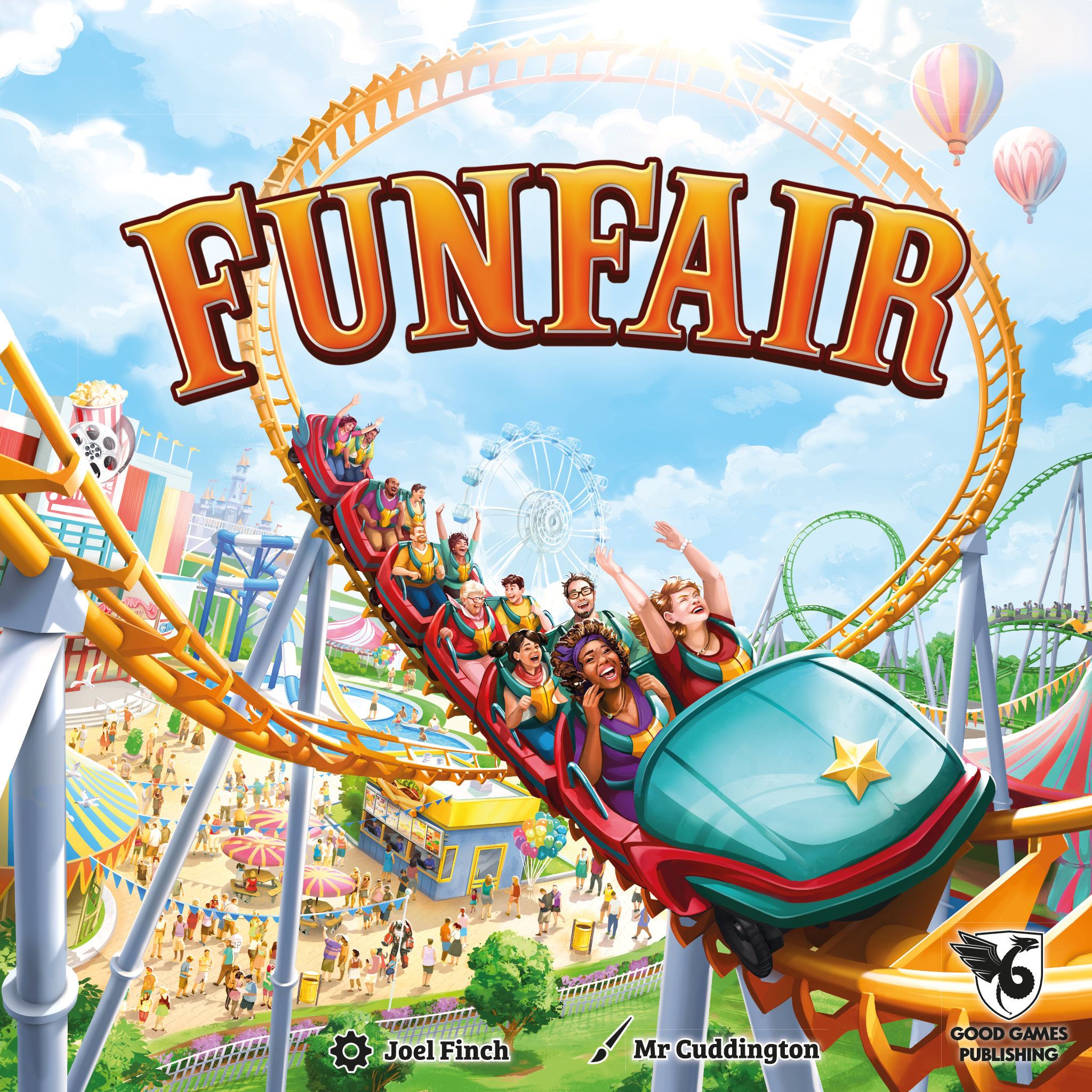
Funfair

2–4 players 30–60 min Ages 14+ 2.1/5 complexity 6.2/10 rating

About this game

Can you build the best theme park in town? Choose and build an exciting mix of attractions in your very own theme park. Upgrade them to match blueprints, or just to stack up towering rides that pull in the crowds and make the most cash. Hire staff members and build super attractions to maximise your park’s strategy for the win! Funfair is a standalone game in the Unfair universe. It's a lighter and faster introduction to Unfair’s ludicrously modular theme park building. With fast setup and gameplay, and only positive player interaction included in Funfair, it’s a fun family-friendly game. However, new goals, new cards, all new build strategies, and tight combos will give experienced gamers and Unfair fans plenty of challenge. SetupThe board is set up with: a 6 card City Event deck (there are 12 such cards in total), a deck of 20 blueprint cards (secret goals), a deck of 97 park cards containing attractions upgrades and staff members, a market of 6 park cards containing a random mix of Attractions, upgrades and staff member cards. an Award card, drawn randomly from the 5 in the game. Awards are public goals that reward players 15 points for meeting the goal. Each of the 2 to 4 players starts with: a gate card, 30 coins to spend, a randomly dealt but hidden showcase card, a type of powerful Thrill Ride they may choose to build sometime during the game, a hand of 5 park cards (attractions, upgrades and staff) they may build later - if you don’t have an attraction in your opening hand you may discard them and draw until you do. GameplayEach of Funfair’s 6 rounds begins with a random City event which helps all players in some way, often requiring interesting decisions about how to best benefit from them, and sometimes interactively with other players. Players then progress to the Park step and take their 3 actions, 1 at a time each clockwise around the table, to build attractions, upgrades on those attractions, or recruit staff directly from the market or their hand. Alternatively players may also draw blueprints from the blueprints decks or park cards from the park deck or market, or gain money (1 per attraction they have built). After all players have taken 3 actions each (or 4 if they have built their Showcase attraction), players progress to the Guests step where they earn income from the stars (representing guest appeal) on the cards they have built in their parks, and perhaps from staff members. In the Cleanup step players discard down to 5 cards in hand and reset the market, ready for the next round. Over each game of 6 rounds and 20 or so actions players build a mix of attractions, upgrades and staff into their park tableau to generate increasingly larger incomes each round. But they also build their park to score victory points in various ways at the end of the game. Exactly how they do so will vary greatly from game to game with different public Awards & private Blueprint goals and other strategic factors and opportunities presenting themselves as the game develops. There are many efficiencies and combinations to be found during play, and numerous ways to earn points. End game scoringAt the end of the game (after the Cleanup step in Round 6), players total their points earned from: The number of icons in each of their 1 to 5 attractions (taller attractions score proportionally better) Matching requirements or bonus sections on their blueprints Their money: 2 coins = 1 point Staff members recruited in the game Meeting the Award goal for the game -description from publisher

What it feels like

Hand Management End Game Bonuses Contracts Open Drafting Economic Card Game City Building Amusement Parks / Theme Parks

Explore these mechanics in Cardboard

Start an original prototype from reusable design patterns—not this game's content.

Open mechanics workbench

Game intelligence

Learn the game

100% knowledge coverage

Setup

1. Clear space for the Automa play area alongside your own park area. 2. Give the Automa one facedown Showcase card and one Gate card (same as a multiplayer opponent). 3. Remove the 'Not-so-secret Santa' card from the City Events deck — it is the only event incompatible with the Automa. 4. Shuffle the 10-card Automa Attraction deck and place it in the Automa's play area. 5. Build the Automa deck from the 34 Automa cards according to difficulty: - Easy: Remove AI cards 16, 32, and 33 (red sad face icon, bottom-left). Keep AI cards 22–27 (yellow happy face icon) in the deck before shuffling. - Normal/Hard/Expert: Remove AI cards 22–27 (yellow happy face icon) before shuffling. All other cards remain. 6. Expert only: Deal the Automa one Blueprint card facedown from the top of the Blueprint deck. It will score this at end game in addition to any Blueprints gained during play. 7. Reveal one Award card, fill the market with Park cards, and create the City Events deck (minus 'Not-so-secret Santa'), exactly as in a multiplayer game. 8. The Automa starts with zero coins. 9. The human player is always the first player, regardless of difficulty. The first player marker passes each round as normal.

Turn flow

A game versus the Automa takes place over 6 rounds. Each round has four steps: STEP 1 – CITY EVENTS: In rounds 1–5, before flipping the City Event card, flip the top card of the Automa Attraction deck and place it in the Automa's play area (positions 1–5, left to right). If the attraction number drawn was already placed in a prior round, discard it and keep drawing until a new number appears. No attraction card is placed in Round 6. Then flip and resolve the City Event card normally. STEP 2 – PARKS: Players alternate taking Park actions. When it is the Automa's turn, flip the top card of the Automa deck and resolve it. The Automa takes 3 Park actions per round by default. If the Automa has built its Showcase card, it takes 4 Park actions per round instead (this increase takes effect immediately in the same round the Showcase is built). STEP 3 – GUESTS: The human player collects income, investor funds, and counts stars as normal. The Automa skips all income collection. Stars on Automa cards exist solely for 'Wooden Spoon Award' eligibility at end game. STEP 4 – CLEANUP: Same as multiplayer, except the Automa has no hand of cards to discard. Move the Starting Player marker at the end of this step.

Scoring and victory

Most Victory Points at the end of 6 rounds wins. If tied, use the standard multiplayer tiebreaker rules. Target score: Outscore the Automa by end of Round 6 Scoring sources: Attraction Size (wild features count), Blueprint cards (top section only on Easy/Normal; top and bottom on Hard/Expert), Coins accumulated in the Automa's play area, Staff card VP values, Awards (wild icons do not count toward Award conditions)

Source: Rulebook

Rules to know

The most useful rules for getting a first game right.

Setup

Prepare the Automa play area with a Showcase card, Gate card, and Attraction deck.

Before the game begins, allocate space on the table for the Automa's play area. Give the Automa one facedown Showcase card and one Gate card, exactly as you would deal to a human opponent in a multiplayer game. Shuffle the 10-card Automa Attraction deck and place it face-down in the Automa's play area.

Setup

Remove 'Not-so-secret Santa' from the City Events deck before play.

The City Event card 'Not-so-secret Santa' is the only event card that is not compatible with the Automa rules. It must be removed from the City Events deck during setup before the deck is shuffled and used.

Setup

For Easy difficulty, remove AI cards 16, 32, and 33; keep AI cards 22–27.

When playing on Easy difficulty, remove AI cards 16, 32, and 33 from the Automa deck (identified by a red sad face icon on the bottom-left of the card). Leave AI cards 22–27 (yellow happy face icon) in the deck. Shuffle the remaining cards to form the Automa deck.

Setup

For Normal/Hard/Expert difficulty, remove AI cards 22–27 from the Automa deck.

When playing on Normal, Hard, or Expert difficulty, remove AI cards 22–27 (yellow happy face icon) from the Automa deck before shuffling. All other cards remain in the deck.

Setup

On Expert difficulty, deal the Automa one facedown Blueprint card at the start.

When playing on Expert difficulty only, deal the Automa one Blueprint card facedown from the top of the Blueprint deck before the game begins. This card is scored at the end of the game in addition to any Blueprint cards the Automa gains through normal gameplay.

Setup

The Automa starts with zero coins and only gains coins through Automa cards or the 'Construction Contracts' event.

The Automa begins the game with no coins. The only ways the Automa can accumulate coins during the game are: (1) through the effects of certain Automa cards, and (2) through the 'Construction Contracts' City Event card.

Setup

The human player is always first player at the start of the game.

Regardless of the chosen difficulty level, the human player always takes the first player role at the start of the game. The First Player marker passes around normally after each round.

Turn structure

In rounds 1–5, flip an Automa Attraction card before resolving the City Event.

At the start of the City Events step in rounds 1 through 5: first, flip the top card of the Automa Attraction deck and place it in the Automa's play area. Attraction cards are numbered 1–5 and are arranged left to right in numerical order. If the number on the revealed card has already been placed in a prior round, discard it and keep drawing until a new, unplaced attraction number is found. In round 6, do not flip any Automa Attraction card (the Automa never builds a 6th attraction). After placing the attraction card (if applicable), flip and resolve the City Event card normally.

Strategy briefing

Prioritize completing Blueprints before Round 5

On Easy difficulty, both you and the Automa lose access to Blueprint cards in rounds 5 and 6. On higher difficulties, the Automa retains Blueprint access all game while you do not. Prioritize securing your Blueprints early (rounds 1–4) to avoid missing out, and on Hard/Expert be aware that the Automa scores both top and bottom Blueprint sections, making it a stronger late-game scorer.

Market disruption via Discard cards (Easy difficulty only)

On Easy difficulty, the Automa deck includes AI cards 22–27, which discard cards from the market. Anticipate market disruption and try to acquire high-value Park cards before the Automa's turn eliminates them. On Normal/Hard/Expert these cards are absent, so market disruption is not a threat.

Race to build your Showcase before the Automa builds its

Once the Automa builds its Showcase, it gains a permanent 4th Park action per round for all remaining rounds. This dramatically increases the Automa's output. Triggering your own Showcase early to match its tempo is critical, especially in later rounds.

Award competition — wild icons don't help the Automa

Wild icons on Automa cards do not count toward Award conditions, but they do count toward Attraction Size. This means you can sometimes edge out the Automa on an Award even if it has more cards, because its wilds are 'wasted' for Award purposes. Focus on Awards that require specific feature types where your targeted builds outperform the Automa's wilds.

Expert difficulty compounds challenge through the starting Blueprint

On Expert, the Automa begins with one Blueprint card already in play and scores both top and bottom sections of all its Blueprints at full completion value. Combined with the stronger Automa deck composition (no easy discard cards), this creates a significantly higher VP ceiling for the Automa. Pursue aggressive scoring in multiple categories to compensate.

Common questions and edge cases

The Automa builds its Showcase card mid-round (e.g., on its 2nd Park action in Round 3). Does it get a 4th action that same round?

Yes. The fourth Park action bonus takes effect immediately. In the example, the Automa would receive a 4th Park action in that same round and all subsequent rounds.

An Automa Upgrade card targets Attraction space 5, but only attractions 2 and 4 have been revealed. What happens?

Follow the arrow direction on the card. If the arrow points Right/Up, count upward from 5, looping back to 1, 2 — building on the next revealed attraction (space 1 if revealed, otherwise space 2). If the arrow points Left/Down, count downward from 5 to 4, which is revealed, so build there. Always loop through the sequence until a revealed attraction is found.

It's Round 5 and an Automa Blueprint card is drawn. Can the Automa gain a Blueprint?

It depends on difficulty. On Easy, no — the Automa cannot gain Blueprints in rounds 5 or 6, and collects loose change instead. On Normal, Hard, or Expert, yes — the Automa can gain Blueprint cards in any round with no restriction.

How does the Automa score Blueprint cards, and does difficulty affect this?

On Easy or Normal: only the top portion of each Blueprint card is scored. On Hard or Expert: both the top and bottom sections are scored. In all cases, the Automa is always assumed to have completed its Blueprints and will never score negative points for them.

Does the Automa's Showcase card get placed into its park like a human player's would?

No. The Automa never adds its Showcase card to its park. It simply flips the Showcase card face-up to signal the 4th action unlock. The Showcase is not used for Automa scoring purposes.

A second 'Build & Collect' Showcase card is drawn after the Automa has already built its Showcase. What happens?

The Automa does not build a second Showcase card. Instead, the second 'Build & Collect' card functions only as a loose change collection action.

Do wild feature icons on Automa cards count toward Award conditions and/or Attraction Size scoring?

Wild icons count toward Attraction Size scoring but do NOT count toward any Award condition criteria.

Do I need to count the Automa's stars during the Guests step each round?

No. The Automa does not collect income or investor funds, so you do not add up its stars during the Guests step. Stars on Automa cards are only relevant during end-game scoring to determine eligibility for the 'Wooden Spoon Award'.

The 'Construction Contracts' City Event triggers. How does this interact with the Automa?

If you choose to build an upgrade via the event, place the resulting coins in the Automa's play area. These coins are scored normally at end game. This is one of only two ways the Automa can gain coins (the other being specific Automa cards).

Can the Automa place two upgrades with the same name on the same attraction?

Yes. The Automa has no upgrade restrictions whatsoever. It may place any upgrade onto any attraction regardless of duplicate names or any other restrictions that apply to human players.

Ask About This Game

Similar games