2019 BGG rank #6765

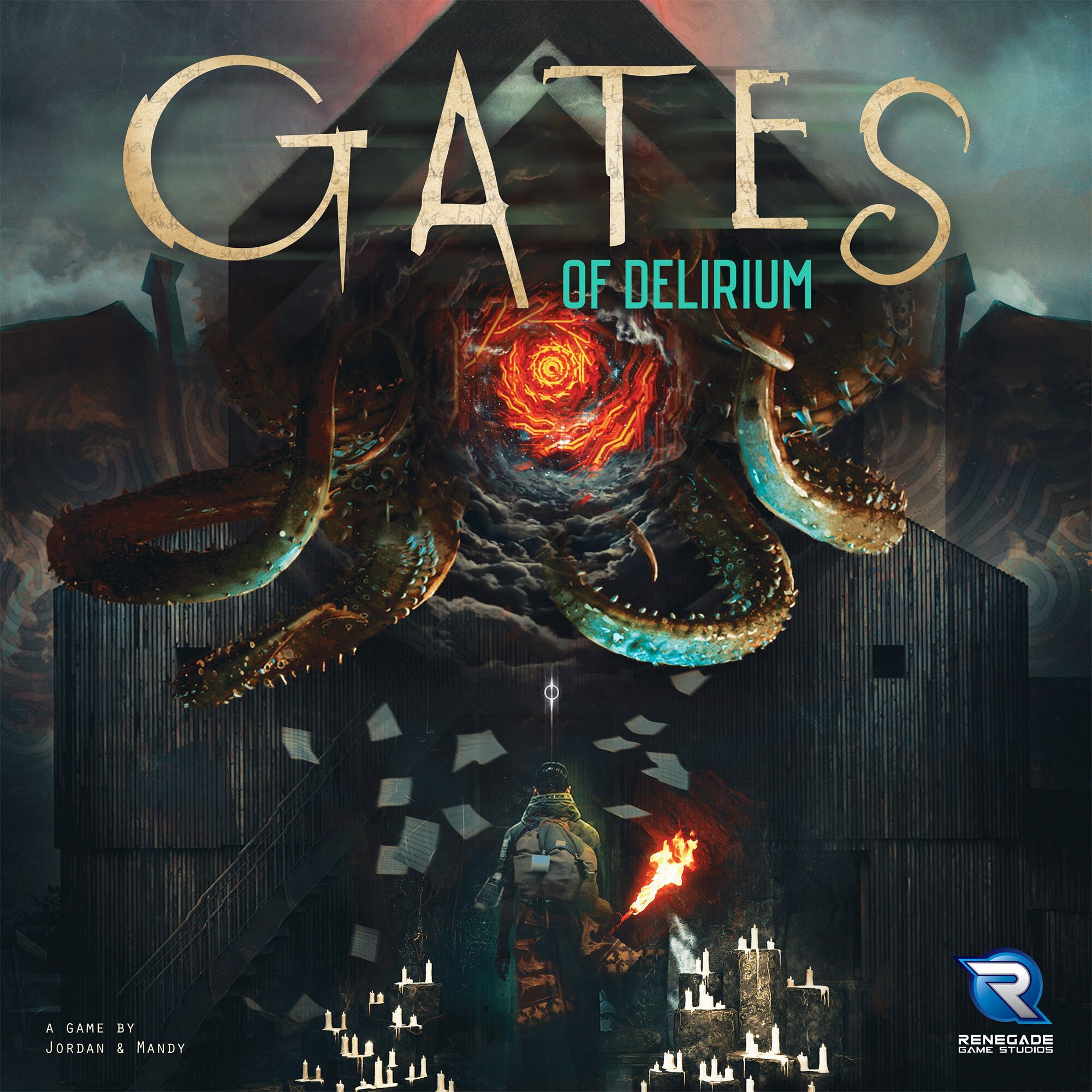
Gates of Delirium

2–4 players 30–45 min Ages 14+ 1.9/5 complexity 5.7/10 rating

About this game

You have finally set out to find the truth. You've heard the rumors of ancient runes and the lost pages of a scattered tome that tell of ancient and evil monstrosities, calling for their return. You've heard tales of those who came before you in this search losing grip on their sanity as they grew nearer to the truth. As you press on, you can't help but notice that you feel less attached to reality yourself. Some days you lose track of time and can't account for hours of the day. The whispers of secret gates to another world are growing stronger, and while no one knows who is building them, you have a dreadful hunch... Could you be the hidden architect of the Gates of Delirium? In Gates of Delirium, players have a hand of split action cards: one side sane, and the other insane. Every round, one player decides whether the round is sane or insane, and all players must play that side of their cards. During sane rounds, players search for maps and lost pages to a secret tome, while assigning investigators to help them in their cause. During insane rounds, players collect ancient runes and work to build gates to release the monstrosities that their sane selves have been trying so hard to understand and prevent. Earn the most victory points by the time the last monstrosity is released to win Gates of Delirium. —description from the publisher

What it feels like

Hand Management End Game Bonuses Area Majority / Influence Set Collection Card Game Horror Mature / Adult Cthulhu Mythos

Explore these mechanics in Cardboard

Start an original prototype from reusable design patterns—not this game's content.

Open mechanics workbench

Game intelligence

Learn the game

60% knowledge coverage

Setup

1. Place the game map in the center of the play area. Use the 3+ player side for 3–4 players, or the 2-player side for 2 players. 2. Shuffle the action cards to form a face-down deck. 3. Shuffle the gate cards to form a face-down deck. 4. Create the gate supply by revealing four cards from the top of the gate deck and placing them face-up in a row next to the gate deck. 5. Place the monstrosity discs face up in a stack, in ascending order of value (lowest value on top, highest on bottom). 6. Shuffle the scroll cards and place one face-down in each card slot along the top edge of the game map. 7. Create a pile of desperation tokens placed within reach of all players. 8. Give each player one player journal, one score marker, and 10 investigators in their chosen color. 9. Place the score tokens next to the score track. 10. Deal each player five action cards as their starting hand. Hands are kept hidden from opponents. 11. Determine the start player and give them the sanity disc. TWO-PLAYER EXTRA STEPS: Use the 2-player side of the map. Remove the 10-point and 11-point monstrosity discs from the stack and return them to the box. Place neutral investigators (of an unused player color) in each region as indicated by the investigator icons beneath each region label (1–3 per region).

Turn flow

At the start of each round, the current start player flips the sanity disc and declares whether the round is SANE or INSANE. Play then proceeds clockwise, with each player taking one turn. On your turn, you MUST play exactly two action cards from hand, one at a time. When you play a card, reveal it and take the action on the side (sane or insane) matching the current round type. Cards that contain artifacts (lost pages, map fragments, ancient runes) are added to your journal; all other played cards go to the discard pile. At ANY point during your turn — including in the middle of an action — you MAY spend desperation tokens to take desperate actions. You may take as many desperate actions as you can afford. After playing both action cards and taking any desired desperate actions, draw two new action cards from the top of the action deck to refill your hand to five cards. If the deck runs out, reshuffle the discard pile. At the end of the round, the start player passes the sanity disc to the player on their left, who becomes the new start player for the next round.

Scoring and victory

false

Source: Rulebook

Rules to know

The most useful rules for getting a first game right.

Turn structure

At the start of each round, the start player declares it sane or insane by flipping the sanity disc.

At the start of each round, the current start player chooses whether the round will be a sane round or an insane round, flipping the sanity disc to indicate their choice. All players in that round may only take the actions corresponding to that round type (sane or insane) on their action cards.

Turn structure

On your turn, you must play exactly two action cards from hand, one at a time.

On your turn, you must play two action cards from hand, one at a time. Each card is revealed, its action (matching the current round type) is taken, and then the card is placed in the discard pile — unless it bears an artifact (lost page, map fragment, or ancient rune), in which case it is added to the corresponding section of your journal.

Drawing

At the end of your turn, draw two new action cards to refill your hand to five.

After playing two action cards and taking any desired desperate actions, draw two new cards from the top of the action deck and add them to your hand, bringing it back up to five cards. If the action deck runs out, reshuffle the discard pile to form a new deck.

Card play

Each action card has a sane half (white frame) and an insane half (dark frame); only the side matching the current round type is used.

Every action card is divided into two parts: a sane side (white frame) and an insane side (dark frame). When you play a card, you perform only the action shown on the side corresponding to the current round type. You cannot choose to use the other side.

Card play

Action cards that show artifacts (lost pages, map fragments, ancient runes) are added to your journal, not discarded.

Cards that feature one of the three artifact types — lost pages, map fragments, or ancient runes — are always added to the corresponding section of your player journal when played. They are never placed in the discard pile.

Turn structure

After each round, the start player passes the sanity disc to the player on their left.

At the end of each round, the current start player passes the sanity disc to the player seated on their left. That player becomes the new start player for the next round and will choose the round type (sane or insane).

Resource management

During a sane round, collect a lost page by adding the card to your journal in numerical order.

When you take the 'collect a lost page' sane action, add the action card to the lost pages section of your journal, tucking it partially beneath the top edge. Arrange all lost pages in numerical order. There are 20 different lost pages (numbered 1–20), and only one copy of each exists in the entire game.

Resource management

During a sane round, collect a map fragment by adding it to your journal to build completed maps.

When you take the 'collect a map fragment' sane action, add the card to the map fragments section of your journal, tucking it partially beneath the top edge. Arrange map fragments next to each other to form maps. A completed map requires four unique fragments: NW, NE, SW, and SE. If you already have a completed map, start a new one.

Ask About This Game

Similar games