1981 BGG rank #15516

Hoax

3–12 players 45 min Ages 10+ 1.3/5 complexity 5.5/10 rating

About this game

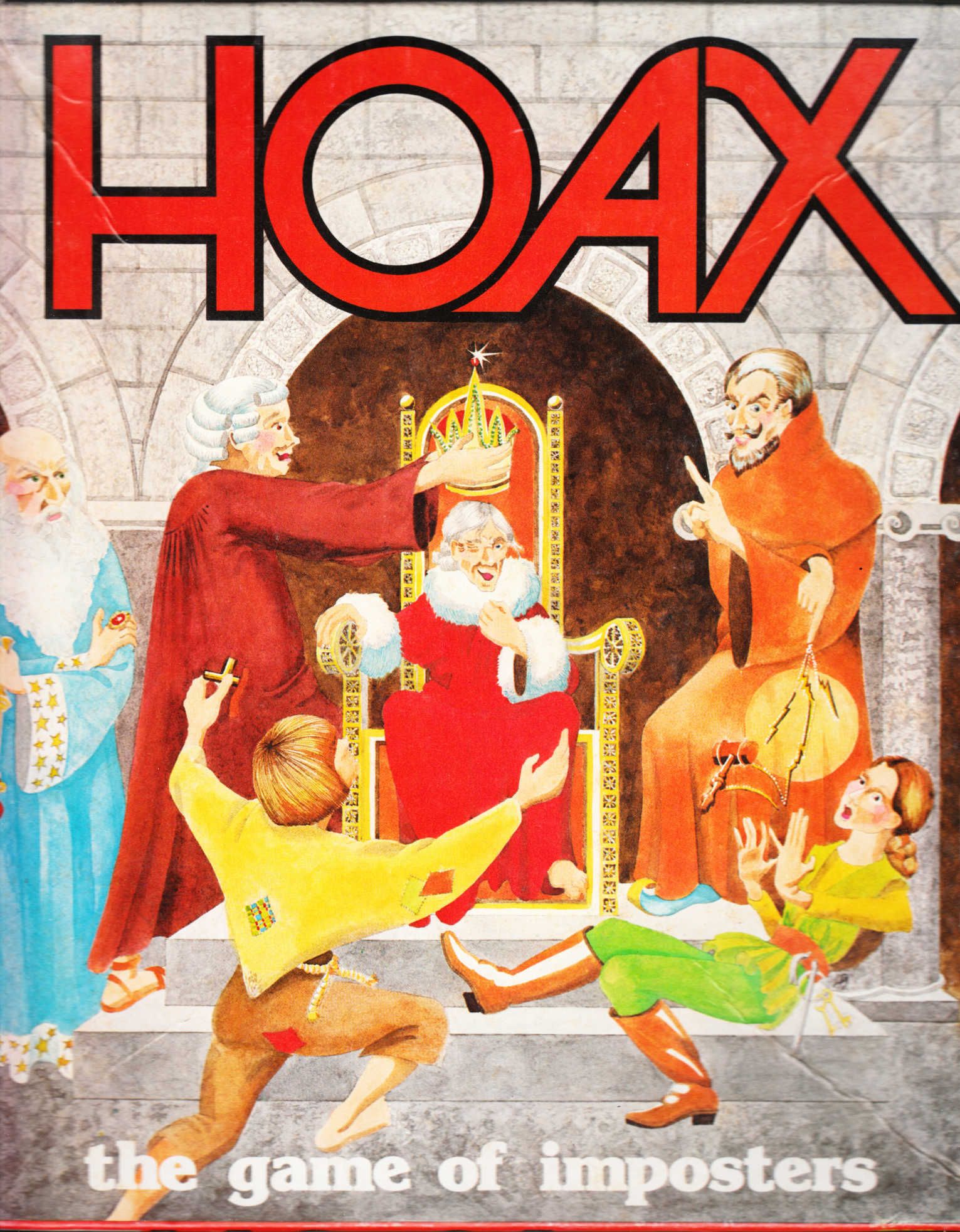
The basic idea in Hoax is to pretend to be somebody you are not while working towards the goal of figuring out who other people are. Each player is assigned one of six different characters -- each with its own unique abilities -- but can pretend to be any character and use its corresponding powers. Abilities are used to acquire 3 different types of goods, which can be spent to get clues to opponents' identities. If the majority of the other players think you're pretending to be a character that you're not, you must either admit that you are not that character (and permanently lose the use of its power), or reveal that you are and win the game. Re-implemented as: Die Erben von Hoax

What it feels like

Voting Hidden Roles Deduction Bluffing Fantasy Deduction Medieval

Game intelligence

Learn the game

100% knowledge coverage

Setup

1. Each player is secretly dealt a character card representing their hidden identity. 2. Keep your character card hidden from all other players at all times. 3. Distribute starting tokens as specified by the character setup rules. 4. Determine a starting player (e.g., most recently told a lie). 5. Play proceeds clockwise from the starting player.

Turn flow

On your turn: (1) Announce a character — this may be your true identity or a bluff. (2) Claim that character's privilege by taking one or more tokens as defined by the character's ability. (3) Any other player may call for a vote if they believe your announced identity is false. If a vote is called: all players vote; if the vote is rejected, nothing happens and your turn ends normally; if the vote is accepted, your true identity is revealed — if you were lying, you are eliminated; if you were telling the truth, the accuser wins immediately.

Scoring and victory

Last player surviving wins; or a player who successfully makes a false accusation that passes a vote wins immediately. Scoring sources: Survival: being the last player not eliminated, Instant win: successfully triggering a false accusation vote that passes against a truthful player

Source: Rulebook

Rules to know

The most useful rules for getting a first game right.

Setup

Each player is secretly assigned a character identity at the start of the game.

At the beginning of the game, each player receives a secret character card representing their identity. This identity must be kept hidden from other players throughout the game. A player's true identity is only revealed when they are successfully accused or when a false accusation is made against them.

Turn structure

On your turn, you must announce a character and claim its privilege.

On each player's turn, they must publicly announce a character (which may or may not be their true secret identity) and then benefit from that character's privilege. The privilege consists of taking one or more tokens in various ways as defined by the announced character's ability. Players may truthfully or falsely claim any character.

Special

Players may lie about their character identity when announcing on their turn.

It is permitted to announce a character other than your true secret identity. This is the central bluffing mechanic of the game. However, lying carries risk: if another player suspects the announced identity is false, they may initiate a vote to challenge the claim. Lying becomes particularly dangerous if the character you claim is actually held by another player, as that player knows your claim is false.

Special

Other players may call a vote if they believe an announced character identity is false.

After a player announces their character, any other player who believes the announcement is a lie may call for a vote. The group then votes on whether the announced identity is false. If the vote is rejected (does not pass), nothing happens and the turn continues normally. If the vote is accepted (passes), the accusation is formally made and must be resolved immediately.

Special

A passed vote results in a formal accusation; if the accused was lying, they are eliminated; if they were telling the truth, the accusers win immediately.

When a vote to challenge passes, the accused player reveals their true identity. If the accusation is accurate (the announced character was not the player's true identity), the accused player is immediately eliminated from the game. If the accusation is inaccurate (the announced character was indeed the player's true identity), the player who initiated or led the accusation wins the game immediately.

Endgame

The last player remaining after all others are eliminated wins the game.

The primary win condition is survival: the last player left standing after all other players have been eliminated inherits the fortune of Hector Vargas and wins the game. Players are eliminated when a successful accusation proves they lied about their character identity.

Endgame

Making a false accusation that passes results in an immediate win for the accuser.

If a vote to challenge is accepted (passes) but the accusation turns out to be wrong—meaning the accused player was truthfully announcing their character—the player who brought the accusation wins the game immediately. This rule creates a high-risk, high-reward dynamic around initiating challenges.

Resource management

Each character's privilege involves taking one or more tokens in a specific way.

When a player announces a character and claims its privilege, they take tokens as specified by that character. Different characters grant privileges that allow tokens to be collected in different quantities or through different methods. Tokens are a central resource in the game, though the exact privileges depend on each character's special ability.

Strategy briefing

When to call a vote

Only call a vote when you are highly confident the announced character is a lie—ideally when you yourself hold the character being claimed. A failed accusation (vote passes but the player was truthful) instantly loses you the game per the false_accusation_instant_win rule.

Strategic bluffing

Bluffing a character that is held by an absent or eliminated player is safer, as no one can definitively know you are lying. Avoid bluffing characters held by active players who will recognize the lie and have strong incentive to challenge you.

Protecting your identity

Revealing your true identity too consistently lets others track your character. Occasionally bluffing other characters (while accepting the risk of a vote) can obscure your true identity and make you harder to eliminate.

Token economy

When bluffing, choose characters with privileges that grant useful token quantities. However, consistently claiming a high-value character you don't own will draw suspicion and increase the likelihood of a vote being called against you.

Common questions and edge cases

A player announces a character that is actually held by another player. Can that player be sure the announcement is a lie?

Yes. Since each character identity is unique and secretly held by exactly one player, if you hold a character card and another player announces that same character, you know with certainty they are lying. This gives you strong grounds to call for a vote.

A player truthfully announces their character, but other players vote to challenge and the vote passes. What happens?

If the vote passes but the accused player was telling the truth (their announced character matches their secret identity), the player who initiated the accusation wins the game immediately. The accused player is NOT eliminated.

A challenge vote is called but does not pass (is rejected). What happens to the accusing player and the turn?

If the vote is rejected, nothing happens. There is no penalty for the player who called the vote, and no penalty for the accused. The turn continues normally and the accused player's privilege stands.

A player successfully bluffs a character and no challenge vote is called. Do they still collect that character's tokens?

Yes. If no vote is called (or if a vote is called and rejected), the announcing player claims the privilege of the announced character and takes the associated tokens, regardless of whether the announcement was truthful or a bluff.

Ask About This Game

Similar games