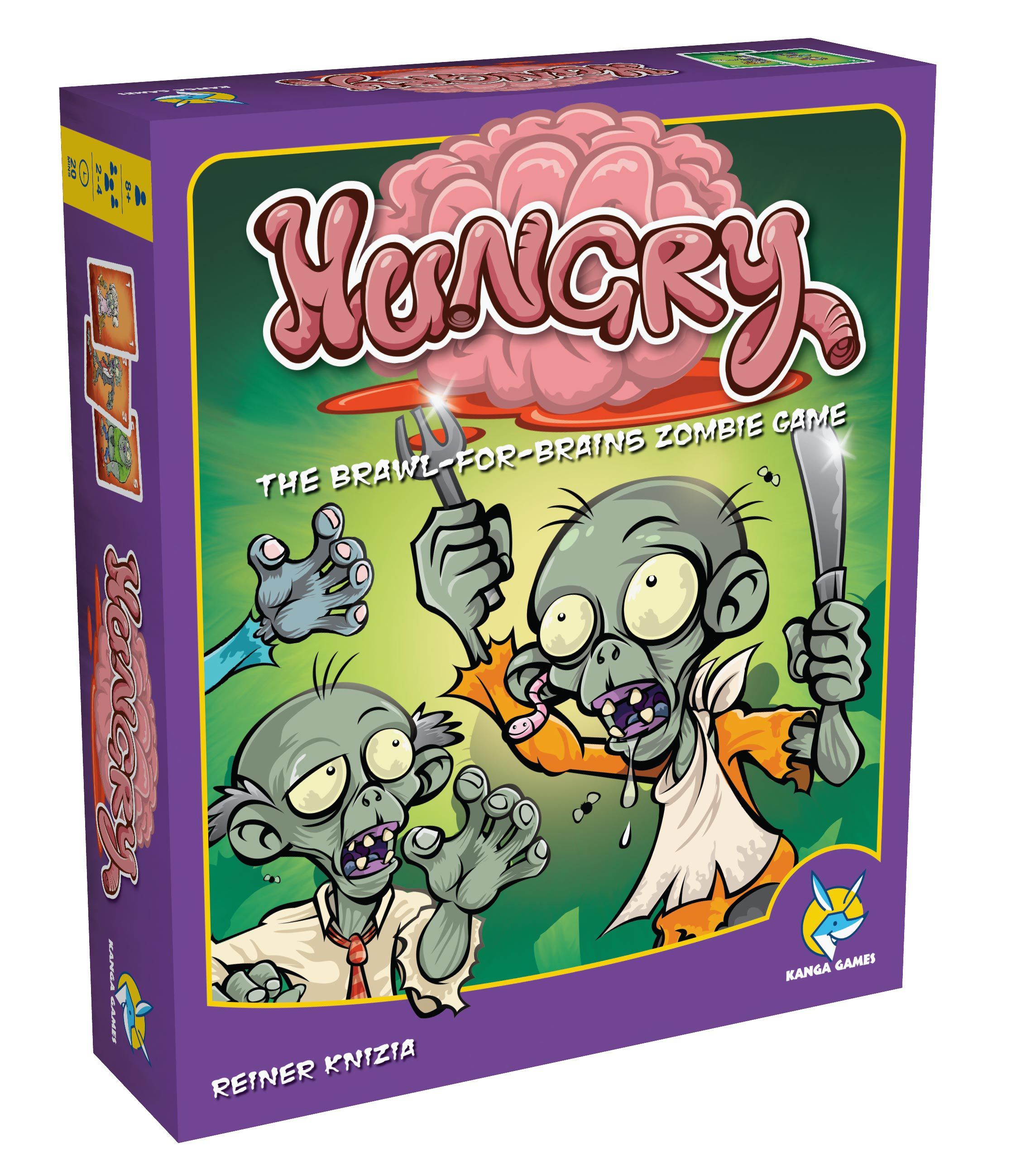
1995 BGG rank #6213

Hungry

2–4 players 30 min Ages 8+ 1.4/5 complexity 5.7/10 rating

About this game

In this quick, fun, and fairly abstract game, players play cards in an effort to acquire tiles that are either color-coded or number-coded. Players take turns, first playing a card onto a tile that matches either the card's number or its color, then drawing to refill their hands. When all cards have been played, each tile is evaluated, and whichever player has the most cards played to that tile gets that tile's points. After calculating point totals and figuring in bonuses, the player with the highest score is the winner.

What it feels like

Team-Based Game Set Collection Hand Management Card Game Medieval

Explore these mechanics in Cardboard

Start an original prototype from reusable design patterns—not this game's content.

Open mechanics workbench

Game intelligence

Learn the game

100% knowledge coverage

Setup

1. Shuffle all 50 tourist cards and place them face-down as a draw deck in the centre of the table. 2. Remove the top 2 cards from the deck and return them to the box without looking at them. 3. Each player draws 8 tourists from the top of the deck and keeps them hidden in hand. 4. Place the 5 holiday home tiles in a row ordered left-to-right from 1 star (lowest) to 5 stars (highest). 5. Place the 5 hotel tiles in a row in any order. 6. Place one 1-point token on each hotel tile and on each holiday home tile (10 tokens total on tiles). 7. Set the 5-point token aside — it will be awarded during scoring. 8. Each player takes a player marker matching their seat position at the table (mountain, bay, etc.) and places it in front of themselves. Each marker determines on which side of the resort row that player places their cards.

Turn flow

The youngest player (or the player with the best tan) goes first. Play proceeds clockwise. On each turn a player performs exactly two actions in order: 1. SEND A TOURIST: Choose one tourist card from hand and place it face-up on your side of the matching resort — either the holiday home whose star rating matches the card's star number, or the hotel whose colour matches the card's colour. Cards must be placed on the side of the resort corresponding to your player marker. 2. DRAW A TOURIST: Draw the top card from the draw deck and add it to your hand. Once the draw deck is exhausted, players no longer draw cards. Players continue taking turns playing cards from their hands until all hands are empty, at which point the game ends.

Scoring and victory

Most points wins. In case of a tie, the tied player holding the holiday home tile with the lowest star rating wins. Scoring sources: Holiday home majority: points equal to the tile's star rating (1–5 points), Hotel majority: 5 points per hotel tile won, Second place at any resort (holiday home or hotel): 1 point (the token placed on the tile), First player to collect 2 holiday home tiles: 5-point bonus token

Source: Rulebook

Rules to know

The most useful rules for getting a first game right.

Card play

Each tourist card can be played to exactly one of two matching resorts.

Every tourist card shows two attributes: a star number (1–5) and a colour. When playing a card, the active player may place it adjacent to either (a) the holiday home whose star count matches the card's star number, or (b) the hotel whose colour matches the card's colour. The player must choose one of these two options; a card cannot be played anywhere else.

Restriction

Each player must place tourist cards on their own designated side of the resort row.

Each player has a unique player marker (mountain, bay, etc.) that corresponds to a specific physical side of the resort row. All tourist cards that player plays must be placed adjacent to the resort on the side indicated by their marker. Players may not place cards on another player's side.

Turn structure

Each turn consists of exactly two actions: play one tourist card, then draw one tourist card.

On their turn, the active player must (1) choose one card from their hand and place it at a valid resort on their side, then (2) draw the top card from the draw deck and add it to their hand. Both actions are mandatory when possible. The turn then passes to the player on the left.

Restriction

Once the draw deck is exhausted, players cannot draw new tourists.

When the draw deck runs out, the draw step is skipped for the remainder of the game. Players continue taking turns playing one card per turn from their existing hand until all players have played every card in their hand, at which point the game ends.

Setup

Two cards are removed from the deck sight-unseen before the game begins.

After shuffling the 50 tourist cards, the top 2 cards are removed from the deck and placed back in the box without any player looking at them. This introduces hidden information about which tourists are in play.

Setup

Each player begins with 8 tourist cards drawn from the top of the deck.

After removing 2 cards from the deck, each player draws 8 cards from the top of the remaining deck. Players keep their hand hidden from other players throughout the game.

Setup

Holiday homes are always arranged in ascending star order from left to right.

The 5 holiday home tiles must be placed in a fixed row ordered from 1 star (leftmost) to 5 stars (rightmost) and remain in this position for the entire game. This order is also the order in which they are scored at the end of the game.

Setup

Hotels can be placed in any order.

The 5 hotel tiles are placed in a row in any order the players choose. Their arrangement does not affect gameplay or scoring, except that each hotel is scored separately.

Strategy briefing

Card Versatility

Because each tourist card can go to either a holiday home or a hotel, you should evaluate both options before placing. A card that gives you a majority at a 5-star holiday home (5 pts) is more valuable than one securing a hotel (5 pts too), but the holiday home also contributes to the 5-point bonus — making it doubly important to contest high-star homes.

Chasing the 5-Point Bonus

The 5-point bonus token for collecting 2 holiday home tiles is a significant swing. Since scoring goes in ascending star order, aim to win the 1-star and 2-star homes early — they cost fewer cards to contest and getting them secures the bonus before opponents can catch up on higher-value tiles.

Exploiting the Tie Rule

The tie rule eliminates tied players from scoring entirely. If you are losing a contest at a resort, you can strategically match a leading opponent's tourist count to force a tie, denying them the tile or token and potentially elevating yourself (or another player) at a different resort. This is especially powerful at high-star holiday homes.

Second Place is Still Valuable

Every resort — holiday home and hotel — awards the second-place player 1 point via the token. Across 10 resorts, second-place finishes can accumulate up to 10 points, often enough to swing a close game. Don't abandon a resort just because you can't win it outright.

Hand Management and Hidden Information

Two cards are removed from the game unseen at setup. This means you cannot be certain which tourist colours or star values are available to opponents. Track which cards have been played to estimate what rivals might hold and plan your placements accordingly.

Tiebreaker Awareness

If the game is likely to be close in score, prioritise winning the 1-star holiday home tile. It is worth only 1 point directly, but it serves as the tiebreaker — the lowest-star tile among tied players determines the winner. A 1-star tile in hand beats any higher-star tile in a final score tie.

Common questions and edge cases

Two players tie for first place at a holiday home. Does anyone get second place?

When two or more players tie for first place, they are all ignored. The next player below the tie is elevated to first place and wins the tile. If no such player exists, no one wins the tile. In that case, the third-place player (if any, and untied) would take second place and earn the 1-point token. If all remaining players are also tied, no one gets the token either.

A holiday home tile is not awarded (e.g., everyone ties for first). Does the bonus token still get awarded if a player later hits 2 tiles?

Only tiles that are actually awarded count toward the 2-tile bonus. If a holiday home tile is not awarded due to a tie, no player receives it, so it cannot count toward the 5-point bonus. The bonus is only triggered the moment a player physically receives their second holiday home tile during the scoring sequence.

Two players each collect their second holiday home tile at the same time (e.g., the same holiday home is scored). Who gets the 5-point bonus?

Because holiday homes are scored strictly in ascending star order (1 through 5), only one tile is awarded at a time. It is impossible for two players to simultaneously earn their second tile. The player who reaches 2 tiles first in that sequential scoring order claims the bonus. If, for example, players A and B both have 1 tile each and a 3-star home is scored, only one player can win that tile — that player immediately claims the 5-point bonus.

The draw deck runs out mid-game. What happens to the rest of the game?

Once the deck is exhausted, players no longer draw a card after playing. Each turn they simply play one card from their hand (and skip the draw step). The game continues until every player has played all remaining cards in their hand, then scoring begins.

A player has a card that could go to either a holiday home or a hotel. Are there any rules restricting which one they must choose?

No. The player freely chooses which of the two valid resorts (matching holiday home OR matching hotel) to place the card at. There is no rule forcing one choice over the other — it is purely a strategic decision.

A player wins multiple hotel tiles. Do they receive any bonus like the 5-point token?

No. The 5-point bonus token is exclusively tied to holiday home tile collection. Winning hotel tiles does not contribute to earning the bonus token, regardless of how many hotels a player wins.

In a 2-player game, both players place the same number of tourists at a holiday home. What happens?

Both players are tied for first place and are both ignored per the tie rule. Since there are only 2 players and both are tied, no player receives the holiday home tile or the 1-point token. That holiday home awards nothing, and that tile cannot contribute to the 5-point bonus.

Two players are tied on final score but neither holds any holiday home tiles. How is the winner determined?

The tiebreaker is the lowest-star holiday home tile held. If neither tied player holds any holiday home tile, the rules do not specify a further tiebreaker — the game is considered a draw in that edge case (the rulebook only defines this one tiebreaker).

Ask About This Game

Similar games