2021 BGG rank #4934

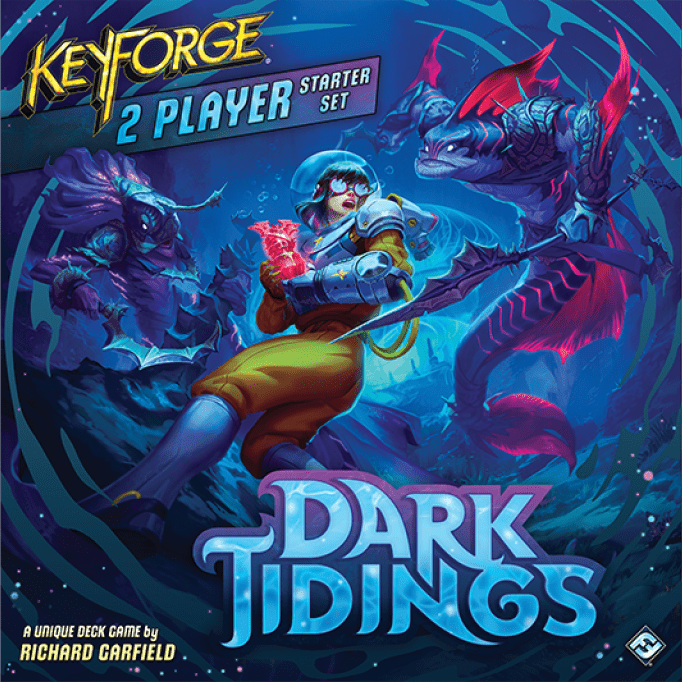
KeyForge: Dark Tidings

2 players 15–45 min Ages 14+ 2.8/5 complexity 5.8/10 rating

About this game

KeyForge: Dark Tidings is the fifth series in the KeyForge line. As always, each deck in the line contains cards from three of the seven houses included in the line, but for Dark Tidings the Dis house will be replaced with the Unfathomable, which specializes in controlling their foes by exhausting enemy creatures. Some cards keep your opponent's creatures down, making it difficult for them to muster a fighting force or reap enough æmber. Once your enemies are exhausted, you can keep them out of commission with other cards or even wipe away their board. Each Dark Tidings deck also includes a high/low tide card. The card starts the game out of play, but eventually one player will bring it into play, especially since some cards in Dark Tidings can carry out their effects — or have a massively larger effect — when the high tide is on that player's side. Many effects can raise the tide, but if they're not available, the player with low tide can always suffer three chains to turn the tide in their favor. Dark Tidings also features the debut of "evil twin decks", a new type of deck. For example, you may open a deck that's entitled "Speaker Domitia's Evil Twin". This deck is an exact copy of "Speaker Domitia", a real deck that has been printed and can be found by another player out in the world. The crucial difference is that in an evil twin deck, many of your creatures look a little different. Specifically, in Dark Tidings, many creatures have evil twin variants, and if you find an evil twin deck, every creature with an evil twin variant appears in that form. These evil twin creatures feature new artwork, graphic design, and abilities, making them a significant departure from the original creature.

What it feels like

Take That Hand Management Card Game Fantasy Fighting

Explore these mechanics in Cardboard

Start an original prototype from reusable design patterns—not this game's content.

Open mechanics workbench

Game intelligence

Learn the game

100% knowledge coverage

Setup

1. Each player takes their KeyForge deck and shuffles it.\n2. Each player draws a starting hand (typically six cards, per standard rules).\n3. Set up an aember token pool accessible to both players.\n4. Each player places their key trackers showing zero keys forged.\n5. Determine who goes first.\n6. The first player begins their turn by declaring a house.

Turn flow

At the start of your turn: (1) Forge a key if you have six or more aember (paying the cost). (2) Choose one of your three houses to be active for this turn. (3) Play, use, and/or discard any number of cards from your hand that belong to the chosen house, in any order. (4) Use any ready creatures and artifacts from the chosen house. (5) At the end of your turn, draw back up to your hand size (modified by chains, if any). Cards from non-active houses cannot be played, used, or discarded this turn.

Scoring and victory

The first player to forge three keys wins the game immediately. Target score: 3 keys forged Scoring sources: Forging keys by spending six aember, Aember generated by playing cards, Aember generated by using creature abilities, Aember generated by using artifact abilities

Source: Rulebook

Rules to know

The most useful rules for getting a first game right.

Endgame

Win by forging three keys before your opponent.

A player wins the game when they have forged three keys. Keys are typically forged by spending six aember. There are no life totals and no base to destroy — the game is purely a race to forge keys first.

Scoring

Each key normally costs six aember to forge.

Forging a key requires a player to spend six aember. Certain cards may modify this cost upward or downward. Once the cost is paid, the key is forged and counts toward the three needed to win.

General

There is no mana or resource cost to play cards.

KeyForge has no mana or resource system. Players may play cards from their hand without paying a resource cost. Many cards actually generate aember when played, meaning playing cards often accelerates your path to victory rather than consuming resources.

Turn structure

At the start of your turn, choose one of your three houses to activate for that turn.

Each deck contains exactly three houses (factions). At the start of your turn, you must declare one of your three houses as the active house. During that turn, you may only play, use, or discard cards that belong to the chosen house. Cards from the other two houses may not be played, used, or discarded that turn.

Restriction

You can only play, use, or discard cards from your chosen house each turn.

The house chosen at the start of your turn acts as a gate on all card actions. Cards belonging to unchosen houses cannot be played from hand, used (if already in play), or discarded that turn. This restriction is the primary limiting mechanic in lieu of a resource system.

Setup

Each deck contains 36 cards split equally among three houses (12 cards per house).

A KeyForge deck is composed of 36 playable cards. The deck building algorithm assigns exactly three houses to each deck, and each house contributes exactly 12 cards. This fixed structure ensures balanced house representation while allowing for a vast combination of specific cards.

General

The four card types are creatures, actions, artifacts, and upgrades.

KeyForge cards fall into one of four types: Creatures (played onto the battlefield, used to fight and generate aember), Actions (one-time effects played from hand), Artifacts (persistent cards played onto the battlefield with reusable effects), and Upgrades (attached to creatures to modify them). Players themselves have no life total and cannot be attacked directly.

Resource production

Aember is generated by playing cards and using creatures and artifacts.

Players accumulate aember — the resource needed to forge keys — primarily by playing certain cards that produce aember as part of their effect, and by using creatures and artifacts whose abilities generate aember. Aember is tracked using tokens and sits in the player's aember pool.

Strategy briefing

House Selection Priority

Because you can only activate one house per turn, sequencing your house choices is the most important decision you make each turn. Favor the house that lets you generate the most aember or deny your opponent's aember when you are close to forging a key, since forging happens at the start of the next turn.

Card Play as Acceleration

Since playing cards has no resource cost and often generates aember directly, playing as many eligible cards as possible each turn is generally correct. Cards that generate aember on play are doubly efficient: they advance your win condition while costing nothing.

Deck Discovery

Because every deck is unique and pre-constructed, learning your deck's best house synergies — and which house to prioritize in which game states — is a primary skill driver. Study your 12-card house pods to understand each house's role: aember generation, board control, or disruption.

Chains as a Balance Tool

When playing casually against a friend with a weaker deck, proactively placing chains on the stronger deck prevents blowout games. Starting at three chains and iterating preserves the fun of the race-to-three-keys dynamic without permanently altering either deck.

Competitive Format Selection

In Archon, your deck is fixed, so pre-game deck knowledge is your edge. In Alliance, house pod selection against a known metagame is the primary skill lever — but be mindful of the restricted list. In Sealed, adaptability and quickly reading an unknown deck are paramount.

Common questions and edge cases

I have a creature from House A already on the battlefield, but I chose House B this turn. Can I use that House A creature?

No. You may only use (fight, reap, or activate abilities of) creatures and artifacts that belong to your currently chosen house. House A cards are completely locked out this turn.

I have six aember at the start of my turn. When do I forge a key?

Key forging happens at the start of your turn, before you choose a house or play any cards. If you have enough aember (usually six), you forge a key at that point.

My deck has chains on it. How does that affect my turn?

Chains reduce the number of cards you draw at the end of your turn. For example, if you normally draw up to six cards and you have one chain, you draw to a reduced hand size. One chain is removed each time it penalizes your draw. Chains are a casual balancing tool and are not used in organized play.

A card is on the Alliance restricted list. Can I still use it in an Archon deck?

Yes. The restricted list only applies to the Alliance format. Archon format uses the errata list in the Master Rules Book, not the Alliance restricted list. A card restricted in Alliance may be freely used in Archon.

If cards are free to play, what stops me from emptying my hand every turn?

The house restriction stops you. You may only play cards from one chosen house per turn, meaning up to 12 of your 36 cards are eligible on any given turn. You cannot play cards from the other two houses, effectively limiting your actions each turn without a mana system.

Can I bring a deck from any set to a Sealed organized play event?

No. Sealed OP events are always set-specific. The decks are typically provided by the tournament organizer, so individual players do not bring their own decks to Sealed events.

Ask About This Game

Similar games