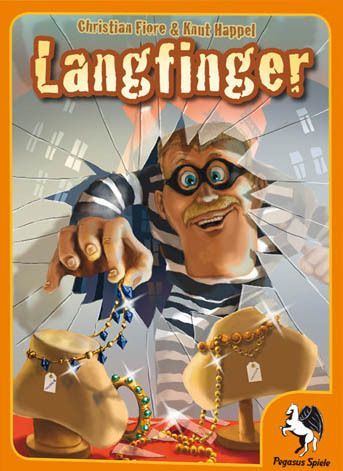
2009 BGG rank #8987

Langfinger

2–5 players 20–30 min Ages 8+ 1.8/5 complexity 5.6/10 rating

About this game

From the publisher's website: "The night is setting in slowly on the city, but not all of its inhabitants are asleep. Under cover of darkness, several scoundrels are on their way to perform their big heist tonight You are playing the role of one of these scoundrels on the hunt for gold and art treasures. Careful planning will let you make the big haul, but be sure not to miss the right moment to cash in your swag at a fence! Rules summary: The players place their Scoundrel tokens at five locations on the central board, which are then resolved in the following order: 1 - City: Receive Tool cards required for the break-ins 2 - Villa: Receive Loot cards if you meet the tool requirements 3 - Ruin: Swap Tool cards from your hand with the draw pile. 4 - Museum: Receive Loot cards if you meet the tool requirements 5 - Harbor: Sell loot to the fence to gain gold (victory points) The first player to earn 20+ gold wins. The game is announced for release at Essen Spiel 2009. Online Play Yucata (turn-based)

What it feels like

Worker Placement Hand Management Burglary and Heists

Explore these mechanics in Cardboard

Start an original prototype from reusable design patterns—not this game's content.

Open mechanics workbench

Game intelligence

Learn the game

100% knowledge coverage

Setup

1. Place the game board in the center of the table. 2. Each player chooses a scoundrel card and places it face up in front of them, along with their 3 matching-color scoundrel tokens. Place their scoundrel playing piece on space 0 of the money tracker. 3. Separate the tool cards, loot cards, and fence cards into three shuffled face-down draw piles placed to the side of the board. Leave space for discard piles beside each draw pile. 4. Determine the starting player (player with the longest fingers) and give them the starting player card. 5. Deal starting hands: the starting player draws 2 tool cards, the player to their left draws 3 tool cards, and all remaining players draw 4 tool cards. 6. Place the number of tool cards face UP next to the City (1) as indicated for the player count. 7. Place the number of loot cards face DOWN next to the Villa (2) and the Museum (4) as indicated for the player count. 8. Place the number of fence cards face UP next to the Harbor (5) as indicated for the player count. 9. The Ruin (3) begins empty — no cards are placed there at setup.

Turn flow

Each round consists of three phases: PHASE A — Place Scoundrel Tokens: Starting with the starting player and proceeding clockwise, each player places exactly 1 scoundrel token onto any available square on the board. Players repeat this until all players have placed all 3 of their tokens (3 placement rounds total). Each of the 5 places has 5 placement squares; each square holds at most 1 token. Multiple tokens from different players may be at the same place if open squares remain. PHASE B — Perform Actions: Places are resolved in numerical order: City (1), Villa (2), Ruin (3), Museum (4), Harbor (5). At each place, the player whose token is on square 1 acts first, followed by square 2, square 3, etc. Each token = 1 action at that place. After performing their action, each player removes their token and returns it to their personal supply — except at the Ruin, where tokens remain on the exchange square until all Ruin actions are resolved. PHASE C — Prepare for Next Round: Replenish tool cards at the City, loot cards at the Villa and Museum, and fence cards at the Harbor back to the player-count-indicated number. Pass the starting player card clockwise.

Scoring and victory

Most money (spaces advanced on the money tracker) wins. The game ends at the end of the round in which any player reaches 20 or more. In case of a tie, all tied players win. Target score: 20 Scoring sources: Cashing in a chest loot card immediately upon acquisition (face value in spaces), Selling loot cards at the Harbor via fence cards (face value in spaces), Fence bonus +1 or +2 for matching loot type

Source: Rulebook

Rules to know

The most useful rules for getting a first game right.

General

When a draw pile is empty, shuffle its discard pile to form a new draw pile.

Whenever one of the three draw piles (tool cards, loot cards, fence cards) runs out of cards, shuffle the respective discard pile and use it face down as the new draw pile.

Setup

Starting hands are unequal: the starting player draws 2 tools, the next player draws 3, all others draw 4.

At the start of the game, the starting player draws 2 tool cards into their hand. The player to the starting player's left draws 3 tool cards. All remaining players each draw 4 tool cards. This compensates for the starting player's positional advantage.

Turn structure

In Phase A, players take turns clockwise placing exactly 1 scoundrel token at a time until all 3 tokens per player are placed.

Phase A proceeds in clockwise order starting with the starting player. On your turn you place exactly 1 scoundrel token onto any square on the board. You may never place more than 1 token per turn in this phase. This continues in rounds until all players have placed all 3 of their scoundrel tokens (i.e., 3 full clockwise passes).

Restriction

Each placement square holds at most 1 scoundrel token; each place has 5 squares.

Each of the 5 places (City, Villa, Ruin, Museum, Harbor) has 5 placement squares. Each square may hold no more than 1 scoundrel token at a time. A player may place multiple tokens at the same place provided unoccupied squares remain there.

Turn structure

Places are resolved in order 1–5 (City, Villa, Ruin, Museum, Harbor); within each place, the token on square 1 acts first.

During Phase B, places are resolved in numerical order: City (1) first, then Villa (2), Ruin (3), Museum (4), and Harbor (5) last. Within a place, the player whose token occupies square 1 acts first, then square 2, then square 3, and so on. Each token grants its owner 1 action at that place.

Turn structure

After performing an action, a player immediately returns their scoundrel token to their personal supply — except at the Ruin.

Once a player finishes their action at any place (City, Villa, Museum, or Harbor), they immediately remove their scoundrel token from the board and place it back in front of them, ready for the next round. The Ruin is the sole exception: tokens placed on Ruin exchange squares remain there until all Ruin actions for the round are fully resolved.

Resource management

At the City, spend 1 action to freely take any 2 of the tool cards currently placed there into your hand.

A player who performs an action at the City (place 1) may take any 2 of the face-up tool cards present there into their hand. The player chooses freely. If all tool cards at the City have already been taken by earlier-acting players, the current player receives nothing.

Resource management

At the Villa, spend 1 action to take 1 loot card by discarding the tools depicted on it.

A player who performs an action at the Villa (place 2) may take 1 of the face-down loot cards placed there. To acquire a loot card, the player must discard from their hand the exact tool cards depicted on that loot card (each loot card shows 2 or 3 tools). The discarded tools go to the tool card discard pile. The player may also use their scoundrel card's printed tool once per round per place (see scoundrel_card_tool rule).

Strategy briefing

Early Tool Acquisition vs. Position

The starting player has the first-mover advantage in token placement (securing square 1 at desirable places) but draws only 2 tool cards at game start compared to 4 for most players. Prioritize the City early to build your tool hand before competing for loot.

Scoundrel Card Tool Efficiency

Your scoundrel card tool is a free substitute that never gets discarded. Always plan your Villa and Museum visits to exploit it — it effectively lets you acquire a loot card with one fewer tool card from hand. Using it at both places in the same round doubles its value.

Prioritize Chest Loot for Immediate Money

Chest-secured loot cards yield money instantly without ever needing a Harbor visit. Acquiring chest loot frees up your Harbor actions for selling safer/more-valuable non-chest loot and avoids the risk of fence cards being taken by opponents.

Harbor Timing and Fence Competition

Fence cards are limited and consumed when used. If another player holds loot of the same type as yours and has a token earlier in the Harbor queue, they may take the best fence (especially one with a +1/+2 bonus). Securing an earlier Harbor square (lower number) is critical when fences are scarce.

Ruin Exchange Timing

Ruin exchange squares are blocked for the entire round once occupied. Arrive early to claim the best exchange rate. Also, since your token stays at the Ruin rather than returning to you, visiting the Ruin with multiple tokens is inefficient — use only one token per round there.

Blocking with Token Placement

Placing tokens early at contested places (like the Harbor or Villa) secures lower square numbers and first-action priority. Conversely, placing a token at the City last is often fine since tools are plentiful there relative to loot and fences.

Common questions and edge cases

Can I use my scoundrel card's tool at both the Villa and the Museum in the same round?

Yes. The scoundrel card may be used once at the Villa AND once at the Museum within the same round. These are independent allowances. However, it cannot be used more than once at the same place in a single round.

I have two scoundrel tokens at the Villa this round. Can I use my scoundrel card tool for both loot cards?

No. The scoundrel card tool may only be used once per round per place. Even if you have multiple tokens (and thus multiple actions) at the Villa, you may only substitute the scoundrel card tool for one of those loot acquisitions.

I just acquired a loot card with a chest security at the Villa. Do I need to visit the Harbor to cash it in?

No. A chest-secured loot card is cashed in immediately upon acquisition — at the Villa or Museum — without needing to visit the Harbor. Turn the card face up, advance your piece the shown value, then discard the loot card.

A fence card shows 'statue' twice. Can I sell two statue loot cards for a single Harbor action?

Yes. When a fence card displays the same loot type twice, you may sell exactly 2 loot cards of that type to it for a single action. You still may not sell two different loot types in one action.

A fence pays +2 for paintings and accepts two paintings at once. Do I get the +2 bonus for each painting I sell, or only once?

The rulebook states you advance by the loot card value plus the bonus. Since both cards are sold in one action to one fence, the most rules-consistent reading is that the bonus applies to the transaction (once per action). Treat it as the combined value of both card faces plus the single +2 bonus. Confirm with your group if a different interpretation is preferred.

When I take my action at the City, all tool cards have already been taken. What happens?

You leave empty-handed. If all tool cards at the City have been collected by earlier players in the same round, the current player receives nothing for that action.

I finished my Ruin exchange. Can I take my token back right away?

No. At the Ruin, your token stays on its exchange square until ALL players have finished their Ruin actions for the round. Only then are all Ruin tokens returned simultaneously.

I have a gold loot card but none of the fence cards currently at the Harbor buy gold. Can I still sell it?

No. You can only cash in a loot card if a fence card accepting that loot type is present at the Harbor. If no matching fence card is available, you must wait for a future round when a gold fence may appear.

A player hits 20 mid-round. Does the game end immediately or after the full round?

The game ends at the END of the round. All remaining actions in Phase B are still resolved. Then scores are compared and the player with the most money wins.

Ask About This Game

Similar games