1988 BGG rank #3666

Ligretto

2–4 players 10 min Ages 8+ 1.2/5 complexity 5.9/10 rating

About this game

In Ligretto, each player has their own deck of forty cards, with cards 1-10 in four colors and a unique symbol on the back to identify which cards are theirs. At the start of each round, each player lays out 3-5 cards (depending on the number of players) face up in front of them to create their row; places a face-up stack of ten cards, seeing only the top card, next to their row to create their Ligretto stack; and holds the remaining cards in hand face down. Playing at the same time, each player tries to empty their Ligretto stack. If a player has a 1 card on top of any face-up stack, they play it to the center of the table. If they have a 2 card of the same color as any 1 in the center of the table, they can place the 2 card on the 1. All cards in the central piles must be played in ascending order and must be the same color. If a player can't play anything, they can reveal cards from the stack in their hand, counting them out in groups of three, then laying them face up while revealing only the top card. They can play this top card onto a central pile as long as the rules for doing so are met. As soon as a player empties their Ligretto stack, the round ends. Each player scores 1 point for each of their cards among the central piles, then loses 2 points for each card remaining in their Ligretto stack. In some versions of the game, the player with the highest score wins; in other versions, players then sort all the cards and play another round, with the first player to reach 99 points winning. A rules variant for Ligretto allows a player to play cards from their Ligretto stack or the cards in hand onto the cards in their row, but only if the numbers are in descending order and the colors of adjacent cards are not identical.

What it feels like

Speed Matching Real-Time Pattern Building Ordering Card Game Real-time

Explore these mechanics in Cardboard

Start an original prototype from reusable design patterns—not this game's content.

Open mechanics workbench

Game intelligence

Learn the game

100% knowledge coverage

Setup

1. Determine the number of players and select the appropriate number of colored Ligretto sets (one set per color: Red, Blue, Green). Two sets support up to 8 players; all three sets support up to 12 players. 2. Each player takes one full color set of cards and shuffles them thoroughly. 3. Each player deals 10 cards face-down to form their personal Ligretto pile, then flips the top card face-up. 4. Each player then lays out a row of 3 cards face-up in front of them as their playing field. 5. The remaining cards are held in hand as the player's personal draw deck. 6. Clear a shared space in the center of the table for the communal center piles. 7. When all players are ready, the game begins simultaneously — all players start playing at the same time.

Turn flow

Ligretto has no turns. All players act simultaneously in real time. Each player works to: 1. Play cards from their face-up row or from the top of their Ligretto pile onto the shared center piles (in ascending numerical order, starting with 1). 2. Refill empty row spaces from their draw deck. 3. Cycle through their draw deck (flipping cards in groups of 3) to find more playable cards. The round ends the instant any player empties their Ligretto pile and shouts 'Stop!' All play halts, and the round is scored.

Scoring and victory

After each round, each player counts their cards in the center piles (+2 each) and subtracts 1 point for each card left in their Ligretto pile. Scores accumulate across rounds. Play continues until at least one player reaches the target score; the player with the highest score wins. Target score: 99 Scoring sources: Cards played to the center piles: +2 points per card, Cards remaining in the Ligretto pile: -1 point per card

Source: Rulebook

Rules to know

The most useful rules for getting a first game right.

Turn structure

All players play simultaneously — there are no individual turns.

Ligretto has no turn order. All players act at the same time, racing to discard their cards as fast as possible. The game is played in real time from the moment it starts until a player empties their Ligretto pile and calls 'Stop!'

General

Each player tries to discard as many cards of their own color as possible onto shared center piles.

The goal for each player is to get rid of all the cards in their personal Ligretto pile by playing cards onto the shared central piles in the middle of the table. Players must be fast, clever, and skillful to succeed.

Setup

Combine two different colored boxes to play with up to 8 players; use all three boxes to play up to 12 players.

Each box of Ligretto supports a base number of players. To increase the player count, combine sets: two different-colored boxes allow up to 8 players, and combining all three colored boxes (Red, Blue, and Green) allows up to 12 players. Each player uses cards from a single color set.

Setup

Each player is assigned one color set of cards (Red, Blue, or Green).

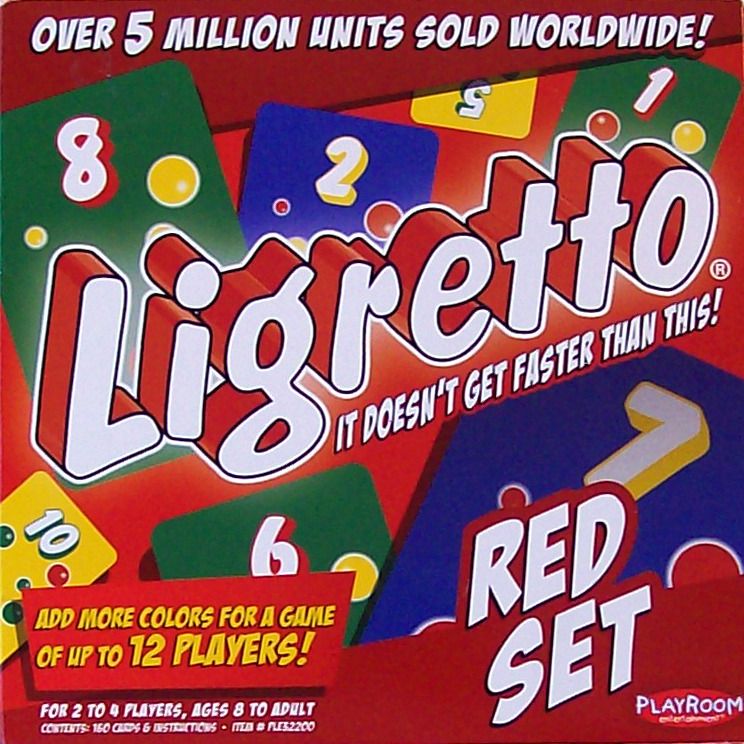
Ligretto is available in Red, Blue, and Green variants. Each variant contains a complete color-coded set of cards. When playing multiplayer, each player uses a distinct color set so cards can be identified by owner at the end of a round.

Endgame

A round ends immediately when any player empties their Ligretto pile and calls 'Stop!'

As soon as one player plays the last card from their Ligretto pile, they call 'Stop!' and all play ceases immediately. No further cards may be played after this call. Scoring then takes place for that round.

Scoring

Players score +2 for each card played to the center piles, and -1 for each card remaining in their Ligretto pile.

At the end of each round, each player counts the cards of their color in the shared center piles — they score +2 points per card played there. They then subtract 1 point for each card still remaining in their Ligretto pile. A player's round score can be negative if few cards were played to the center.

Endgame

The game ends when a player reaches or exceeds the target score (typically 99 points); the player with the highest score wins.

After each round is scored, cumulative scores are tallied. The game continues over multiple rounds until at least one player reaches or exceeds the agreed target score (commonly 99 points). The player with the highest cumulative score at that point wins the game.

Card play

Cards are played to the center in ascending numerical sequence starting from 1, all of the same color.

The shared center piles are built in ascending numerical order. A new pile can only be started with a '1' card. Subsequent cards must be the next number in sequence on any existing center pile. Any player may play onto any center pile at any time during real-time play.

Strategy briefing

Prioritize the Ligretto pile

Emptying your Ligretto pile is the only way to end the round AND avoids the -1 per remaining card penalty. Always prioritize playing cards from your Ligretto pile over your row or deck.

Manage your row aggressively

Keeping your row full maximizes the number of playable options visible at any time. Quickly refilling empty row spaces from your hand gives you more chances to find a card that fits a center pile.

Start center piles early

Playing a '1' card to start a new center pile opens a new sequence that everyone can contribute to, increasing your own opportunities while forcing opponents to react to a crowded center.

Cycle your deck quickly

Cards in your draw deck score nothing unless played. Keep cycling through your deck rapidly to surface playable cards before opponents close out center piles.

Know when to scale up player count

Adding more sets increases competition for center pile spots dramatically. With 8–12 players, the center fills faster and the race to empty the Ligretto pile becomes more intense — speed becomes even more critical.

Common questions and edge cases

Two players try to place a card on the same center pile at the exact same moment — whose card counts?

The card that is physically placed on the pile first is the valid play. The other card must be taken back. Because the game is real time with no adjudication mechanism, players must resolve this by sight — the bottom card stays, and the top (later) card is returned to its owner.

Can a player end a round with a negative score?

Yes. If a player plays very few cards to the center (e.g., 2 cards = +4 points) but still has many cards left in their Ligretto pile (e.g., 8 cards = -8 points), their round score would be -4. Cumulative scores can go negative.

A player calls 'Stop!' — can other players finish placing a card they already started?

No. All play must cease immediately when 'Stop!' is called. Cards already in motion that have not yet been placed on a pile are returned to the player and count as remaining in hand or the Ligretto pile.

When must a player refill an empty spot in their row?

A player should refill empty row spaces as soon as possible during real-time play — there is no forced timing, but since the row is the primary playing field, delaying refills is a disadvantage. Cards are drawn from the player's hand deck to refill.

How many sets are needed for a specific player count?

One box supports up to 4 players. Two different-colored boxes combined support up to 8 players. All three boxes (Red, Blue, Green) combined support up to 12 players. Each player always uses exactly one color set.

Ask About This Game

Similar games