2007 BGG rank #12960

Make 'n' Break: Extreme

2–4 players 30 min Ages 8+ 1.1/5 complexity 5.5/10 rating

About this game

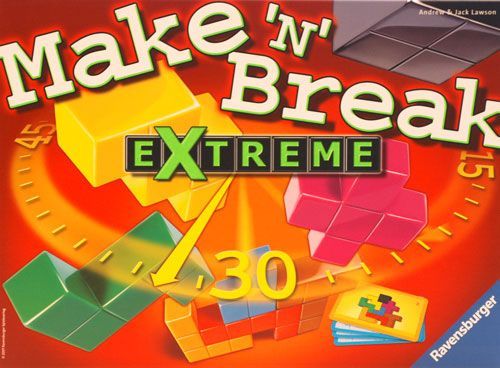
Players race against the clock to copy building plans of various difficulties, each one revealed in turn from a deck of cards. Each completed card is worth a number of points, with harder builds being worth more points. If you spot an error in an opponent's build, call it, and they lose those points. After three rounds, the player with the most points is the champion builder. Features 10 new and different shapes from the original Make 'N' Break, leading to new and more challenging tasks to complete.

What it feels like

Real-Time Stacking and Balancing Action / Dexterity Card Game

Game intelligence

Learn the game

100% knowledge coverage

Setup

1. Before the first game, carefully remove the tiles from the board. 2. Place all 10 construction blocks, the die, and the shuffled deck of 80 construction cards face-down in the centre of the table. 3. Place the chips (values 1 and 10) in a communal supply accessible to all players. 4. Determine the youngest player — they will take the first turn. 5. The timer starts with the player to the right of the first builder.

Turn flow

Players take turns clockwise. On each turn: 1. The active player (the builder) takes the 10 building blocks and the deck of building cards and places them in front of them. 2. The builder rolls the die. The player to their right presses the timer's red STOP key, turns the dial to the number rolled, and waits. 3. The builder says "Start", the player to the right immediately presses the green START button, and the builder begins. 4. The builder flips the top card and builds the structure shown as quickly and accurately as possible. 5. Once a structure is correctly and solidly built, the builder destroys it ("Break") and flips the next card to build again. 6. Other players watch and call out any errors; the builder must correct mistakes before moving on. 7. When time expires, the turn ends. The builder scores points only for fully completed builds. 8. Completed and unsolved cards go to the discard pile. The die, blocks, deck, and timer pass clockwise to the next player.

Scoring and victory

The player with the most accumulated point chips after five rounds wins. Ties are resolved by a sudden-death bonus round. Scoring sources: Points printed on completed standard construction cards, 2 points each for both players on a completed '4 left-arrow' Extreme card, 5 bonus points for successfully completing the '10' Extreme card challenge

Source: Rulebook

Rules to know

The most useful rules for getting a first game right.

Turn structure

The youngest player goes first; play proceeds clockwise.

The youngest player takes the first turn as builder. After each turn, all items (die, blocks, deck, timer) pass to the next player in clockwise order.

Turn structure

The player to the right of the builder sets and starts the timer based on the die roll.

Before each build phase, the builder rolls the die. The player sitting to the right of the builder presses the red STOP key on the timer, turns the dial to the number shown on the die, and waits. When the builder says 'Start', that player immediately presses the green START button to begin the countdown. Always press the red STOP key before setting the timer for a new turn.

Turn structure

The builder flips cards one at a time and builds each structure before moving to the next.

The builder reveals the top card of the deck and immediately begins constructing the structure shown. Once a structure is correctly and solidly built, the builder must destroy it ('Break') before flipping the next card and starting a new build. The builder may keep flipping and building new cards until the timer runs out. Only fully completed builds are scored.

Restriction

Structures must be built exactly as shown on the card, including block colours and positions.

For standard coloured construction cards, the builder must replicate the structure exactly as depicted — all coloured blocks must be in the correct positions. Other players monitor the builder and indicate any errors. The builder must correct all errors within the allotted time and before revealing the next card.

Restriction

A structure must be solidly built before it can be destroyed and the next card revealed.

A completed structure must be stable and not collapsing before the builder may destroy ('Break') it and proceed to the next card. A structure that collapses does not count as a completed build.

Scoring

Incomplete builds do not count toward scoring.

When the timer expires, the builder's turn ends immediately. Any structure that was not fully and correctly completed at the moment time ran out does not earn points. Only cards the builder placed face-up as completed builds are scored.

Scoring

The builder scores points equal to the total on their completed build cards and takes that many chips.

After time expires, the builder totals the point values printed on all their face-up completed build cards. They receive that many points in chips from the communal supply (chips are valued at 1 and 10). Completed and unsolved cards are then placed face-up in the discard pile.

General

When the draw deck runs out, shuffle the discard pile to form a new deck.

Completed build cards and unsolved cards are placed face-up in the discard pile after each turn. When the draw deck is empty, shuffle all discarded cards together to form a new draw deck.

Strategy briefing

Prioritise easy cards over hard ones

Since incomplete builds score nothing, it is better to quickly complete several simpler structures than to spend most of your time struggling with one complex card. Abandoned cards still go to the discard pile without scoring.

Exploit high die rolls

A high die roll gives significantly more time. When the timer is set to a high number, attempt more ambitious or point-heavy cards, including Extreme cards, which you might otherwise skip. On low rolls, focus on the fastest possible builds.

Set up the '10' card early

When the '10' card is revealed, it is set aside and normal building continues. This means revealing it early in your turn is ideal — you still use the full original timer for regular builds, and then get an entire extra timer-1 turn for 5 bonus points.

Use the No-Dice variant to favour skilled players

In the standard game, a low die roll heavily penalises a player regardless of skill. The No-Dice variant removes this luck factor — but also removes the '10' bonus cards. Skilled, fast builders should prefer this variant for a fairer competition.

Practise the two-blocks-on-table constraint

All Extreme cards share the restriction that at most two blocks may touch the table. This structural constraint requires building upward or using creative bridging, which is harder under time pressure. Familiarity with stable tall configurations is key to scoring Extreme card points.

Coordinate on the '4 arrow' card for mutual points

The '4 with left arrow' card awards 2 points to BOTH the builder and the left-side player if completed in time. This is the only card that scores for someone other than the builder, so the left-side player has strong incentive to build quickly and accurately.

Common questions and edge cases

The builder reveals the '10' card mid-turn. When exactly does the bonus extra turn happen, and does it affect the rest of the normal build phase?

The '10' card is immediately set aside when revealed and does NOT interrupt the current turn. The builder continues flipping and building other cards normally until the original timer expires. Only after the original time runs out is the timer reset to '1' for the bonus turn. The bonus turn is entirely separate from the normal scoring turn.

On the '4 with left arrow' card, does the builder also receive points even though they don't do the building?

Yes. If the left-side player successfully completes the structure within the remaining time, BOTH the builder and the left-side player receive the 2 points shown on the card. The builder earns those points despite not building the structure themselves.

After the left-side player completes the '4 with left arrow' structure, what happens if time hasn't run out yet?

If time has not expired after the left-side player completes the structure, the builder continues their turn normally — flipping new cards and building until the timer runs out.

Can the builder flip the next card before correcting an error pointed out by other players?

No. The builder must correct any identified error within the allotted time BEFORE revealing the next card and starting a new build. Uncorrected errors mean the current card does not count as a completed build.

What happens to the '10' card in the No-Dice variant?

In the No-Dice variant, both '10' cards are removed from the game entirely before play begins and are never used.

A builder finishes a structure, it is marked as complete, but it then collapses before time runs out. Does it still score?

No. The solidity requirement means a structure must be stable and not collapsing. A structure that collapses does not count as a completed build and does not score points.

On the red hand card, do both the one-hand restriction AND the two-blocks-on-table restriction apply simultaneously?

Yes. Both restrictions apply at the same time on the red hand card: the builder may only use one hand (the other must remain under the table), AND no more than two blocks may be touching the table surface.

Ask About This Game

Similar games