2014 BGG rank #4351

Myth

2–5 players 120 min Ages 12+ 3.9/5 complexity 5.8/10 rating

About this game

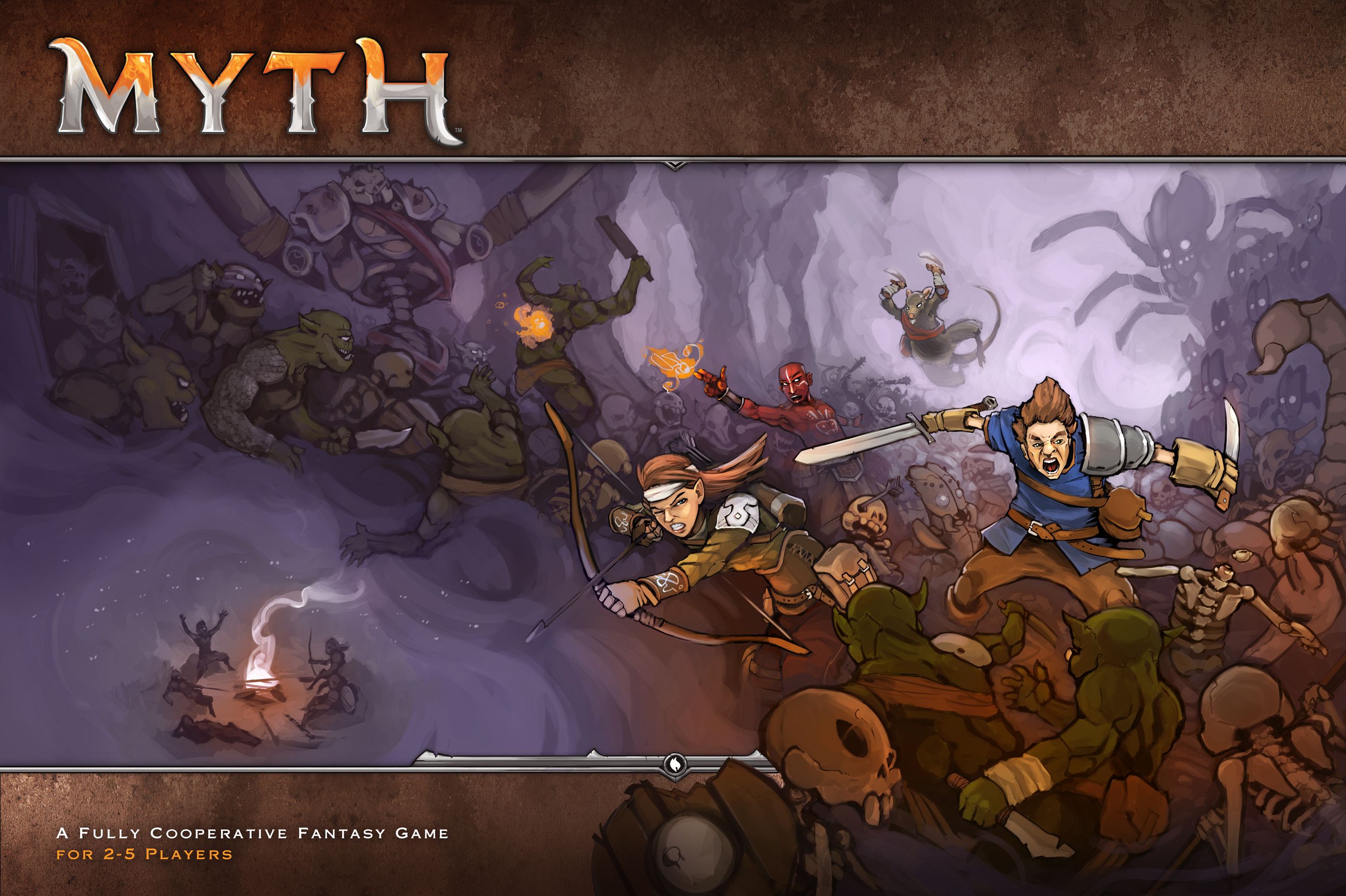
Myth is a fully co-operative fantasy game. Players take on the role of one of 5 different heroes working together to defeat the Darkness. Each hero has a different skill set which represented by a unique deck of cards. Players spend Action Points by using cards. Once a certain amount of Action Points have been spent the Darkness fights back by activating monster lairs, spawning monster captains and eventually the Boss. A complete game in Myth is called a Story. Each Story is played over three Acts. Acts can be played sequentially, or can be split up over three different game sessions. Players' avatars within a Story are called Heroes. Myth Heroes are clothed in immense power, able to reave all but the mightiest foes. However, this power must be balanced lest the Darkness take too much notice. Players must weigh their actions against the Threat each will bring, with the consequences of awakening more evil and bringing doom on the party's endeavors. And be careful they must, as the Darkness is formidable and eager to snatch glory from the valiant. Heroes are controlled through an intuitive Hero Deck (videos for each Hero can be found in the Game Play Videos section below). Each deck plays uniquely and allows players more freedom of action and the ability to truly impact the Story each and every Act. Yet, cooperation is the key to victory and bloody fortune. Players must communicate, interact, and assist each other or surely the Darkness will cover all. Myth is a fully cooperative game. There is no player controlling the Darkness. The Darkness is governed by a set of rules unique to each Boss Deck and is activated through Hero actions. If the Heroes get overzealous, then the Darkness pushes back by activating Lairs, spawning Captains, and punishing the Heroes with devious Events. If the Heroes take a more subtle approach, then the Darkness reacts by reducing the potential for treasure and rewards. Without the treasures and equipment to upgrade, the Heroes will find each Act more difficult and eventually fail. The dynamic nature of the Darkness really lends a more fluid feel to the Story. Players aren't being driven by properties out of their control, nor are they being shepherded by a person whose skill has a direct impact on the enjoyment of the game. Myth is a fun fantasy romp where players feel truly heroic. In the playing of the game, the players are creating their own mythos. These stories are the ones carried away from the table, becoming myths themselves. And these are the myths, with friends and family, that we carry with us; telling and retelling our endeavors at the mead benches, earning treasured smiles and laughter.

What it feels like

Cooperative Game Variable Player Powers Grid Movement Dice Rolling Hand Management Variable Phase Order Fantasy Adventure Miniatures

Explore these mechanics in Cardboard

Start an original prototype from reusable design patterns—not this game's content.

Open mechanics workbench

Game intelligence

Learn the game

80% knowledge coverage

Setup

1. Draw a challenge card at the start of each new adventure mode session or module act. 2. Each hero chooses one of the two challenges listed on their drawn challenge card to pursue during the session. 3. Sleeve challenge cards and use a dry-erase pen to track checkbox progress. 4. Apply any earned stickers to hero cards before beginning play, respecting all sticker placement restrictions.

Turn flow

Heroes take turns playing cards from their hand and spending Action Points (AP) to perform actions. Cards have AP costs and various keywords (Dash, Rage, Faith, etc.) that define their effects. Some cards are Actions, some are Reactions, and some are dual Action/Reactions, each usable at different times. Heroes earn upgrade points between sessions by completing challenges drawn at the start of each session or act.

Scoring and victory

false

Source: Rulebook

Rules to know

The most useful rules for getting a first game right.

Special

Hero card stickers modify hero cards to provide additional hero progression bonuses.

Hero card stickers are physical stickers applied directly to hero cards that grant bonuses or change card attributes. Examples include +1 to a stat or reducing the AP cost of a card by 1. It is recommended to print the provided sticker sheet on self-adhesive paper and use a 3/8 inch (0.95cm) motive circle puncher to create the stickers.

Special

Hero card stickers are earned by completing challenges, not found or bought from merchants.

Hero Card Modifications (stickers) cannot be found during play or purchased from merchants. Instead, each hero must overcome challenges to earn upgrade points, which are then spent to gain stickers. Challenges are initiated by drawing a random challenge card at the start of a new adventure mode session or module act.

Special

Each challenge card lists two challenges; the hero must choose one to pursue.

Each challenge card presents two distinct challenges, each with a name, description, upgrade point reward, and checkboxes to track progress. The hero must decide which of the two challenges to undertake. It is recommended to sleeve challenge cards and use a dry-erase pen to mark the checkboxes. Once a hero fully completes their chosen challenge, they earn either 1 or 2 upgrade points.

Resource management

Upgrade points can be accumulated over time but cannot be traded between heroes.

Upgrade points earned from completing challenges can be saved and accumulated across sessions. However, upgrade points are strictly personal to each hero and cannot be transferred or traded to other heroes under any circumstances.

Restriction

Each hero card can only have one sticker of each type.

A single hero card may not have more than one sticker of any given type applied to it. For example, only a single +1 Strength sticker and only a single +1 Agility sticker may appear on the same hero card.

Restriction

+1 Strength and +1 Agility stickers must be placed in a movement section unless the card text section lists that bonus.

The +1 Strength and +1 Agility stickers must be added to one of the movement sections of the hero card. The only exception is if the card already lists that bonus in its text section, in which case the sticker may be applied to the text section instead.

Restriction

Certain stickers can only be applied if the hero card already has the corresponding keyword or bonus.

The following stickers can only be added to a hero card if that card already has the given keyword or bonus printed on it: +1 Damage, +1 Faith, +1 Dash, +1 Rage, -1 Threat, -1 TN, and +1 Range. For example, a +1 Dash sticker can only be applied to a card that already has the 'Dash' keyword.

Restriction

Stickers can be removed from hero cards, but the spent upgrade points are lost; the sticker becomes earnable again.

Once a sticker has been applied to a hero card, it may be physically removed. However, the upgrade points that were spent to gain that sticker are permanently lost — they are not refunded. On the positive side, the sticker slot becomes available again, meaning the hero can earn and re-apply that sticker type in the future.

Strategy briefing

Prioritizing Challenge Selection

Since each challenge card offers two options with different upgrade point rewards (1 or 2 points), prioritize the two-point challenge if it aligns with your hero's card roster. Because upgrade points cannot be traded between heroes, each hero must self-sufficiently earn what they need.

Sticker Prerequisite Planning

Before spending upgrade points on stickers like +1 Damage, +1 Dash, or +1 Range, verify that the target hero card already has the required keyword. Spending points on a sticker you cannot legally apply is effectively wasted, and removal does not refund points.

AP Reduction as High Value

The -1 AP sticker can only be gained once and directly reduces the action cost of a hero card, allowing more actions per turn. This is likely one of the highest-value stickers for high-cost, frequently used cards.

Card Type Stickers for Flexibility

The stickers that change a card's type (Reaction to Action/Reaction, or Action to Reaction) each can only be gained once, making them rare and impactful. Changing a powerful Action to a Reaction or giving a Reaction dual Action use can dramatically alter a hero's playstyle.

Careful Sticker Removal Consideration

Since removing a sticker causes permanent loss of the upgrade points spent on it, players should be certain of their choices before applying stickers. The ability to re-earn a sticker after removal softens this, but the point cost makes it a significant setback.

Common questions and edge cases

Can I apply a +1 Dash sticker to a card that has Dash but already has another sticker on it?

Yes, as long as the existing sticker on the card is not also a +1 Dash sticker. The one-sticker-per-type-per-card rule only prevents two stickers of the same type on one card. As long as the card has the Dash keyword (prerequisite met) and does not already have a +1 Dash sticker (limit not exceeded), the sticker may be applied.

If I remove a sticker from a hero card, can I earn and reapply that same sticker type?

Yes. Removing a sticker makes that sticker type available to earn again. However, the upgrade points originally spent to gain the removed sticker are permanently lost and are not refunded.

Can one hero give their unused upgrade points to another hero who needs them for a sticker?

No. Upgrade points are personal to each hero and cannot be traded or transferred to another hero under any circumstances.

When exactly is a challenge card drawn?

A challenge card is drawn when starting a new adventure mode session or at the beginning of a module act. It is not drawn mid-session.

Can I place a +1 Strength or +1 Agility sticker in the text section of a hero card?

Only if the card already lists that specific bonus in its text section. Otherwise, these stickers must be placed in one of the movement sections of the hero card.

Ask About This Game

Similar games