2004 Puesto n.º 9587 en BGG

Naval Battles: World War II on the High Seas

2–6 jugadores 30 min A partir de 10 años 1.9/5 de complejidad 5.6/10 de valoración

Acerca de este juego

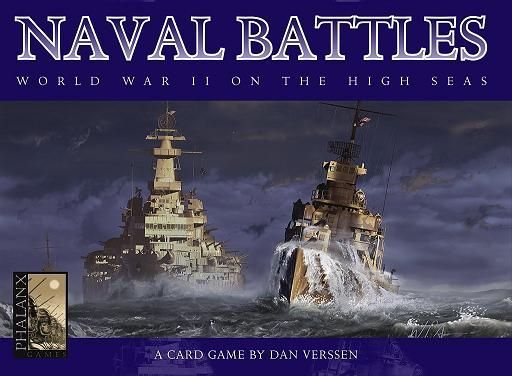
As can be read on the Phalanx Games site: Naval Battles: The World War II naval combat cardgame by Dan Verssen (2-6 players, 30 minutes playing time) is a fast and furious game of naval combat in World War II. Each player commands a fleet of World War II ships. His goal is to launch attacks from his ships and sink the ships of the opposing players. The game includes surface vessels and submarines of six different nations – France, Germany, Great Britain, Italy, Japan, and the United States. Naval Battles contains two types of cards: 102 Action cards and 78 Ship cards. At the start of the game a player chooses a fleet of ship cards. These ship cards are used to launch attacks. In addition, a player receives action cards to play out of his hand.

Qué sensaciones ofrece

Campaign / Battle Card Driven Wargame Card Game World War II

Inteligencia del juego

Aprende el juego

100% de cobertura de conocimiento

Preparación

1. Each player assembles a fleet from their reserve of ships, organized into up to 3 rows plus a submarine position.\n2. Place ships in their legal rows: 1st row (ships with secondary batteries and torpedo mounts), 2nd row (ships with main batteries), 3rd row (aircraft carriers). Submarines are designated as either Active (red) or Passive (blue).\n3. Shuffle the action card deck. Each player draws 7 cards.\n4. Determine a first player. Play proceeds in turns following the Sequence of Play.

Flujo del turno

Each turn follows five steps in order:\n\n1. REORGANIZE STEP: Discard any Retreat and Prepare cards remaining from the prior turn. Rearrange ships within their legal rows. Play Reorganize-step cards (e.g., Reinforcement to add ships, Retreat to remove damage and skip attacks).\n\n2. PREPARE STEP: Play Prepare-step cards face-up in front of your fleet (e.g., Planning for +1 to die rolls, Near Miss to block a Main Salvo, Armor Plating to block a Secondary Salvo, Escort Ship to redirect attacks).\n\n3. ATTACK STEP: Declare ALL attacks against all defenders before resolving any. Each weapon may only attack once per turn. Don't forget aircraft carrier attacks. Defenders may play Defense cards in response. Then resolve all attacks with die rolls and determine damage. Collect any sunk ships (worth Victory Points).\n\n4. DISCARD STEP: Optionally discard any cards from your hand face-up to the discard pile.\n\n5. DRAW STEP: Draw back up to 7 cards in hand.

Puntuación y victoria

The first player to accumulate 25 or more Victory Points from sunk enemy ships wins immediately. Puntuación objetivo: 25 Fuentes de puntuación: Sinking enemy ships — each sunk ship is worth its Victory Point value

Fuente: Rulebook

Reglas que debes conocer

Las reglas más útiles para jugar bien la primera partida.

Setup

Ships must be placed in specific rows based on their weapon systems.

Fleets are organized into up to 3 rows plus a submarine area. 1st row: ships with secondary batteries and/or torpedo mounts. 2nd row: ships with main batteries. 3rd row: aircraft carriers. Submarines are placed separately and designated as either Active (red) or Passive (blue). Ships may be rearranged during the Reorganize Step each turn.

Turn structure

At the start of each turn, discard expired cards, rearrange ships, and play Reorganize cards.

The Reorganize Step is the first step of each turn. Players must: (1) Discard any Retreat and Prepare cards that were played in the prior turn. (2) Rearrange ships among their legal rows (1st, 2nd, 3rd, and submarine positions). (3) Optionally play Reorganize-step action cards such as Reinforcement or Retreat.

Turn structure

Players play Prepare cards face-up in front of their fleet before attacks are declared.

The Prepare Step is the second step of each turn. Players may play any number of Prepare-step action cards face-up in front of their fleet. These cards remain in play for one full round (until the next Reorganize Step). Legal Prepare cards include: Planning (+1 to die rolls), Near Miss (block a Main Salvo), Armor Plating (block a Secondary Salvo), and Escort Ship (redirect an attack to another ship in the same row).

Turn structure

Players declare all attacks first, then defenders respond, then all attacks are resolved.

The Attack Step is the third step of each turn. The active player must first DECLARE all attacks (specifying all targets for all weapons). Each weapon may only attack once per turn. Aircraft carrier attacks must also be declared at this time. After all attacks are declared, the defending player(s) may play Defense-step cards in response. Then all attacks are resolved via die rolls, damage is applied, and any sunk ships are collected for Victory Points.

Restriction

All attacks must be declared before any are resolved.

During the Attack Step, the attacking player must declare ALL attacks against ALL defenders before resolving any single attack. This means placing dice on all intended targets showing the relevant to-hit numbers prior to rolling. This prevents players from adjusting later attacks based on earlier results.

Restriction

Each individual weapon on a ship may only be used to attack once per turn.

During the Attack Step, each weapon (secondary battery, torpedo mount, main battery, etc.) on each ship may only be used to make one attack per turn. A single ship cannot fire the same weapon system twice in one turn.

Turn structure

Players may optionally discard any cards from hand face-up to the discard pile.

The Discard Step is the fourth step of each turn. The active player may discard any number of cards from their hand face-up onto the discard pile. This step is optional.

Turn structure

Players draw back up to a hand of 7 cards at the end of their turn.

The Draw Step is the final step of each turn. The active player draws cards from the deck until they have 7 cards in hand.

Informe estratégico

Declare Attacks Strategically

Since all attacks must be declared before any are resolved, experienced players place dice on lower-priority targets last so that if a primary target is sunk early (due to prior damage), they aren't locked into redundant attacks. Plan your declaration order carefully.

Time Your Retreat Wisely

Retreat removes 3 damage cards and grants full immunity from attack, but costs you your entire Attack Step. Use it when your fleet is badly damaged AND when the VP race means a turn without attacking is worth the recovery. Beware Surprise Attack stripping the card away.

Layer Defenses in Prepare Step

Pre-placing Near Miss, Armor Plating, and Escort cards during the Prepare Step gives you wider coverage than saving them for reactive Defense plays, since pre-placed cards block one attack from EACH opponent, not just one total. Stack multiple types for robust defense.

Use Surprise Attack to Break Defensive Walls

An opponent who has stacked Retreat, Planning, Near Miss, and Armor Plating cards is very hard to damage. A single Surprise Attack wipes all of those cards in one action, leaving them completely exposed. Save Surprise Attack for the most fortified opponents.

Aircraft Carriers as Reliable Attackers

Carriers attack once per turn without consuming a card, which is a highly efficient free action. Protecting your carriers in the 3rd row means they contribute damage every turn. Losing your carrier not only costs VP to the opponent but eliminates this free attack source.

Submarine Positioning: Active vs. Passive

Active (red) submarines are offensive powerhouses — they can use Torpedo Spread to hit all 3 enemy rows. Passive (blue) submarines sacrifice offense for survivability via the Run Silent roll. Use Planning (+1 to Run Silent rolls) to improve a passive sub's evasion chance.

Evasive Action as an Emergency Wildcard

Evasive Action stops any one attack of any type with no restrictions — it is the only defense that works against every attack in the game. Hold these cards for critical situations where type-specific defenses won't work (e.g., stopping a carrier attack when you have no air cover).

Preguntas frecuentes y casos límite

A player has played a Retreat card and believes they are safe. Can they be hit by a Surprise Attack?

Yes. Surprise Attack forces the targeted player to discard ALL Reorganize and Prepare cards in play — explicitly including the Retreat card. Once the Retreat card is discarded, its protection (immunity to attack and attack step skip) is removed. However, since Surprise Attack is played during the Attack Step, the attacking player's attacks for this turn have already been declared. The Retreat card's protection is lost for future attacks in that same step and onward.

Can a player use their Planning card to boost the Air Cover die roll or the Passive Sub's Run Silent roll?

Yes. Planning grants +1 to one die roll during each other player's turn as well. Air Cover rolls and Run Silent rolls are die rolls made during the opponent's turn, so a player with an active Planning card may declare its use before those rolls to add +1.

Can an aircraft carrier use its once-per-turn attack to target a submarine?

No. Aircraft carrier attacks follow LBA rules except that they explicitly cannot attack submarines. Only Depth Charge cards (played with torpedo-mount ships from the 1st row) can target submarines.

Can a single ship fire a Double Secondary Salvo card alone?

No. Double Secondary Salvo cards (4–5 inch double and 6–8 inch double) must be fired by 2 different ships acting together. A single ship cannot use a Double Secondary Salvo card by itself.

Can a Near Miss card stop a Land-Based Air attack or a carrier air attack?

No. Near Miss only stops Main Salvo attacks (whether pre-placed or played reactively from hand). Air attacks from LBA cards or aircraft carriers must be countered using Air Cover (if carriers are present) or Evasive Action cards.

An active (red) submarine fires a Torpedo Spread. Which enemy rows can it target?

An active submarine using Torpedo Spread can attack all 3 enemy rows (1st, 2nd, and 3rd row ships). However, it cannot attack other submarines with Torpedo Spread.

Can the Escort card redirect an attack to a ship in a different row than the original target?

No. The Escort card (whether pre-placed or played reactively) can only redirect an attack to another ship in the SAME ROW as the original target. It cannot redirect an attack to a different row.

A ship has taken damage and its current hull is reduced to 4 or less. Can Small Target be used to protect it?

No. Small Target requires the ship's UNDAMAGED Hull Value to be 4 or less. If the ship's base (undamaged) Hull Value exceeds 4, Small Target cannot protect it regardless of current damage state.

Can a player use more than one Planning card on the same die roll?

Yes. Multiple Planning cards can be applied to a single die roll, each contributing +1. Each use must be declared before the roll is made.

A player plays a Reinforcement card worth 7 VP but only adds ships worth 5 VP. What happens to the remaining 2 VP?

The unused 2 Victory Points are lost. Unused points from Reinforcement cards cannot be saved or carried over.

Pregunta Sobre Este Juego

Juegos similares