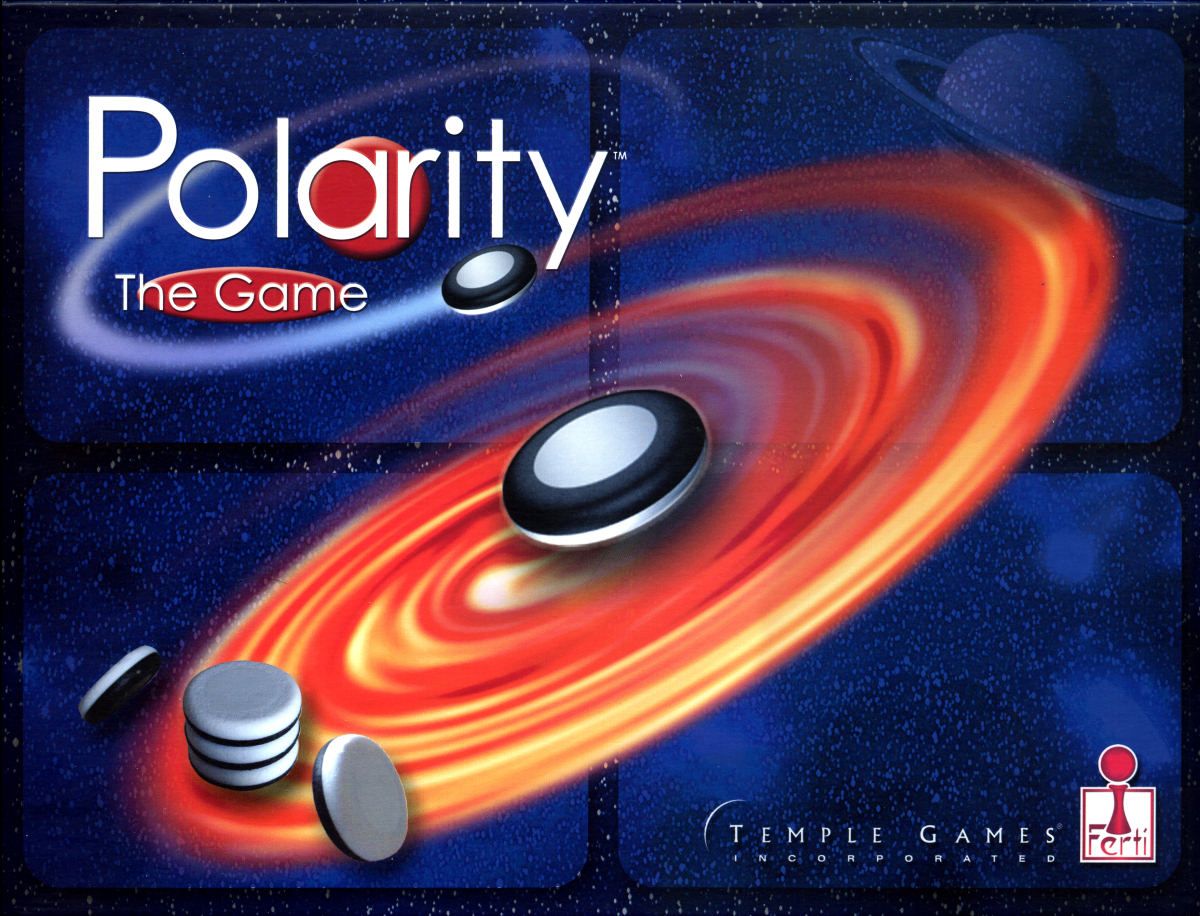
1986 BGG rank #4412

Polarity

2–4 players 20 min Ages 8+ 1.7/5 complexity 5.8/10 rating

About this game

Once rare and mysterious, now thankfully back in print, Polarity is a 2-player game using lots of magnets (so keep it away from credit cards, watches and so on). The plastic coated pieces look like Reversi/Othello discs, with black and white faces. Each piece contains a magnet, with the black side being North and the white side being South. Each player gets a stack, one plays black one plays white. A neutral red piece goes in the center of the game cloth and players start by place five each of their stack around the cloth. These flat pieces are the foundations. On your turn, you take one piece from your stack into your hand, then bring it to bear against one of your foundations. You keep your color face up, so the opposing polarity bears against your foundation piece. This way, you can very carefully balance your new piece in the air against the foundation stone! This is just fantastic to see. The board fills up with lots of discs teetering at 45 degrees, ready to fly about if the balances are upset. Get it right and your stack is one piece smaller. Make a mistake and your turn ends. Either a piece falls flat somewhere (becoming a new foundation) or pieces jump together making towers or into your hand. Your opponent takes the tower you accidentally made and places it their side up where they like. Towers get you points at the game end. If a piece jumps to the stone in your hand, they both go back on your stack. The game ends when one player finishes their stack and points are calculated based upon towers and discs remaining. Causing the red piece to jump to another loses you the game outright. To be honest, the scoring matters less than the tension and joy of watching the natural but weird force of magnetism at play. Because the discs are discs, they can easily roll around, causing domino effects. Because the towers increase the magnetic pull, they make it so much harder to find a safe spot to play. If you want a strange fun game to amaze your friends and family, Polarity is hard to beat. If you want a serious 2-player game, you may prefer other abstracts. The rules could do with being shorter and simpler. Otherwise, a joyous game. Comment from the designer "Polarity began as a sculpture. Polarity is zen. It represents that point where absolute opposites merge. In this case, the poles of the magnetic field. The quality of play is determined by one's ability to perceive balance in the midst of extremes. Each game is unique and can never be reproduced. It is in that uniqueness that I was awarded a patent from the U.S. Pat. & Trdmks. office for magnetic principle. The strategy must be viewed 3-dimensionally. It is not just control of a 2-dimensional board but must include the space above and below the playing surface."

What it feels like

Stacking and Balancing Abstract Strategy Action / Dexterity

Game intelligence

Learn the game

100% knowledge coverage

Setup

1. Lay the canvas play mat on a sturdy, level surface. Avoid surfaces with metal in or around them. 2. Set aside the red disc. Divide the 52 black and white discs evenly into two stacks of 26 — one stack per player. 3. One player takes the red disc and flips it in the air like a coin. The other player calls "bar" or "dot" while it is in the air. The winner of the flip chooses whether to play White (goes first) or Black (goes second). 4. Place the red disc on the dot in the middle of the play mat, with the result of the flip showing. 5. Starting with White, each player places their 5 Foundation Discs on the play mat with their color showing. Discs may be placed anywhere inside the circle as long as they do not touch any other disc, including the red disc. Black then does the same. Once all 10 Foundation Discs are placed, the game begins.

Turn flow

Starting with White and alternating turns, each player draws one disc from their stack — called the Action Disc — and attempts to place it on the play mat as a Leaner. The Action Disc must always be played with the player's color facing upward and can only be played on the player's own discs (Foundation Discs or Towers). The player may take as much time as needed and retry if the Action Disc simply falls flat with no reaction. However, if the Action Disc causes any other discs to react (a Fault), the turn immediately ends. Before making a normal turn, if any discs are connected together due to a previous Fault (excluding already-captured Towers), the active player must first attempt to capture them. Only after resolving any capture does the player proceed with placing their Action Disc as a Leaner.

Scoring and victory

The player with the highest score wins. Score = (number of discs in your Towers) minus (number of discs remaining in your unplayed stack). Foundation Discs and Leaners on the mat do not count toward scoring. A player can also win immediately if the opponent triggers a sudden-death loss condition. Scoring sources: Discs captured into Towers (1 point per disc), Penalty: subtract discs remaining in unplayed stack

Source: Rulebook

Rules to know

The most useful rules for getting a first game right.

Setup

Each player places 5 Foundation Discs on the mat before the game begins.

After the red disc is placed on the center dot and colors are determined, White places 5 discs from his or her stack on the play mat with the white side showing. These discs may be placed anywhere inside the circle, as long as they do not touch any other disc (including the red disc). Once White is done, Black does the same with the black side showing. After all 10 Foundation Discs are placed, the game begins.

Setup

The red disc is placed on the center dot of the play mat with the coin-flip result showing.

One player flips the red disc like a coin; the other calls 'bar' or 'dot.' The winner chooses to play White (first) or Black (second). The red disc is then placed on the center dot of the play mat with the result of the flip showing. It remains there throughout the game as a hazard landmark.

Turn structure

On your turn, take one disc from your stack (the Action Disc) and place it as a Leaner on the mat.

Starting with White and alternating, each player takes one disc from his or her stack — called the Action Disc — and places it on the play mat. The Action Disc must always be played with the player's own color facing upward. It can only be played on (i.e., float off of) that player's own discs. A player may not simply lay the Action Disc flat on the mat; it must be placed as a Leaner, floating on a magnetic cushion.

Turn structure

A Leaner is a disc that floats on the magnetic cushion of a Foundation Disc or Tower.

To place a Leaner, hold the Action Disc with your color facing upward at about a 45-degree angle. Slowly move it toward one of your own Foundation Discs or Towers, feeling for the magnetic cushion between the discs. The Leaner will hover and rest on this cushion. You may take as much time as needed. If the Action Disc simply falls flat with no reaction from other discs, you may pick it up and try again. If any other discs react (a Fault), your turn immediately ends.

General

Towers are stacks of two or more discs that score points at end of game.

Towers consist of two or more discs stacked on top of each other. They are created as a result of captured Faults. Towers score points at the end of the game — each disc in a Tower counts as one point for its controller. Once Towers are in play, a player may use them just like a single Foundation Disc and play Leaners off of them.

Special

A Fault occurs when placing the Action Disc causes other discs to react; your turn immediately ends.

If, while trying to place the Action Disc, you cause other discs to react in any way, you have created a Fault and your turn immediately ends. Reactions that constitute a Fault include: (1) causing two or more discs that were not touching to touch each other; (2) making an already-placed Leaner fall and lay flat on the play mat; (3) having a disc on the play mat snap up onto the Action Disc; (4) making a Foundation Disc or Tower move more than its own diameter; (5) making a disc in play move entirely outside the circle (out of bounds). Any Faults that occur before your opponent brings his or her hand into the circle count against you.

Special

Leaners that fall flat due to a Fault are left where they land unless flipped to the opponent's color.

If a Fault causes Leaners to fall to the play mat and those discs are not touching other discs, they are left where they landed. However, if an opponent's Leaner is flipped over during the Fault so that your color is now showing upward, the opponent gets to capture that disc.

Special

Discs that snap onto the Action Disc (still in hand) during a Fault are returned to the faulting player's unplayed stack.

If a Fault causes discs to snap together onto the Action Disc that is still in the player's hand, the faulting player adds those discs (including the Action Disc) to his or her own unplayed stack. The turn then ends.

Strategy briefing

Conversions Are Key to Expansion

Deliberately converting Leaners into Foundation Discs is the primary way to expand your playable area. Although a Conversion ends your turn (as it is technically a Fault), each new Foundation Disc gives you another platform to float future Leaners from, compounding your placement options over the game.

Force Opponent Faults Near the Center

Positioning your discs near the red center disc is a high-risk, high-reward strategy. Any disc that touches the red disc causes an immediate loss for the player who caused it. Placing discs close to the red disc can pressure opponents into causing this instant-loss condition while trying to navigate around your pieces.

Manage Your Unplayed Stack to Maximize Final Score

The scoring formula subtracts remaining unplayed discs from your Tower count. Even a large Tower score can be wiped out by having many discs left in hand. Prioritize getting all your discs into play — either as Foundation Discs, Leaners, or captured into Towers — to minimize end-of-game penalties.

Strategic Fault Creation to Deny Opponent Captures

When discs snap together on the play mat during a Fault, the opponent captures them. However, discs that snap onto the Action Disc still in your hand return to your own stack — not the opponent's. You can sometimes use this to your advantage by positioning your hand to intercept potential snapping discs and recover them rather than surrendering them as opponent Towers.

Deny the Opponent Leaner Targets

Since players can only float Leaners off their own Foundation Discs and Towers, limiting the opponent's Foundation Disc positions (by crowding the mat or forcing Faults that remove their pieces) can bottleneck their ability to play discs. A player with no discs on the mat showing their color loses immediately.

Capture Order Matters — Prioritize Large Fault Groups

Because you must capture all connected Fault discs at the start of your turn before placing your Action Disc, a large Fault group on the mat forces you to spend an action on a capture. When engineering Faults against your opponent, try to create multi-disc snap situations — these give you larger Towers and also cost your opponent their turn's normal play if the Fault is on their side.

Common questions and edge cases

A player intentionally pushes a Leaner flat to convert it — does this end the turn even though it was deliberate?

Yes. A Conversion is technically a Fault (causing a disc to fall flat), so the turn immediately ends after the Leaner falls. The player must quickly remove their hand to avoid additional Faults. The fallen disc becomes a new Foundation Disc, and the Action Disc returns to the player's unplayed stack. This is intentional and strategically beneficial despite ending the turn.

There are discs snapped together from a previous Fault at the start of my turn. Do I have to capture them before placing my Action Disc?

Yes. You must attempt to capture any discs connected due to a Fault (excluding previously captured Towers) before you make your normal turn. Only after resolving the capture can you proceed to place your Action Disc as a Leaner.

While attempting to capture a Fault, I accidentally cause another disc to react. What happens?

If another Fault is created during a capture attempt, that player's turn ends and normal Fault rules apply. Any discs that become separated from the capture attempt create a new Fault, subject to the standard Fault resolution rules.

During a Fault, some discs snapped onto the Action Disc in my hand and others snapped together on the mat. What happens to each group?

The two groups are resolved differently. Discs that snapped onto the Action Disc while it was still in your hand are added to your own unplayed stack. Discs that snapped together on the play mat (not onto the Action Disc) are captured by your opponent on their next turn.

A Fault I caused flipped my opponent's Leaner so that my color is now showing. What happens?

Your opponent gets to capture that disc. Even though it landed on the mat, the fact that it flipped to show your color means the opponent is entitled to capture it as part of Fault resolution.

Can I play a Leaner off a Tower the same way I would off a Foundation Disc?

Yes. Once Towers are in play, you may use them exactly like a single Foundation Disc and play Leaners off of them. The same rules apply: the Action Disc must have your color showing and can only be played on your own Towers.

I caused a disc to touch the red disc — is this just a Fault, or do I lose?

You immediately lose the game. Touching the red disc is not treated as a normal Fault with standard Fault resolution; it is a sudden-death loss condition that overrides all other rules.

A Fault sent some discs flying outside the circle. Who gets those discs?

The faulting player adds those discs to his or her own unplayed stack. They are not captured by the opponent — being knocked out of bounds simply returns them to the faulting player.

Discs snapped together into a Tower on the mat from a previous Fault and they're already showing my color. Do I still have to formally capture them?

If the Fault-created group is already completely in Tower form with your color facing upward, you may simply leave it where it is and declare it captured. You do not need to lift and re-place it.

I played my last disc from my stack — does the game end immediately even if it's mid-turn?

Yes. The game ends as soon as one player is out of discs in their stack. Proceed to scoring immediately.

Ask About This Game

Similar games