2005 BGG rank #31013

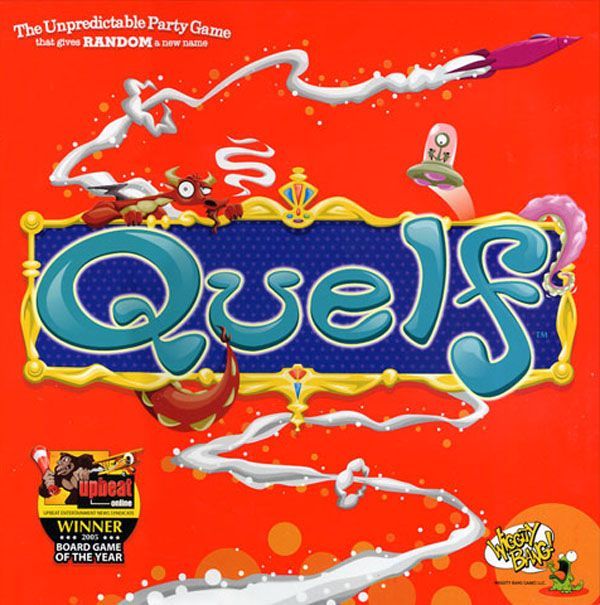
Quelf

3–8 players 60 min Ages 12+ 1.3/5 complexity 5.3/10 rating

About this game

Quelf is the unpredictable party game that gives Random a new name! Whether you're answering hilarious trivia, performing ridiculous stunts, or obeying silly rules, Quelf will inspire you to use your creativity, wit and sense of humor in ways you've never imagined. As you move around the game board, as one of eight quirky characters, crazy things start to happen. Your friends start talking strangely. Your mom's face is wrapped in toilet paper. Your dad is acting like Dracula. And you are reciting a poem about your armpits. Cards: Stuntz - balancing acts, costume creations, daredevil moves, weird contraptions Showbiz - mime, sing, tapdance, draw, do impressions, write poetry Quizzle - mind-twisting trivia, nutty riddles, brain teasers Rulez - rules you must follow: snort like a pig when you laugh, say everything twice, roll the dice with your elbows Scatterbrainz - choose one of two topics and everyone gives answers until no one can think of a valid one ("Ways to get your leg out of a spring-loaded, steel bear trap" or "Brands of Lipstick") Characters: The Platypus Mr. Lugnut Super Ninja Monkey The Dude The Biscuit Farmer Queen Spatula Batbileg Chinzorig Mrs. Pickle Feather

What it feels like

Paper-and-Pencil Singing Acting Storytelling Humor Trivia Action / Dexterity Party Game

Game intelligence

Learn the game

100% knowledge coverage

Setup

1. Unfold and place the game board in the center of the table. 2. Each player selects a character token and places it on the START space. 3. Shuffle each color-coded deck of cards separately and place them face-down in their designated spots on or near the board. 4. Give each player a reference card if available. 5. Determine the first player (e.g., most recently silly person goes first). 6. Keep a supply of penalty tokens or use a notepad to track movement penalties.

Turn flow

On your turn: (1) Roll the die and move your token the indicated number of spaces forward along the track. (2) Look at the color of the space you landed on — this determines which card deck you draw from. (3) Draw the top card from that deck and read it aloud (or have another player read it to you). (4) Obey the card's instructions completely. (5) If you succeed, your turn ends normally. If you fail or refuse to comply, you must move your token backward as a penalty. Some cards introduce ongoing rules (Quelf cards / Roolz cards) that remain in effect until the end of the game or until fulfilled; violating these rules at any time costs you spaces. Play passes clockwise.

Scoring and victory

The winner is the first player to move their token to or past the FINISH space on the board. There is no point scoring — advancement is achieved by obeying cards and avoiding backward movement penalties. Target score: Reach or pass the FINISH space before any other player Scoring sources: Reaching or passing the FINISH space first, Avoiding backward movement penalties by obeying all cards and active Roolz rules

Source: Rulebook

Rules to know

The most useful rules for getting a first game right.

General

The one fundamental rule: you must obey whatever your card says.

The single overriding rule of Quelf is: obey the card. Whatever instruction is printed on the card you draw must be followed completely and in good faith. Refusing or failing to obey a card results in a movement penalty (moving your token backward). There are no exceptions — creativity and silliness are expected and required.

Turn structure

On your turn, roll the die and move your token forward that many spaces.

At the start of your turn, roll the single die and advance your token forward (clockwise) along the board track by the number of spaces shown. The color of the space you land on determines which card category you must draw from. You must always move the full number rolled — you cannot choose to move fewer spaces.

Card play

Each board space color corresponds to a specific card category/deck.

The board spaces are color-coded, each linking to a specific deck of cards: (1) Showbiz (typically red/orange) — performance challenges where you act, sing, or physically perform a stunt; (2) Scatterbrainz (typically yellow/green) — creative brainstorming or list-based challenges; (3) Stuntz (typically blue/purple) — physical or bodily challenges and dares; (4) Quelf / Roolz (typically purple/dark) — ongoing rule cards that impose a persistent behavior you must maintain for the rest of the game; (5) Trivia (typically another distinct color) — question-and-answer trivia cards. Draw the top card of the matching deck and read it aloud.

Card play

Showbiz cards require the player to perform an act, skit, song, or physical stunt.

When you land on a Showbiz space, draw a Showbiz card and read it aloud. You must perform the described action — which may include singing, acting, impersonating, or doing a physical feat — to the satisfaction of the other players (or within a time limit if stated). Failure to perform as instructed results in a backward movement penalty.

Card play

Scatterbrainz cards challenge players to rapidly list or generate creative answers.

When you land on a Scatterbrainz space, draw a Scatterbrainz card and read it aloud. These cards typically ask you (and sometimes all players simultaneously) to rapidly name items fitting a specific absurd or creative category, often within a time limit or for a set count. All players may be involved. Failure to meet the card's requirement results in a backward movement penalty for the applicable player(s).

Card play

Stuntz cards require the active player to perform a physical challenge or dare.

When you land on a Stuntz space, draw a Stuntz card and read it aloud. You must perform the described physical challenge or dare (e.g., balance something on your head, hold a pose, complete a bodily task). If the card specifies a duration or condition for success, you must meet it. Failure results in a backward movement penalty.

Card play

Roolz (Quelf) cards impose an ongoing behavioral rule on the player that lasts until the end of the game.

When you land on a Quelf/Roolz space, draw a Roolz card and read it aloud. The card imposes an ongoing rule — a specific behavior, phrase, action, or restriction — that you must obey for the remainder of the game (or until the card's stated condition is met). Examples include: always speaking in a specific accent, saying a phrase before every sentence, or maintaining a physical posture. Any time you violate your active Roolz card, you must immediately move your token backward the penalty number of spaces. You may accumulate multiple Roolz cards over the course of the game.

Card play

Trivia cards ask the active player a question; answering correctly lets them stay, wrong answer causes a penalty.

When you land on a Trivia space, draw a Trivia card. Another player reads the question aloud. The active player must answer. If correct, the turn ends normally with no penalty. If incorrect or unable to answer, the active player receives a backward movement penalty.

Strategy briefing

Roolz Card Management

Roolz cards are the most dangerous cards in the game because their penalties extend across all turns, not just your own. Landing on Roolz spaces late in the game when you're close to the finish is especially risky — a violation while a leader can rapidly erase your progress. Early in the game, accumulating Roolz cards is lower stakes, so consider them more tolerable then.

Monitoring Other Players

Actively watch opponents who have Roolz cards in play. Catching a Roolz violation forces them backward, which is functionally equivalent to advancing yourself in a race game. Paying attention during other players' turns is directly rewarded.

Good Faith Performance

On Showbiz and Stuntz cards, the group judges your performance. Committing fully and enthusiastically — even to absurd tasks — is more likely to earn group approval than a half-hearted attempt, avoiding the backward penalty.

Board Position Awareness

Because movement is determined by a single die, you cannot reliably control which color space you land on. However, being aware of upcoming spaces a few rolls ahead can mentally prepare you for likely card types (e.g., an upcoming Roolz cluster means prepare to take on a new rule).

Penalty Avoidance as Primary Strategy

There is no mechanic to gain extra spaces beyond normal die rolls — the only way to fall behind is through penalties. Therefore the dominant strategy is not speed but penalty avoidance: obey every card, maintain all Roolz, and let opponents penalize themselves.

Common questions and edge cases

Can a player be penalized for violating their Roolz card when it's not their turn?

Yes. Roolz cards are always in effect, not just on your turn. If another player notices you violating your Roolz rule at any time — even during someone else's turn — they can call it out and you must immediately move backward the penalty spaces.

What happens if a player has two Roolz cards that seem contradictory or very hard to follow simultaneously?

Both Roolz cards remain in effect and must be obeyed simultaneously. There is no rule for discarding a Roolz card due to conflict. The player must do their best to comply with both; the group may use good judgment for truly impossible simultaneous compliance, but the spirit of the game encourages creative adherence to both.

If a player lands on or passes the FINISH space, do they still have to draw and complete a card?

Reaching or passing the FINISH space wins the game immediately. The game ends at that moment. Whether a card must still be drawn and completed may depend on the specific edition; in standard play, successfully reaching the finish by surviving the turn (not being penalized back) is sufficient to win.

What happens if a backward penalty would move a player behind the START space?

The rulebook does not explicitly address this, but standard convention is that a player's token cannot move behind the START space — it stops at START. The player does not wrap around the board backward.

Two players disagree on whether a Showbiz or Stuntz performance was good enough to count as success. How is it resolved?

The group of non-active players votes. The majority decision stands. In the event of a tie, the ruling favors the active player (benefit of the doubt). The active player themselves does not vote on their own performance.

Ask About This Game

Similar games