2023 BGG rank #4922

Regroup! Chicken Army

2–4 players 10–20 min Ages 6+ 1.4/5 complexity 5.8/10 rating

About this game

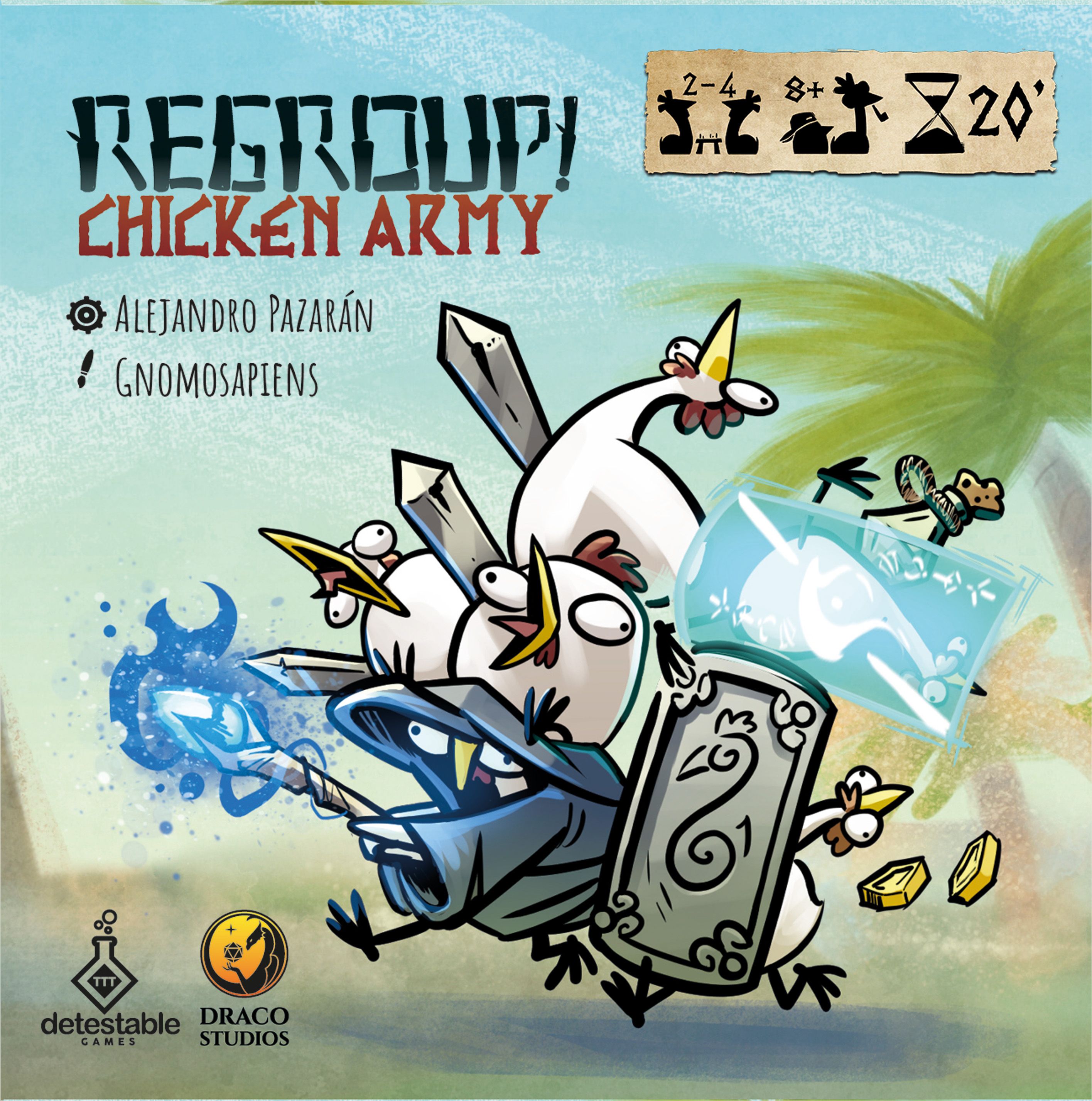
In Regroup! Chicken Army you organize your army of chicken warriors or chicken wizards to fight with the other players' armies. Only one chicken army will emerge victorious from battle! Each turn you choose a card and place it over another card on your grid seeking a match between physical or magical attack and defense. Once all the players have placed and organized their card, the round ends and the combat begins. Each player deals or absorbs damage (physical or magical) based on the connected chickens of the same type (sword, shield, wands, barriers). The last player standing, wins! —description from the publisher

What it feels like

Layering Pattern Building Card Play Conflict Resolution Humor Animals Children's Game Card Game Fantasy Animal Battles Anthropomorphic Animals

Explore these mechanics in Cardboard

Start an original prototype from reusable design patterns—not this game's content.

Open mechanics workbench

Game intelligence

Learn the game

100% knowledge coverage

Setup

1. Give each player one Initial Card and place it face-up in front of them. For a first game, use the side that is identical for all players. This card is the foundation of each player's grid and must remain visible to all other players. 2. Give each player a Leader Card and the Life Counter Card of the matching color. Set the Leader Card arrow to point at 30 life points on the Life Counter Card. For a first game, use the iconless side of the Life Counter Card. 3. Shuffle the Game Cards and place the deck face-down in the center of the table. Reveal the top three cards from the deck in a horizontal face-up line directly next to the deck — this is the market. 4. Hand the First Player Card to the last person at the table who won a board game. That player places it next to their life counter where all players can see it.

Turn flow

Each round has three phases resolved in clockwise turn order starting with the First Player Card holder. Only players who still have life points participate. A. ARRANGEMENT — On their turn, each player: (1) Picks exactly ONE card from the market, then (2) Places (arranges) that card on their grid by covering at least one existing box. B. BATTLE — Once all players have arranged their cards, each player in turn order: (1) Announces their total physical and magical attack points (counting all orthogonally adjacent groups of 2+ matching chicken types visible on their grid), then (2) Each other player calculates their defense points the same way and determines how much damage they receive (physical attack vs. physical shields; magical attack vs. magical shields). Life counters are updated. All players who were alive at the start of the round get to attack, even if they lost all life points during this phase. C. CLEAN-UP — (1) Recovery: players still alive add 1 life point per visible potion on their grid. (2) The First Player Card passes left to the next living player, starting a new round.

Scoring and victory

Last player with life points wins. If all are eliminated simultaneously, the player closest to zero (least negative) life points wins; ties go to the First Player Card holder. If the deck runs out, the player with the most life points wins. Target score: 30 Scoring sources: Starting life total: 30 points, Damage received: reduces life points (physical attack minus physical defense, magical attack minus magical defense), Potion recovery: +1 life point per visible potion during Clean-up

Source: Rulebook

Rules to know

The most useful rules for getting a first game right.

Turn structure

Each round has three phases: Arrangement, Battle, and Clean-up, resolved clockwise from the First Player.

Each game round consists of three sequential phases: A) Arrangement, B) Battle, and C) Clean-up. Each phase is resolved in clockwise turn order beginning with the holder of the First Player Card. Only players who still have at least one life point participate in each round.

Setup

The market is three face-up cards placed in a horizontal line next to the deck.

At the start of the game, the top three cards of the shuffled deck are placed face-up in a horizontal line directly adjacent to the deck. This line of three face-up cards, together with the top card of the deck (face-down), constitutes the available card pool players may pick from during the Arrangement phase. Positions in the market are described relative to the deck: the card closest to the deck, the center card, and the card furthest from the deck.

Card play

The face-up card furthest from the deck and the top card of the deck can be picked freely with no cost.

During the Arrangement phase, a player may pick one of two cards at no cost and with no restriction: (1) the face-up card that is furthest from the deck in the market line, or (2) the top card from the deck (which is face-down until picked). No coins or other resources need to be visible on the player's grid to take either of these cards.

Restriction

The center face-up market card requires at least 1 visible coin on the player's grid to pick.

During the Arrangement phase, to pick the center (middle) face-up card from the market, the picking player must have at least ONE coin visible anywhere on their grid. Additional coins beyond the minimum provide no extra benefit for this card.

Restriction

The face-up card closest to the deck requires at least 2 visible coins (adjacent or not) on the player's grid.

During the Arrangement phase, to pick the face-up card that is closest to the deck in the market line, the picking player must have at least TWO coins visible on their grid. These two coins do not need to be adjacent to each other. Additional coins beyond the minimum provide no extra benefit for this card.

General

When a face-up market card is taken, remaining cards shift toward the deck and a new card is drawn from the top of the deck.

Whenever a player picks a face-up card from the market, the remaining face-up cards slide toward the deck to fill the gap, and a new card from the top of the deck is placed face-up in the position furthest from the deck. This keeps the market at three face-up cards whenever possible.

Building

A picked card must be placed on the grid covering at least one existing box; it may not be placed in empty space or under a previously placed card.

After picking a card, the player must place (arrange) it on their grid according to these rules: (1) At least one box on the new card must overlap on top of one or more boxes on cards already present in the grid. A card can cover one, two, three, or up to four boxes. (2) Cards cannot be placed in spaces where there are no underlying boxes — the new card must anchor to existing grid content. (3) Cards cannot be slid underneath cards that were placed in previous turns. (4) The card can be rotated or spun into any orientation the player chooses.

Combat

Attack points equal the sum of all orthogonally adjacent groups of 2+ matching chicken type boxes visible on the grid.

During the Battle phase, a player's total attack is calculated separately for physical (warrior chickens) and magical (wizard chickens) types. To count: scan the player's grid for all boxes of each type that are currently visible (not covered). Groups of matching chicken boxes that are orthogonally adjacent (sharing an edge, not diagonal) count toward that attack type. A group must contain at least TWO boxes of the same type to score. Players count every chicken in every qualifying group and sum them all up for each attack type. Single isolated boxes of a type do not count.

Strategy briefing

Prioritize adjacency when placing cards

Since isolated chicken boxes score zero attack and defense, every card placement should aim to extend or create groups of at least two matching boxes. A card that adds a lone chicken is wasted placement — always check if the new card's boxes will be orthogonally adjacent to at least one matching box already on your grid.

Use covering to block opponent visibility

You cannot cover your own previously placed cards, but you CAN place new cards to cover earlier ones intentionally. Covering your own old, low-value boxes to expose better ones is a valid and important strategy — but be careful not to accidentally bury your coins if you need them for expensive market picks.

Keep coins visible for market access

The two most powerful cards in the market (the center and closest-to-deck positions) cost 1 and 2 coins respectively. Maintaining visible coins on your grid is a long-term strategic resource. Avoid covering coin boxes unless you have enough redundancy.

Balance attack and defense

Physical and magical damage are calculated independently — an opponent with strong physical defense but no magical defense is highly vulnerable to magical attacks. Diversifying your attack types can ensure that at least some damage always gets through.

Leverage potions for longevity

Potions heal 1 life point each per round during Clean-up — but only for surviving players. Even one or two visible potions compound over many rounds into significant life recovery, allowing you to absorb more combat damage than opponents without potions.

Going first is a double-edged sword

The First Player picks first in Arrangement (best market access before others take cards) but also attacks first in Battle (opponents can see your declared attack total before their own turns). Consider this asymmetry when positioning yourself relative to the First Player Card.

Common questions and edge cases

Do coins on my grid get spent/removed when I use them to pay for a market card, or do they just need to be visible?

Coins are not spent. The rules state coins must be 'visible on the player's grid' as a requirement to access certain market cards — they are a visibility threshold, not a currency that is consumed. As long as the required number of coin icons are visible (not covered) on your grid at the time of picking, you may take the card.

I have one warrior chicken box visible but it's not adjacent to any other warrior box. Does it contribute to my attack?

No. A group must have at least TWO boxes of the same type orthogonally adjacent to each other to count. A single isolated box of any type contributes zero attack or defense points.

Player A attacks Player B and reduces them to zero life points. Can Player B still attack later in the same Battle phase?

Yes. All players who were alive at the start of the Battle phase get to attack, regardless of being eliminated mid-phase. Player B still takes their attack turn even at zero life points.

A player is at zero life points after the Battle phase. Do they gain potion recovery?

No. Potion recovery during Clean-up applies only to players who 'still have life points' after the Battle phase. A player at exactly zero is eliminated and does not benefit from potion recovery.

I had 2 coins visible to pick the closest market card, but then I covered them with a new card. Can I still pick expensive market cards in future rounds?

No. The coin requirement is checked at the moment of picking — coins must be visible on your grid at that time. If you've covered your coins with later cards, they no longer count toward market access requirements.

All players are eliminated during the Battle phase and two players are tied for the closest life total to zero. Who wins?

The player currently holding the First Player Card wins the tiebreaker.

An attacker has 8 physical attack and 2 magical attack. A defender has 7 physical defense and 0 magical defense. How much damage does the defender take?

Physical damage: 8 − 7 = 1. Magical damage: 2 − 0 = 2. Total damage = 3 life points. Physical and magical damage are calculated independently and both amounts are applied.

Can I rotate a card 180° or place it sideways when arranging it on my grid?

Yes. Cards can be spun into any position (any rotation) the player wants, as long as the placement rules are otherwise satisfied (covering at least one existing box, not placed in empty space, not placed under a previously placed card).

Ask About This Game

Similar games