1991 BGG rank #8794

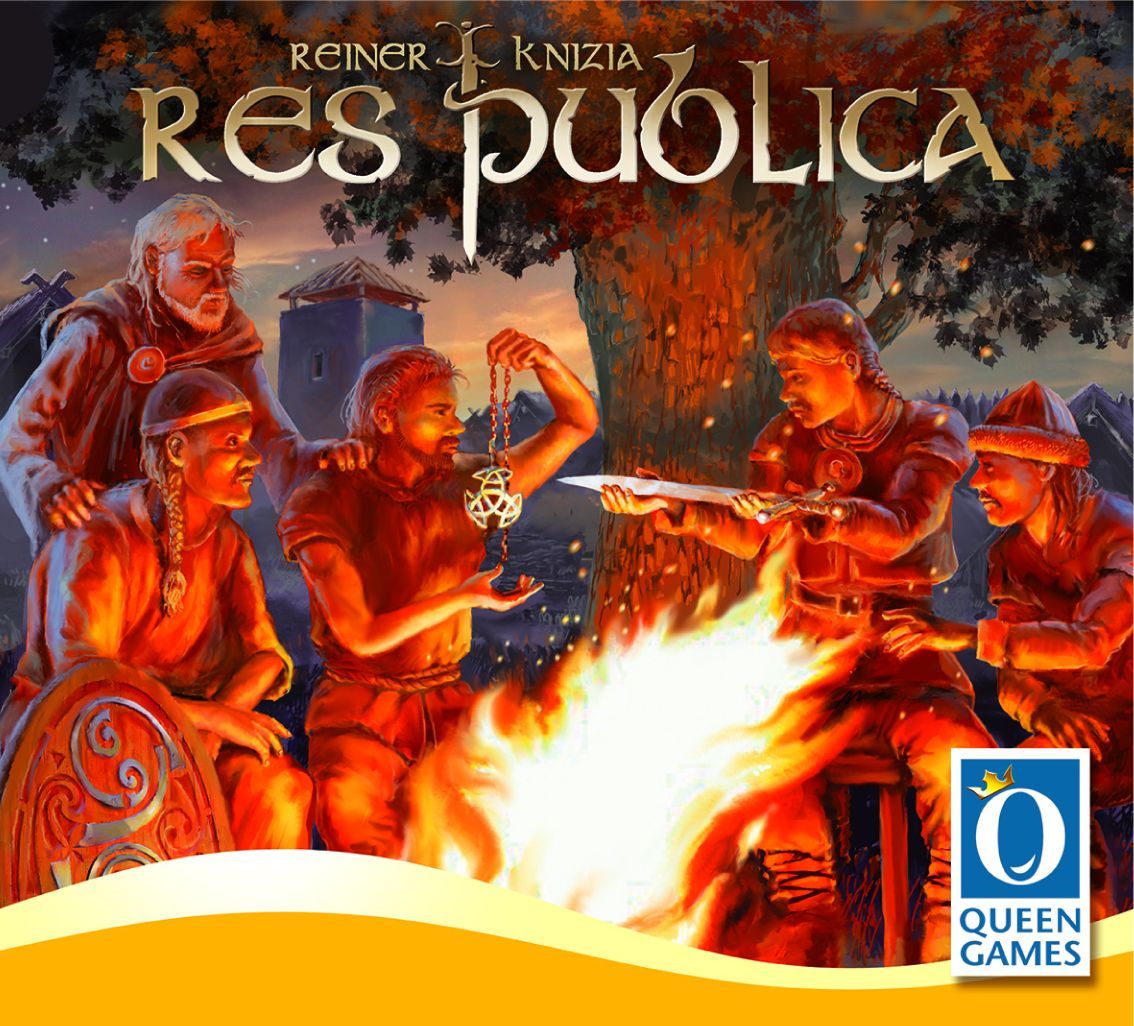
Res Publica

3–5 players 30–60 min Ages 10+ 1.7/5 complexity 5.6/10 rating

About this game

In Res Publica you are the will of the people, guiding five ancient civilizations to greater heights of power and technology. Each turn, the active player makes a trade offer... and each player in turn responds in kind. Using the cards and the information gained through the trading process, players work to acquire five identical people cards in order to build a city (which increases the number of cards you can draw each turn) or five identical technology cards in order to build a monument (which garners end game victory points). At the end of the game, players total the points achieved via cities and monuments and the one who has the most wins.

What it feels like

Trading Set Collection Card Game Civilization Anthropomorphic Animals

Explore these mechanics in Cardboard

Start an original prototype from reusable design patterns—not this game's content.

Open mechanics workbench

Game intelligence

Learn the game

100% knowledge coverage

Setup

Separate the deck into People cards and Technology cards. Shuffle each deck separately. Shuffle City cards and Monument cards into their own respective piles. Deal starting hands to all players (hand size not specified in this rulebook excerpt). Place decks within reach of all players. Each player begins with no Cities or Monuments in front of them.

Turn flow

On your turn, you perform any or none of the following three actions in this exact order: (1) TRADE — negotiate and swap cards with one opponent; (2) SHOW SETS OF 5 — reveal one or more complete sets of 5 identical cards to earn City or Monument cards; (3) DRAW CARDS — draw up to 3 cards total from the People deck (1 card) and/or Technology cards generated by your Cities (1 per City you control). You are never required to perform any of these actions, but if you do them, they must occur in this sequence.

Scoring and victory

Most victory points wins. Tally all point sources at game end after the final round. Scoring sources: Cities: 3 points each, Monuments: points equal to the number printed on the card, Pairs in hand: 1 point per pair of identical cards

Source: Rulebook

Rules to know

The most useful rules for getting a first game right.

Turn structure

On your turn, perform actions in strict order: (1) Trade, (2) Show Sets of 5, (3) Draw Cards.

Each turn, a player may perform any or none of the following three actions, but they must be resolved in this precise order: 1. TRADE — trade and swap cards with an opponent; 2. SHOW SETS OF 5 — display one or more sets of 5 identical cards to earn City or Monument cards; 3. DRAW CARDS — draw up to 3 cards total. No action is mandatory, but the order cannot be altered.

Trading

On your turn you may trade and swap cards with one opponent.

During the Trade phase of your turn, you may negotiate and swap cards with one opponent. You must choose either to REQUEST one or more cards, OR to OFFER one or more cards. Trading is bilateral: the active player initiates, and an opponent may respond. A trade only completes if both parties agree on terms.

Trading

When trading, you may request one or more cards from an opponent.

When it is your turn to trade, one option is to REQUEST one or more cards from an opponent. You state what you want and the opponent may respond with what they want in return. Requests must follow the naming restrictions: you may name no more than two types in any single request or response.

Trading

When trading, you may offer one or more cards to an opponent.

When it is your turn to trade, one option is to OFFER one or more cards to an opponent. You state what you are willing to give and what you want in return. Offers must follow the naming restrictions: you may name no more than two types in any single offer or response.

Restriction

When requesting, offering, or responding in a trade, you may never name more than two types.

At any point during a trade negotiation — whether requesting, offering, or responding — a player may name no more than two card types. If two types are named, they must be combined using 'and' or 'or'. You may NOT use negative qualifiers such as 'no' (e.g., saying '1 Pair and no Romans' is illegal).

Trading

Trade offers and responses may name a category or multiples, combined with 'and'/'or'.

Offers and responses in a trade may specify a card category (e.g., 'People', 'Technology', 'Babylonians', 'Architecture') and/or multiples (e.g., 'Three of a kind', 'Two pairs', '3 Technology cards', 'Two Romans and Two Greeks'). Two types may be joined with 'and' or 'or'. Examples of legal trades: 'I request 1 Viking — For two Greeks or one Shipbuilding'; 'I offer 2 Alchemy or 3 Technology — For 1 Babylonian and 2 Greeks.'

Scoring

Display one or more sets of 5 identical cards to earn a City or Monument card per set.

During the Show Sets of 5 phase of your turn, you may reveal one or more complete sets of 5 identical cards from your hand. For each set displayed: if the 5 cards are People cards, you receive one City card; if the 5 cards are Technology cards, you receive one Monument card. The 5 displayed cards are removed from your hand. You place the earned City or Monument card in front of you on the table.

Scoring

A set of 5 identical People cards earns you one City card.

When you display a set of 5 identical People cards during the Show Sets phase, you receive one City card, which you place face-up in front of you. Cities are worth 3 points each at game end and allow you to draw Technology cards each turn.

Strategy briefing

City Engine Priority

Cities are doubly valuable: they score 3 points each AND grant an extra Technology card draw per turn. Prioritizing People card sets to earn Cities early creates a compounding advantage — more Cities means more Technology draws, which means faster access to Monument sets.

Draw Cap Management

The 3-card draw cap means that having 3+ Cities makes the People draw redundant if you want to maximize Technology draws. With 3 Cities, you can draw 3 Technology cards and skip the People draw entirely, rapidly building toward Monument sets.

Trade Phrasing as Leverage

Because you can only name two types per trade statement, vague category terms ('People', 'Technology') give you flexibility while specific names ('Vikings', 'Romans') reveal what you need. Using categories in offers hides your set-building intentions.

Trade Timing Relative to Sets

Since Trade occurs before Show Sets, you can acquire the final card(s) needed to complete a set via trading, then immediately show the completed set in the same turn. Plan trades specifically to enable same-turn set reveals.

End-Game Hand Management

Pairs in hand score 1 point each at game end. In the final round, prioritize trading to form as many pairs as possible from your remaining cards, since incomplete sets (no longer buildable into 5s) still yield value as pairs.

Monument Value Variance

Monuments vary in point value (printed on the card). If some Monuments are worth more than others, targeting Technology sets that yield high-value Monuments should be prioritized over lower-value ones, making Monument deck awareness critical.

Common questions and edge cases

A player has 4 Cities. Can they draw 4 Technology cards on their turn?

No. Even though each City entitles you to draw 1 Technology card, the total number of cards drawn during the Draw Cards phase can never exceed 3. So with 4 Cities and a People draw, the player may draw at most 3 cards total (e.g., 3 Technology draws, forfeiting the People draw and one City draw).

During the final round (after the last Technology card is drawn), can players still use their Cities to draw Technology cards?

No. The final round permits players to display sets, trade, and draw People cards only. Since the Technology deck is exhausted, City-generated Technology draws cannot occur during the final round.

Can a player first show a set of 5 cards and then use the earned City to draw Technology cards, before trading?

No. The order of actions is fixed: Trade must happen first, then Show Sets of 5, then Draw Cards. A player cannot show sets before trading, nor draw cards before showing sets.

Can a player say 'I offer 2 Romans or 2 Greeks and no Technology'?

No. Two rules are violated: (1) Only two types may be named, but three concepts are named here (Romans, Greeks, Technology). (2) Negative qualifiers like 'no Technology' are not permitted.

If a player holds 4 identical cards at game end, how many points do they score for pairs?

4 identical cards form 2 pairs, scoring 2 points. Each pair of identical cards in hand is worth 1 point, so pairs are counted within the full group (4 cards = 2 pairs = 2 pts; 3 cards = 1 pair + 1 leftover = 1 pt).

Can a player show more than one set of 5 in the same turn?

Yes. The rules explicitly state you may display '1 or more sets of 5 identical cards' during the Show Sets phase. Each set earns its corresponding City or Monument card.

Ask About This Game

Similar games