1977 BGG rank #1757

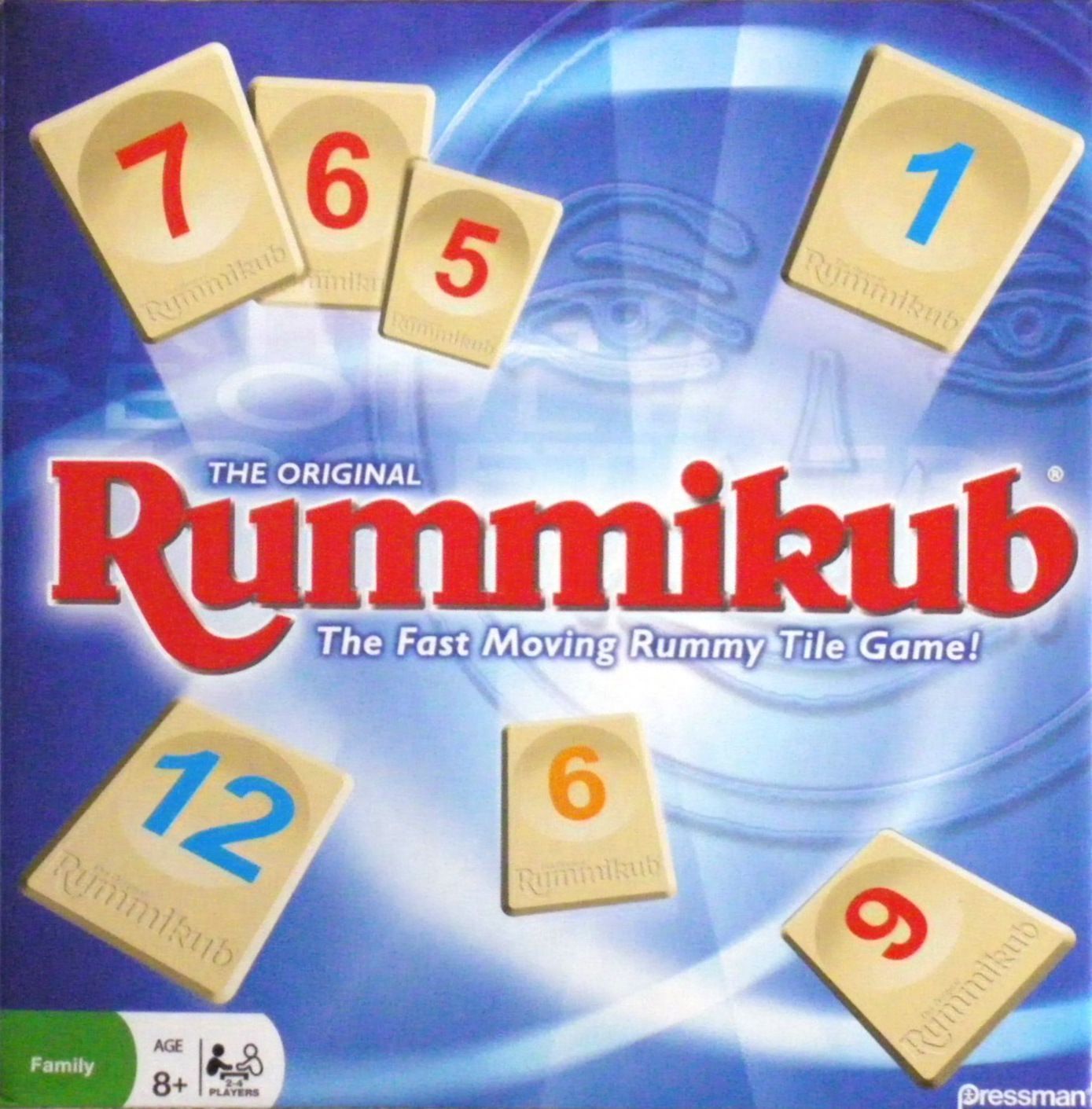
Rummikub

2–4 players 60 min Ages 8+ 1.7/5 complexity 6.3/10 rating

About this game

Rummikub is similar to several central European card games which are played with two decks of playing cards, including Machiavelli and Vatikan. Ephraim Hertzano invented the tile game Rummikub in the 1940s when card-playing was outlawed under the Communist regime. After World War II, Hertzano immigrated to British Mandate of Palestine (now Israel) and developed the first sets with his family. Over the years, the Hertzano family licensed it to other countries and Rummikub became Israel's best-selling export game. Hertzano's Official Rummikub Book, published in 1978, describes three different versions of the game: American, Sabra, and International. Modern Rummikub sets include only the Sabra version rules, with no mention of the others, and there are variations in the rules between publishers. In Turkey, the game is known as Okey and is widely played by families at gatherings or at local cafes. Like Rummy that you play with cards, you try to get rid of all your tiles by forming numbers into runs of 3 tiles or more, or 3 to 4 of a kind. The colors of the numbers on the tiles are like card suits. This game may start rather uneventfully, but when the players start putting more and more tiles in play, the options for your upcoming turns can become more complex, challenging, and exciting (from areyougame.com).

What it feels like

Set Collection Tile Placement Abstract Strategy Card Game Number

Explore these mechanics in Cardboard

Start an original prototype from reusable design patterns—not this game's content.

Open mechanics workbench

Game intelligence

Learn the game

100% knowledge coverage

Setup

1. Shuffle all tiles face-down into a shared pool.\n2. Each player takes 14 tiles from the pool (drawn as two face-down stacks of 7 tiles each).\n3. Place tiles on your personal rack, keeping them hidden from other players.\n4. Determine the starting player (e.g., by raffle or agreement).\n5. In tournament play, seating and table assignments are determined by raffle prior to entering the competition hall.

Turn flow

On your turn, you must do one of the following:\n\n**Option A – Draw:** Take one tile from the pool and add it to your rack. Your turn then ends.\n\n**Option B – Play tiles:** Place one or more tiles from your rack onto the table to form or extend valid sets, or manipulate existing sets on the table.\n\n- Before your initial meld (first play), you may only place tiles from your own rack and may not build upon or manipulate any sets already on the table.\n- After your initial meld, you may freely manipulate all sets on the table, as long as only legitimate sets remain and no loose tiles are left over at the end of your turn.\n- You have a one-minute time limit to complete your turn. If you fail to complete a valid play within the time limit, all tiles return to their original positions and you draw 3 penalty tiles from the pool.\n\nPlay passes clockwise until one player empties their rack.

Scoring and victory

The first player to empty their rack wins the game and scores positive points equal to the sum of all tiles remaining on opponents' racks. Losing players record negative scores equal to their remaining tile values. In tournament rounds, the player with the most game wins advances; ties are broken by highest cumulative score. Scoring sources: Face value of tiles remaining on opponents' racks (scored positively by the winner), Joker on rack at end of game: 50-point penalty to holder, Failed initial meld penalty: 100 points if player could not have melded; 200 points if player had the opportunity but chose not to meld, 3 penalty tiles drawn from pool for time violations (tiles added to rack, increasing end-game penalty exposure)

Source: Rulebook

Rules to know

The most useful rules for getting a first game right.

General

The aim is to be the first player to place all tiles from your rack onto the table.

The aim of the game is to be the first player to get rid of all of one's tiles by placing them on the table. Upon doing so, the winning player scores all the points represented by the tiles remaining on opponents' racks (as penalty points charged to those opponents).

Setup

Each player starts the game by drawing 14 tiles from the pool.

At the start of the game, each player takes 14 tiles from the pool, drawn as two face-down stacks of 7 tiles each. These tiles are placed on the player's personal rack and kept hidden from other players.

Turn structure

On your turn, you must either draw one tile from the pool or play one or more tiles from your rack onto the table.

During a turn, a player may either: (A) Draw one tile from the pool and add it to their rack, ending their turn; or (B) Lay one or more tiles from their rack onto the table to form new sets, extend existing sets, or manipulate sets already on the table. A player cannot both draw and play tiles in the same turn.

Restriction

A player's first play (initial meld) must consist of sets totaling at least 30 points in face value.

To enter the game, the first set or sets placed on the table by a player must have a combined face-value total of at least 30 points. Tile face values equal their number (e.g., a '7' tile is worth 7 points). The joker's value in an initial meld is the value of the tile it represents. A player may not build upon or manipulate any sets already on the table prior to completing their initial meld.

Restriction

A player may delay their initial meld by continuing to draw one tile per turn.

A player may choose to delay entry into the game by picking one tile from the pool on each of their turns instead of playing. This continues until the player is ready and able to make a valid initial meld of at least 30 points.

Restriction

Before completing their initial meld, a player may not build upon or manipulate any sets already on the table.

Prior to making their initial meld (and during the turn of the initial meld itself), a player may only place tiles directly from their own rack. They may not add to, split, rearrange, or otherwise manipulate any sets that other players have already placed on the table. This restriction is lifted after a player has completed their initial meld.

General

Valid sets are either a 'run' (3+ consecutive numbers of the same color) or a 'group' (3–4 tiles of the same number in different colors).

There are two types of valid sets: (1) A RUN consists of three or more consecutive numbers, all of the same color (e.g., red 4-5-6-7). The number '1' tile may only be used before '2' and never after '13'; runs do not wrap around. (2) A GROUP consists of three or four tiles sharing the same number but each of a different color (e.g., three '9' tiles in red, blue, and black). Duplicate colors are not allowed within a group. All sets on the table must be valid at the end of every turn.

Restriction

The '1' tile may only be used before the '2' tile in a run; it cannot follow the '13' tile.

The number '1' tile can only be placed at the low end of a run (before '2'). It cannot be used after the '13' tile; runs do not wrap around. For example, '12-13-1' is not a valid run.

Strategy briefing

Delaying the Initial Meld

Deliberately delaying your initial meld (by drawing tiles each turn) gives you more tile options for a stronger entry, but it also increases your rack size—raising your penalty exposure if another player goes out before you. Weigh this risk carefully, especially if you already hold tiles close to 30 points.

Joker Management

Playing a joker early avoids the 50-point end-game penalty, but jokers on the table become targets for opponents to retrieve. Consider timing joker placement so opponents have fewer opportunities—or fewer matching tiles—to retrieve it and redirect it against you.

Manipulation to Drain Your Rack

Freely rearranging sets on the table can unlock placements for tiles that don't fit any new set on their own. Mastering manipulation lets you play more tiles per turn, accelerating your path to going out. However, always ensure the board is fully valid before time expires to avoid the 3-tile penalty.

Blocking Opponents from Going Out

Since tiles on the table can be rearranged, leaving 'tight' or minimally-splittable sets limits opponents' manipulation options and may force them to draw tiles instead of playing, keeping their rack sizes—and your potential end-game score—high.

Initial Meld Threshold

Hitting exactly 30 points for your initial meld is sufficient. Saving higher-value tiles for your initial meld while using lower tiles afterward can be effective, but hoarding high tiles on your rack too long increases penalty risk if another player goes out suddenly.

Time Management During Manipulation

Complex manipulations must be fully valid within one minute. Plan your rearrangement mentally before touching tiles. An incomplete manipulation returns all tiles and costs you 3 extra tiles, significantly increasing your rack and end-game penalty exposure.

Common questions and edge cases

Can a player retrieve a joker from the table and simply place it in a different existing set on the table without playing any tile from their rack?

No. At least one tile from the player's own rack must be played on any turn that involves freeing or using a joker. The joker also cannot remain on the rack; it must be used immediately in a new set during the same turn.

On the turn a player makes their initial meld, can they also rearrange sets already on the table to help meet the 30-point requirement?

No. During the initial meld turn, a player may only place tiles from their own rack. They may not build upon or manipulate any sets already on the table until after a valid initial meld of at least 30 points has been made.

Can a player form the run '12-13-1' using the '1' tile after '13'?

No. The '1' tile may only be used before the '2' tile (at the low end of a run). It cannot follow '13'. Runs do not wrap around.

If a player's time runs out mid-manipulation, what happens to the tiles they moved and how many penalty tiles do they draw?

All tiles that were moved must be returned to their exact original positions (other players at the table assist). The player then draws 3 penalty tiles from the pool. If some tiles' original positions cannot be determined, those tiles go to the bottom of the pool and the player draws an equal number of replacement tiles.

A game ends and a player never made their initial meld. How is their penalty determined?

If the player genuinely could not assemble 30 points of face value from their rack at any point, they are penalized 100 points. If the player had 30+ points available to meld but chose not to, they are penalized 200 points.

A player splits a set on the table and the split frees a joker. What must the player do with it?

The freed joker must be used in the same turn to substitute for any number in a new valid set. It cannot be left on the table as a loose tile or held on the rack. Additionally, at least one tile from the player's rack must be played in the same turn.

Two players finish a tournament round with the same number of game wins. Who advances?

The player with the highest cumulative score across the games in that round is deemed the winner.

Ask About This Game

Similar games