2026 BGG rank #11309

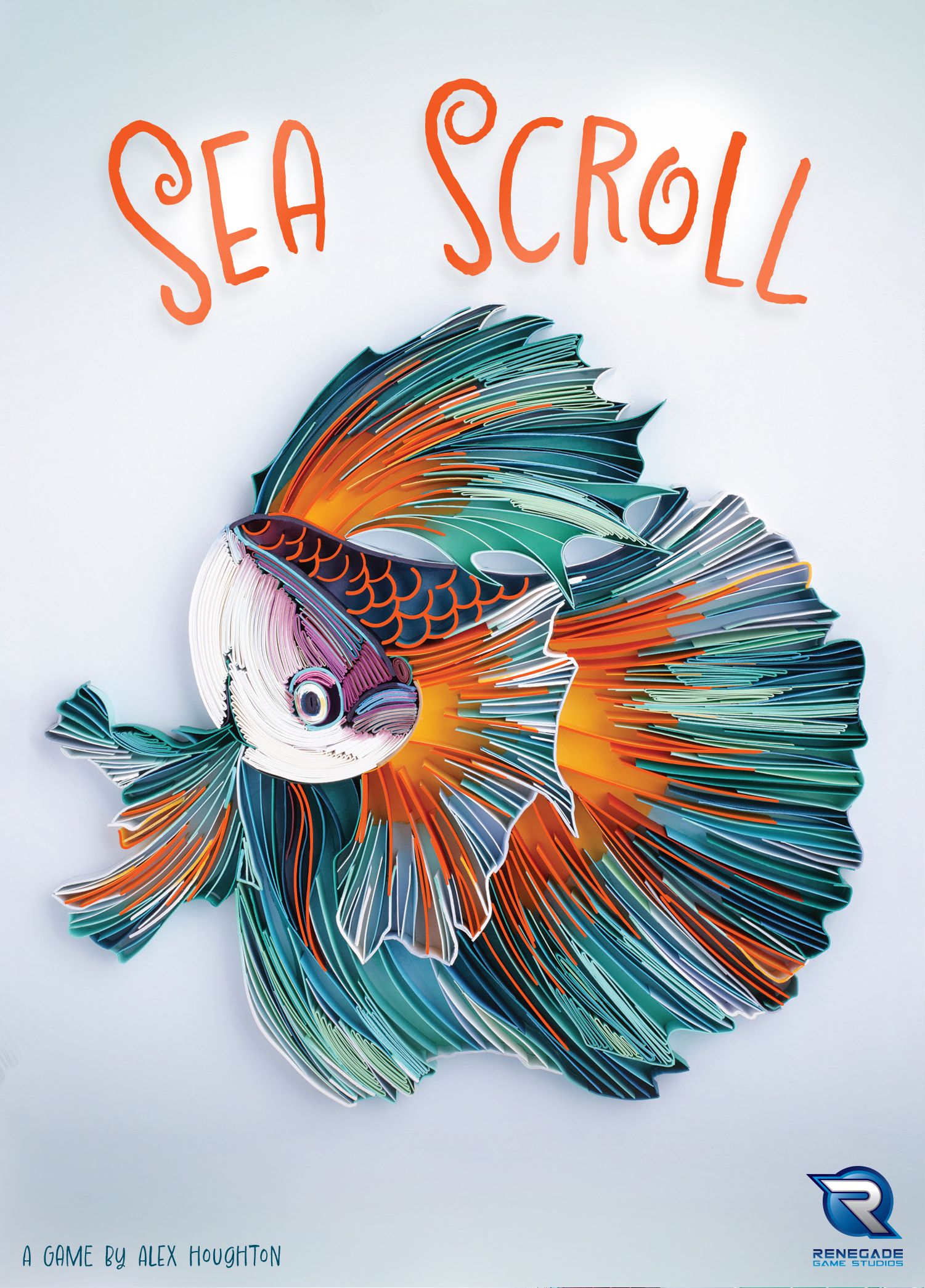
Sea Scroll

2–6 players 15 min Ages 10+ 1.6/5 complexity 5.6/10 rating

About this game

Sea Scroll is a quick-playing, deceptively strategic set collection card game where players will guide schools of fish from the Reef, or the central discard area, to their personal Habitat to form schools of fish, or card sets in front of them. At the end of the game, each player will combine their schools with fish cards remaining in their hands to score! Each species of fish is evaluated to see who has collected the most of that type fish. The player with the most of each species scores point equal to that fish’s value, while all other players lose points equal to its value! Collect, Curate and Combine beautiful fish to emerge the victor! —description from the publisher

What it feels like

Set Collection Variable Set-up Hand Management Animals Card Game Sealife, Seas, and Oceans

Explore these mechanics in Cardboard

Start an original prototype from reusable design patterns—not this game's content.

Open mechanics workbench

Game intelligence

Learn the game

100% knowledge coverage

Setup

1. Give each player a Quick Guide card with the 'On Your Turn' side facing up. 2. Remove fish cards from the deck based on player count: For 2 players, remove all 11 Royal Angelfish and all 12 Clown Fish cards. For 3 players, remove all 12 Clown Fish cards. For 4 or more players, use all 72 fish cards. Shuffle the remaining cards to form the ocean deck and place it in the center of the table. 3. Without looking at them, remove a number of fish cards from the ocean and set them aside in the box: 2 players remove 14, 3 players remove 14, 4 players remove 11, 5 players remove 6, 6 players remove 5. 4. Deal 2 fish cards to each player as their starting hand. 5. Reveal fish cards from the ocean equal to the number of players plus 1 (e.g., 5 cards in a 4-player game) and place them face-up in a row near the ocean. This is the reef. 6. Place the Quick Guide card marked 'Last Round' face-up on the bottom of the ocean deck. 7. The player who most recently went swimming takes the first turn.

Turn flow

Each player's turn has three steps in order: 1. DRAW: Draw 2 fish cards from the ocean into your hand. (Mandatory) 2. TAKE (Optional): Take 1 school from the reef and place it face-up in front of you into your habitat. You may only do this up to 3 times total per game. Once you have 3 schools in your habitat, you cannot take any more schools from the reef. 3. DISCARD: Choose 1 fish card from your hand and discard it face-up into the reef. If one or more schools of that fish type already exist in the reef, you must add it to one of those existing schools. If no school of that type exists in the reef, start a new school with that card. (Mandatory) Turns proceed clockwise. When a player cannot draw at the start of their turn because the ocean is empty (signaled by the 'Last Round' Quick Guide appearing), that triggers the final round: each remaining player takes one final turn without drawing from the ocean, but may still take from the reef (if under 3 schools) and must still discard.

Scoring and victory

The player with the most total points after The Reveal wins. Points can be negative. Each fish type is scored once: the player(s) with the most of that type gain points equal to its value; players with at least 1 but not the most lose points equal to its value; players with 0 are unaffected. Scoring sources: Gaining points equal to a fish type's value for having the most (or tied for most) of that type, Losing points equal to a fish type's value for having at least 1 but not the most of that type, Variant Ante: +2 bonus points per fish card removed to the stash when you hold the largest school of that type in the stash

Source: Rulebook

Rules to know

The most useful rules for getting a first game right.

General

Each fish card has a type and a value; the value equals both its point worth and the total number of that fish type in the full deck.

Every fish card has a type (e.g., Betta Fish, Regal Tang) and a numeric value. The value serves two purposes: (1) it is the number of points a player gains or loses for that fish type at the end of the game, and (2) it equals the total count of that fish type in the complete 72-card deck. For example, Clown Fish (12) is worth 12 points and there are 12 Clown Fish cards total; Regal Tang (4) is worth 4 points and there are 4 Regal Tang cards total.

General

A school is a collection of one or more fish cards of the same type.

A school is any group of one or more fish cards that share the same type. Schools exist both in the reef (shared area) and in a player's habitat (personal area). A single fish card counts as a school of one.

General

The ocean is the shuffled face-down draw deck placed in the center of the table.

The ocean is the central face-down deck from which players draw cards each turn. It is formed during setup by shuffling the appropriate fish cards (after removals based on player count and random blind removal). The 'Last Round' Quick Guide card is placed face-up at the very bottom of the ocean deck.

General

The reef is the shared face-up row of fish schools near the ocean from which players may take schools on their turn.

The reef is a communal face-up play area containing schools of fish cards. It is seeded during setup with a number of face-up cards equal to the number of players plus 1. During the game, the reef grows and changes as players add discarded cards to it or take schools from it. There is no limit to the number of schools that can exist in the reef.

General

A player's habitat is their personal face-up area holding up to 3 schools of fish taken from the reef.

Each player's habitat is the face-up area in front of them where schools taken from the reef are placed. A habitat can hold a maximum of 3 schools. Two schools of the same fish type cannot be merged together to make room for another school. At the end of the game, all fish in a player's habitat are combined with their hand for scoring.

Setup

Remove certain fish types from the deck based on player count before shuffling.

Before forming the ocean deck, remove fish cards based on the number of players: For 2 players, remove all 11 Royal Angelfish cards AND all 12 Clown Fish cards. For 3 players, remove all 12 Clown Fish cards only. For 4, 5, or 6 players, use all 72 fish cards with no type-based removals.

Setup

After type-based removals, remove additional random cards face-down from the ocean based on player count.

After removing fish types by player count and shuffling, blindly remove cards from the ocean (without looking at them) and place them back in the box. The number to remove: 2 players = 14 cards, 3 players = 14 cards, 4 players = 11 cards, 5 players = 6 cards, 6 players = 5 cards. This ensures the ocean runs out at the right time.

Setup

Place the 'Last Round' Quick Guide face-up at the bottom of the ocean deck to signal the final round.

After completing all setup steps, place the Quick Guide card with the 'Last Round' side facing up at the very bottom of the ocean deck. When a player draws this card (or cannot draw because the ocean is empty), the final round begins.

Strategy briefing

Avoiding losing fish types

Holding even 1 fish of a type you can't win creates a guaranteed point loss. Because scoring is per group (not per card), you lose the same points whether you hold 1 or 4 of a losing type. Consider discarding single fish of types you cannot dominate to neutralize the penalty.

High-value fish are high risk, high reward

Clown Fish (12) and Royal Angelfish (11) offer the largest point swings in both directions. Winning the Clown Fish race earns +12 points; losing it costs -12. Contesting high-value fish is only worthwhile if you can reliably secure the majority.

Timing habitat grabs

You only get 3 total habitat grabs across the entire game. Taking large schools early locks in cards from the reef before opponents can grow them further. However, waiting lets you take schools that have been fattened by opponents' discards.

Using discards strategically

Because discarded fish must join existing schools of the same type in the reef, you can deliberately 'feed' a school of a type you plan to take, growing it before your turn to grab. Conversely, discarding into a school an opponent wants makes it more attractive—but also more powerful for whoever grabs it.

Low-value fish as safe anchors

Regal Tang (4) carries the smallest point swing. Winning or losing this type costs or earns only 4 points. It can be worth taking a Regal Tang school early to lock in a safe +4, especially since there are only 4 total in the deck—easy to monitor.

2-player game focus

In 2-player games, Royal Angelfish and Clown Fish are removed entirely, limiting the fish types in play to the four lower-value types. This reduces maximum score swings and creates a more focused contest over fewer types.

Hand management before final scoring

Since habitat fish are merged into your hand at the end, be mindful of which fish types you're accumulating in both zones throughout the game. A fish type you're losing in your habitat may be recoverable through hand cards, or a type you're winning in hand may be ruined by a competing opponent's habitat grab.

Common questions and edge cases

A player has no Betta Fish at all. Do they lose points when Betta Fish are scored?

No. A player with 0 of a fish type is completely unaffected by that type's scoring—no points gained or lost. Only players with at least 1 of that fish type are affected.

Two players are tied for the most of a fish type. Do both gain points, or do neither?

Both gain points equal to that fish's value. Being tied for the most counts as having the most. Any other players with at least 1 of that fish type (but fewer than the tied leaders) still lose points.

A player has 4 Clown Fish (value 12) and has the most. Do they gain 12 points or 48 points?

They gain 12 points. Scoring is per fish type group, not per individual card. No matter how many Clown Fish you hold, you gain (or lose) only the fish's value once.

A player has 3 schools in their habitat. Can they still take from the reef?

No. Once a player's habitat contains 3 schools, they may no longer take any schools from the reef for the rest of the game, including during the final round.

A player wants to discard a Betta Fish card to the reef, but there is already a school of Betta Fish there. Can they start a new separate school?

No. If a school of that fish type already exists in the reef, the discarded card must be added to one of the existing schools of that type. A new separate school of the same type cannot be started.

During the final round, does a player still have to discard even though they can't draw?

Yes. During the final turn, players skip the draw step (ocean is empty) but must still perform the discard step. They may also still optionally take a school from the reef if they have fewer than 3 in their habitat.

A player already has a school of Regal Tang in their habitat. They take another school of Regal Tang from the reef. Can these be merged to count as one school and free up a slot?

No. Two schools of the same type in a player's habitat cannot be merged. They remain as two separate schools, each occupying one of the 3 habitat slots.

All players end the game with negative scores. Who wins?

The player with the least negative (highest) score wins. Negative total scores are valid, and the player with the most points wins regardless of whether that score is positive or negative.

In a 2-player game, which fish types are available to collect?

In a 2-player game, Royal Angelfish (11) and Clown Fish (12) are removed entirely from the deck. Only Regal Tang (4), Moorish Idol (6), Mandarin Fish (8), and Betta Fish (10) are used.

Can the Chaos variant be combined with another variant card?

No. Chaos is marked Standalone, meaning it must be played on its own. Standalone variants cannot be combined with any other variant cards.

Ask About This Game

Similar games