2004 BGG rank #15865

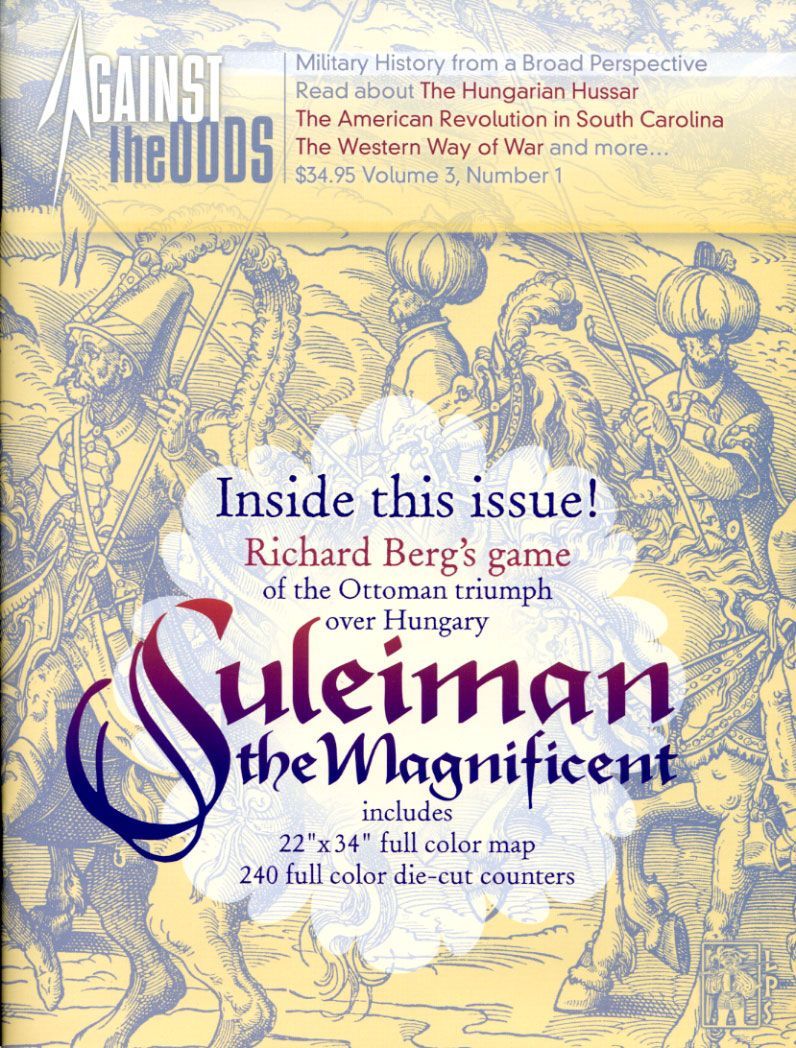
Suleiman the Magnificent

2 players 120 min Ages 0+ 2.8/5 complexity 5.5/10 rating

About this game

Suleiman the Magnificent is a game covering the massive battle on August 29th, 1526 between the Ottoman Empire and the army of the Kingdom of Hungary that eventually resulted in the fall of the latter kingdom and the disappearance of Hungary as an independent country for 400 years. The Hungarians numbered around 35,000 (including artillerist), the Ottomans, about 60,000. While there is much disagreement about numbers at this battle, all sources agree that the Ottomans did outnumber the Hungarians significantly. The Hungarian front line was stretched rather thinly to match, or attempt to match, the frontage that would be presented by the Ottomans. The Hungarians had, as was the practice for the last 200 years in European warfare, dug a trench in front of their front line infantry and artillery to give them a defense advantage. The actual battle, which started at around 3:00 PM, lasted but a few hours, maybe less. Each combat unit represents about 750 men. The map scale is about 225 yards per hex and depicts the flat and, because of the proximity of the oft-overflowing Danube, somewhat soft and, in many places, slippery battlefield at Mohacs. Suleiman the Magnificent is an accessible, fast-playing, fun game of low complexity. Optional rules include the politically charged issue that has reverberated down over the centuries, that many of the contingents of allies called in by Hungarian King Lajos did not arrive in time for the battle. Some were never going to do so; some were held back - specifically the charge leveled at Johann Szapolyai, Voivode of Transylvania because of his ambitions for the Hungarian throne (which he did get after Lajos' death and some deals reached with Suleiman). Full color 22"x34" map 240 full color die cut counters Rulebook length - 12 pages Charts and tables - 2 pages Complexity - Low Solitaire suitability - Medium Playing time - 2 hours Design - Richard Berg Development - Paul Rohrbaugh Graphic Design - Craig Grando

What it feels like

Grid Movement Hexagon Grid Dice Rolling Simulation Movement Points Wargame Renaissance Pike and Shot

Explore these mechanics in Cardboard

Start an original prototype from reusable design patterns—not this game's content.

Open mechanics workbench

Game intelligence

Learn the game

100% knowledge coverage

Setup

1. Reference Rule 14.3 for all starting deployment restrictions before placing any units. 2. Place Suleiman's Center formation units in the off-map box (Rule 15.1.1) — they do not start on the main board. 3. Place the Anatolian Wing units in their off-map box (Rule 15.1.2) — they also begin off-board. 4. Place Suleiman's Standard in its designated off-map box (it may never move onto the main board). 5. Deploy all remaining Ottoman and Hungarian forces on the main board according to Rule 14.3 starting restrictions. 6. If using optional rules, set aside Transylvanian, Slovonian, and/or Mixed Contingent reinforcements per Rule 15.2 and adjust the Hungarian victory threshold accordingly (+10, +5, and/or +7 points respectively). 7. Confirm flight level starting values and victory point thresholds: Ottomans 65, Hungarians 45 (adjusted for optional forces).

Turn flow

Players alternate activating formations and units using their leaders. Suleiman may activate all units in the center formation; Achmed is limited to LEVY infantry in the center formation while Suleiman is alive. During a turn, eligible units may conduct missile fire (Archer Infantry 'A', Musket Infantry 'M', Mounted Archers 'A') or engage in shock combat. In shock combat, only 'A' cavalry may retreat before shock from mounted units (rolling for disorder). Hungarian Leaders provide a combat bonus only when stacked with a charging HC. Flight levels are tracked as units are lost, retired, or rallied, using unit-type-specific adjustment values. The game ends when a side reaches its victory level threshold or another endgame condition is triggered.

Scoring and victory

Each side accumulates victory points during the game; the side that reaches or exceeds its victory level threshold wins. The Ottoman threshold is 65 points. The Hungarian base threshold is 45 points, increasing by optional reinforcement bonuses (+10 Transylvanians, +5 Slovonians, +7 Mixed Contingent). Target score: Ottomans: 65 points; Hungarians: 45 points (base), adjusted upward by optional reinforcements Scoring sources: Destruction or routing of enemy units, Capturing objectives, Optional reinforcement threshold adjustments

Source: Rulebook

Rules to know

The most useful rules for getting a first game right.

Combat

Eligible units for missile fire are Archer Infantry ('A'), Musket Infantry ('M'), and Mounted Archers ('A').

In Suleiman the Magnificent, the units eligible to conduct missile fire are: Archer Infantry (designated 'A'), Musket Infantry (designated 'M'), and Mounted Archers (designated 'A'). This differs from Kulikovo: The Golden Horde, which uses Bowman Infantry ('B'), Crossbow Infantry ('C'), and Mounted Archers ('L') as its missile fire eligible units.

Restriction

Musket Infantry ('M') cannot receive return fire.

When Musket Infantry (designated 'M') conduct missile fire, they do not receive return fire from their target. This is a special property exclusive to Musket Infantry in Suleiman the Magnificent, analogous to the Crossbow Infantry ('C') rule in Kulikovo: The Golden Horde.

Combat

'A' cavalry ONLY may retreat before shock from mounted units (roll for disordered).

In shock combat, only 'A' cavalry units have the option to retreat before shock when facing mounted units. When exercising this retreat, the player must roll to determine whether the retreating unit becomes disordered. No other cavalry type may use this pre-shock retreat against mounted units. This mirrors the rule for 'L' cavalry in Kulikovo: The Golden Horde.

Restriction

There are no leader bonuses in shock combat (with the exception of the Hungarian Leader rule for charging HC).

Leaders do not provide general combat bonuses during shock combat in Suleiman the Magnificent. The sole exception is the Hungarian Leaders rule: Hungarian Leaders only grant a combat bonus when stacked with a charging Heavy Cavalry (HC) unit. Outside of this specific case, leader presence confers no shock combat benefit.

Special

Hungarian Leaders only give a combat bonus if stacked with a charging HC.

Hungarian Leaders are restricted in when they can contribute a combat bonus. They may only provide a combat bonus when they are stacked with a Heavy Cavalry (HC) unit that is charging in shock combat. They provide no bonus in any other combat situation, including non-charging HC or any infantry combat.

Special

Suleiman may activate all center formation units.

The leader Suleiman has the special ability to activate all units within the center formation. This is a broad activation power unique to Suleiman among the Ottoman leaders.

Special

Achmed may only activate LEVY infantry in the center formation while Suleiman is alive.

The leader Achmed is restricted in his activation ability: he may only activate LEVY infantry units located in the center formation, and this restriction applies only while Suleiman is still alive. If Suleiman is eliminated, Achmed's activation restrictions may change (per the broader ruleset).

Restriction

Standards may never move; Suleiman's standard is in an off-map box.

In Suleiman the Magnificent, Standards may never be moved under any circumstances. Furthermore, Suleiman's Standard is placed in an off-map box, making it permanently inaccessible on the main game board. This contrasts with Kulikovo: The Golden Horde, where standards may move but require a die roll for each adjacent retired unit (a result of 4 or more eliminates that unit).

Strategy briefing

Maximizing Suleiman's Activation Advantage

Since Suleiman can activate ALL center formation units while other Ottoman leaders have restricted activations, keeping Suleiman alive is critical for Ottoman operational tempo. Losing Suleiman collapses Achmed's utility to only LEVY infantry in the center.

Using Musket Infantry for Safe Missile Fire

Musket Infantry ('M') units are the only missile fire units that generate no return fire. Positioning them to fire on key targets eliminates the risk of counterfire casualties, making them ideal for softening high-value units before shock.

Hungarian Leader Deployment

Hungarian Leaders are effectively useless unless stacked with a charging HC. Avoid spreading leaders across infantry formations — concentrate them with HC units to extract their combat bonus during charges.

Managing the Hungarian Victory Threshold

If the Hungarian player chooses optional reinforcements, they raise their own victory threshold significantly (up to +22 points). The extra forces must generate enough victory points to justify the higher bar — carefully weigh whether optional reinforcements are net positive.

Flight Level Management

Artillery units contribute 0 to the flight level, making them safe to lose without accelerating army rout. Preserve high-value flight level units (Overall Commander = 3, HC = 3, MC = 3) and rally retired units whenever possible (-1 per rally) to suppress your flight level total.

'A' Cavalry Pre-Shock Retreat Timing

'A' cavalry's ability to retreat before shock only applies against mounted opponents. Use this tactically to avoid unfavorable mounted-vs-mounted shock engagements, but accept that this route is unavailable against infantry assaults.

Common questions and edge cases

Suleiman is eliminated. Can Achmed now activate units beyond LEVY infantry in the center formation?

The rulebook states Achmed may only activate LEVY infantry in the center formation 'while Suleiman lives,' implying the restriction is tied to Suleiman's survival. Once Suleiman is eliminated, Achmed's activation restrictions may be lifted or modified — refer to the full activation rules for the post-Suleiman scenario, as the core ruleset likely governs this.

A Musket Infantry ('M') unit fires at an enemy Archer Infantry ('A'). Does the Archer Infantry return fire?

No. Musket Infantry ('M') units have the special property that their targets cannot conduct return fire. The Archer Infantry unit does not get to return fire in this exchange.

A Hungarian Leader is stacked with an HC unit that is NOT charging. Does the leader provide a combat bonus?

No. Hungarian Leaders only provide a combat bonus when stacked with a charging HC. If the HC is not charging (e.g., it is receiving a charge or in a non-charging shock combat role), the Hungarian Leader provides no combat bonus.

An 'A' cavalry unit is facing infantry in shock combat. Can it retreat before shock?

No. The pre-shock retreat option for 'A' cavalry is explicitly limited to retreating from mounted units only. When facing infantry, 'A' cavalry cannot use the retreat-before-shock option.

All three optional Hungarian reinforcements (Transylvanians, Slovonians, Mixed Contingent) arrive. What is the Hungarian victory threshold?

The base Hungarian threshold of 45 is increased by all three bonuses: +10 (Transylvanians) + +5 (Slovonians) + +7 (Mixed Contingent) = +22, making the new threshold 67 points.

Can Suleiman's Standard ever be brought onto the main game board?

No. Standards may never move in Suleiman the Magnificent, and Suleiman's Standard is specifically placed in an off-map box. It can never be moved onto or across the main game board.

A unit is rallied out of retirement. How does this affect the flight level?

Rallying a unit out of retirement applies a -1 adjustment to the army's flight level, reducing the total. This can help pull an army back from the brink of its flight threshold.

Ask About This Game

Similar games