2024 BGG rank #15103

Time Zoo

2–5 players 20–30 min Ages 8+ 1.0/5 complexity 5.5/10 rating

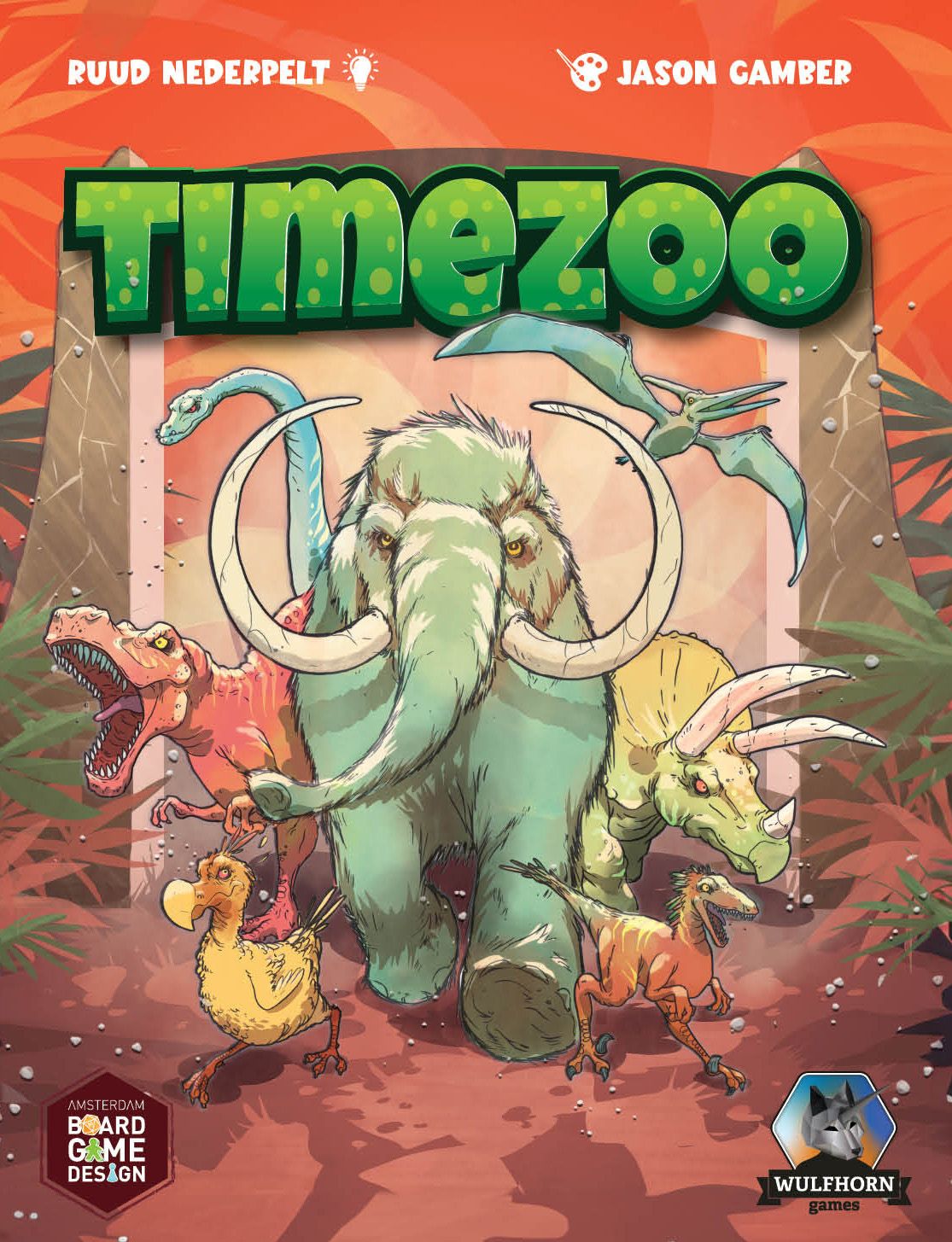
About this game

You landed your dream internship; working for professor Darwina Anning at the Time Zoo. The zoo filled with prehistoric animals is about to open when disaster strikes and all animals escape! It’s up to you to lure them back to the Time Zoo. Time Zoo is a card game for 2 to 5 players in which you have to lure prehistoric animals by playing different food cards. The animals all have different properties and are also worth points at the end of the game. The player with the most points at the end of the game is the winner and will receive the highest internship allowance from Professor Anning. Collect enough of the correct food cards are lure different animals in your part of the Time Zoo. All the prehistoric animals are worth points at the end of the game. Most of the cards also trigger special abilities that can give you more food cards, add points to you score or steal from your opponents. -description from designer

What it feels like

Set Collection Take That Prehistoric Animals Card Game Zoos, Aquaria, Safari Parks

Explore these mechanics in Cardboard

Start an original prototype from reusable design patterns—not this game's content.

Open mechanics workbench

Game intelligence

Learn the game

80% knowledge coverage

Setup

1. Shuffle the Animal cards into one face-down deck and the Food cards into a separate face-down deck. Keep the two piles apart.\n2. Deal 5 Food cards to each player as their starting hand.\n3. Flip the top Food card face up next to the Food deck to begin the discard pile. Cards in the discard pile are always placed face up.\n4. Place 5 Animal cards face up in a row in the center of the table. These are the animals available to lure.\n5. Deal 1 Intern card face up to each player; place it in front of them.\n6. Determine the first player: the player who best imitates a Tyrannosaur or Mammoth (their choice) goes first. Give that player the Professor card as the first-player marker.\n\nAdvanced variant: Instead of dealing Intern cards at setup, shuffle them into the Animal deck. When an Intern card appears in the row, a player may use their action to claim it for free.

Turn flow

On your turn you perform exactly 1 action. You choose either:\n\n• TAKE FOOD: Draw the top 2 cards from the Food draw pile, OR the top 2 cards from the discard pile, OR 1 card from the draw pile and 1 card from the discard pile.\n\n• LURE AN ANIMAL: Play the required Food cards from your hand to claim 1 Animal card from the row. Place the Animal card face up in front of you (your Time Zoo). Immediately fill the empty slot in the row with the top card of the Animal deck. Then immediately resolve any action printed on the Animal card (or note its end-game bonus for final scoring).\n\nIn the Advanced variant, a third action is available: CLAIM AN INTERN CARD from the row (no food cost, but uses your full action for the round).

Scoring and victory

Highest total point score wins. Each player sums base points on Animal cards, end-game bonus points from special actions, and Intern card bonuses. The player with the most points wins. Scoring sources: Base point values printed on Animal cards, Mammoth pair bonus (+2 per Mammoth if you own both male and female), Mammoth single bonus (+1 per Mammoth for having a male and/or female), Vegetarian food cards tucked under a specific Herbivore animal (+1 per card), Dodo set bonus (2 Dodos = +4, 3 Dodos = +8), Egg set bonus (2 eggs = +3, 3 eggs = +5, 4 eggs = +7), Intern card bonus: +3 for at least 3 animals of a matching type, Intern card bonus: +3 for having at least 1 animal of each type, Intern cards acting as Dodo or Egg tokens for set bonuses

Source: Rulebook

Rules to know

The most useful rules for getting a first game right.

Setup

Shuffle Animal and Food cards into two separate decks.

Before the game begins, shuffle the 38 Animal cards into one face-down draw pile and the 63 Food cards into a separate face-down draw pile. These two piles are kept apart throughout the game.

Setup

Each player receives 5 Food cards as their starting hand.

At the start of the game, deal 5 Food cards to each player. These form each player's starting hand, which they keep secret from other players.

Setup

Flip the top Food card face up to start the discard pile.

After dealing starting hands, flip the top card of the Food draw pile face up and place it next to the Food deck. This is the beginning of the discard pile. Cards in the discard pile are always placed face up and visible to all players.

Setup

Place 5 Animal cards face up in a row in the center of the table.

Draw the top 5 cards from the Animal deck and place them face up in a row at the center of the table. These are the animals currently available to be lured. Players may only lure animals from this row.

Setup

Each player receives 1 Intern card, placed face up in front of them.

At the start of the game, deal 1 Intern card to each player. Players place their Intern card face up in front of them so all players can see it. Intern cards provide end-game bonus points based on the composition of each player's Time Zoo.

Setup

The best Tyrannosaur or Mammoth imitator goes first and receives the Professor card.

To determine the first player, all players compete to best imitate a Tyrannosaur or a Mammoth (the group's choice). The winner of this contest receives the Professor card, which serves as the first-player marker. Play proceeds clockwise from the first player.

Turn structure

On your turn, perform exactly 1 action: either Take Food or Lure an Animal.

Each player's turn consists of performing exactly 1 action. The two available actions are: (1) Take Food — draw cards from the Food draw pile and/or discard pile into your hand; or (2) Lure an Animal — play Food cards from your hand to claim an Animal card from the row. You may not perform both actions in one turn, nor skip your turn entirely.

Resource management

Take Food: draw 2 cards from the draw pile, 2 from the discard pile, or 1 from each.

When you choose the Take Food action, you have three options: (a) take the top 2 cards from the Food draw pile; (b) take the top 2 cards from the discard pile; or (c) take 1 card from the top of the Food draw pile and 1 card from the top of the discard pile. All taken cards are added to your hand.

Common questions and edge cases

I want to play a Food card with two icons to help pay for an Animal card. Which icon counts?

When you play a dual-icon Food card, you must choose one of the two icons at the time of play. Only the chosen icon counts toward the animal's food requirement. You cannot use both icons from a single card simultaneously.

An Animal card shows 3 yellow circles (no food icons). Can I pay with 3 different types of food?

No. When multiple yellow circles appear in a row, all cards played to satisfy those circles must be the same color/type. You must pay 3 Food cards of the same type, even though each circle individually accepts any type.

I lured a Pescatarian that lets me lure another animal. Does the second lure cost me an extra action?

No. The extra lure granted by the Pescatarian special action is free — it does not cost an additional turn action. However, you must still pay the full food cost of the second Animal card from your hand.

I have 2 female Mammoths and 1 male Mammoth. Does the male get +2 twice?

No. Mammoth bonuses are not cumulative. The male Mammoth gets +2 only once for having the female Mammoth, regardless of how many female Mammoths you own. Similarly, a single Mammoth can only score its bonus once.

Can my Intern card that counts as a Dodo contribute to the Dodo set bonus?

Yes. The Intern card that says it counts as 1 Dodo is included when calculating the Dodo set bonus. For example, if you have 1 Dodo Animal card and the Dodo Intern card, that counts as 2 Dodos for +4 bonus points.

Can my Intern card that counts as an Egg contribute to the Egg set bonus?

Yes. The Intern card that says it counts as 1 Egg is included when calculating the Egg set bonus. For example, 1 Egg Animal card plus the Egg Intern card counts as 2 Eggs for +3 bonus points.

A Carnivore action removes 3 Animal cards from the row. Are those slots refilled immediately?

Yes. Any time an Animal card is removed from the row for any reason, the empty slot is immediately filled from the top of the Animal deck. After removing 3 cards, 3 new Animal cards are drawn to refill the row (assuming cards remain in the deck).

In the advanced game, can a player have more than 1 Intern card?

Yes. In the advanced variant, Intern cards are shuffled into the Animal deck and any player can claim one as a free action when it appears in the row. It is possible to hold multiple Intern cards, and all of them count for scoring at the end of the game.

The last Animal card was just placed in the row on my turn. Does the game end immediately?

No. When the last Animal card is placed in the row, the end-game is triggered, but play continues until all players have had the same number of turns. Players who have not yet taken a turn in that round finish their turns before final scoring begins.

I lured the Omnivore with the exchange action. Do I have to swap it with an opponent's animal?

Yes. The exchange action is mandatory — once you lure this Omnivore card, you must exchange it with an Animal card from one of your opponents' Time Zoos. You choose which opponent and which of their Animal cards to take.

When I lure the Herbivore that tucks food cards for +1 each, do ALL food cards I pay go under it, or just the vegetarian ones?

Only vegetarian (Herbivore-type) Food cards played during that lure action are tucked under the card for +1 point each. Non-vegetarian food cards used to pay any wild (yellow circle) slots go to the discard pile as normal and do not count.

Ask About This Game

Similar games