2005 BGG rank #2338

Trans Europa

2–6 players 20 min Ages 8+ 1.4/5 complexity 6.2/10 rating

About this game

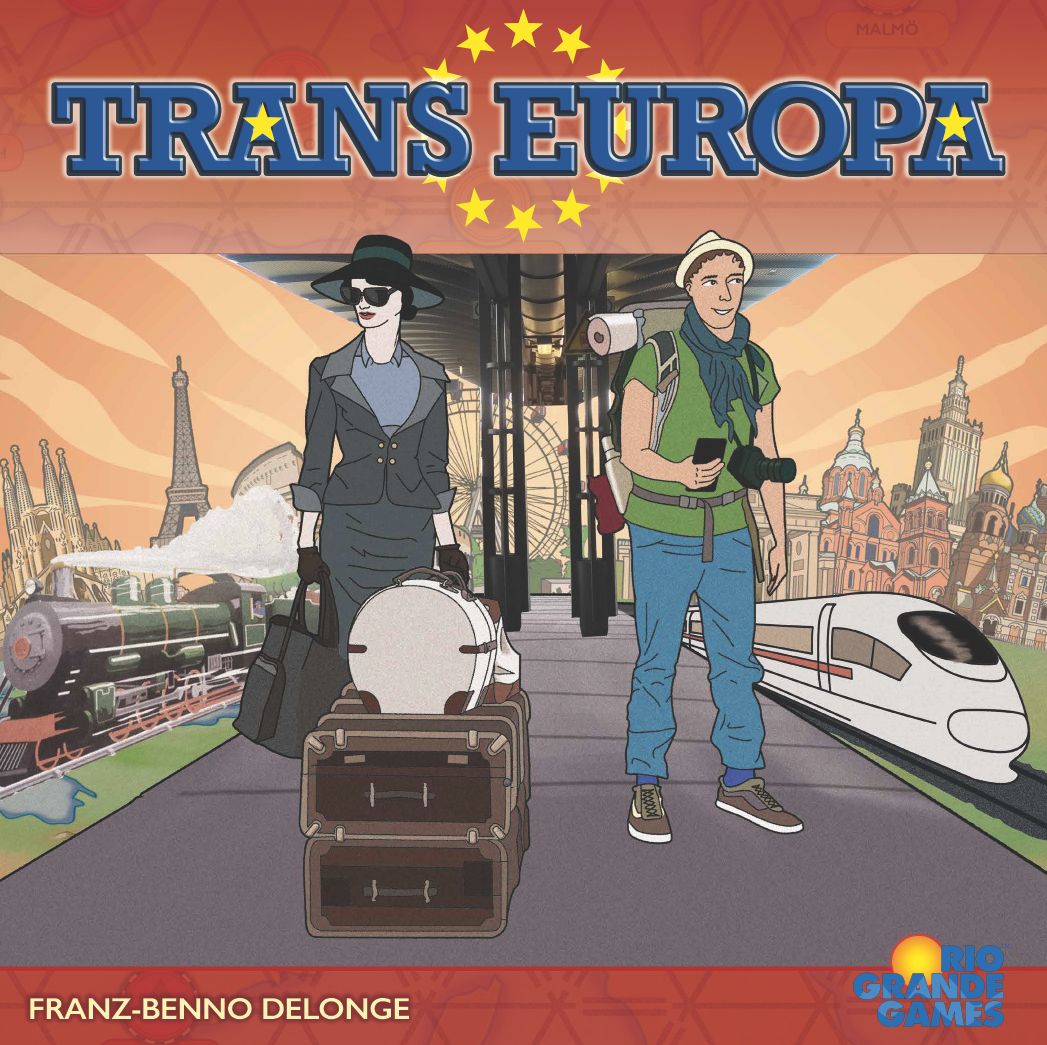
Trans Europa is a simple railway game. Each player has a set of five cities strung across Europe that need to be connected by rail. Players place either one or two rails each turn. The first player to connect their five cities wins the round, with all other players losing points for being too slow! After 3-4 rounds, the player with the most points wins! One version of this game, TransEuropa+, includes the Vexation expansion of colored rails, with each of the six colors having three colored rails. When you place one of these rails on the board, it counts only as part of your network and not anyone else's. The 2018 edition of Transeuropa, which is the preferred spelling of the publisher although the box suggests otherwise, includes a slightly different map of Europe, with the colored cities rotated so that all of the yellow cities are in the UK and Scandinavia. What's more, these cities are separated from others by double-squiggly lines that represent spaces where a ferry can go. As with the Vexation expansion, in this edition each player has three colored rails, and on a ferry route up to two rails can be placed, whether both colored rails or one being colored and the other a normal black rail line that any player can use. A player can lay only one colored rail per turn, and they can claim both possible rail lines in a ferry space. A ferry space is not complete unless it contains two rail lines.

What it feels like

Race Connections Score-and-Reset Game Trains

Game intelligence

Learn the game

100% knowledge coverage

Setup

1. Unfold the board and place all track tokens nearby. 2. Each player chooses a color, places their cylindrical starting marker in front of them, and positions their locomotive on the red engine-shed space at the top of the scoring track (above space 12). 3. In a 2- or 3-player game, remove the 10 city cards with a striped border (2 from each color) from the deck, leaving 25 cards. 4. Shuffle all remaining city cards (35 in a 4–6 player game, 25 in a 2–3 player game) face-down and spread them across the table. 5. Each player secretly selects 5 cards — exactly one card from each of the 5 colors. Players may look at their own cards but must keep them hidden from others. 6. Remove all remaining city cards from the game without looking at them (they are set aside for future rounds). 7. Give the Starting Player card to one player.

Turn flow

Each round begins with the starting player, then proceeds clockwise. On the very first turn of each round every player places their cylindrical starting marker on any free intersection (which may also be a city) on the board — this becomes the origin point of their rail network. On each subsequent turn a player MUST do exactly one of the following: (A) Place 1 or 2 track tokens on free single-line segments, OR (B) Place 1 track token on a free double-line segment (river bridge, mountain tunnel, or sea crossing). Additional rules governing track placement: • All placed track must be adjacent to (connected to) the player's existing network, i.e. reachable from their starting marker. • At least 1 track token must be placed each turn. • When placing 2 tokens on single-line segments, the two segments do NOT need to be adjacent to each other — a player may extend their network in two different places simultaneously. • During play, different players' networks may merge/connect. The round ends immediately when one player has connected all 5 of their cities. The winning player reveals their city cards. If they made an error (a city is not actually connected), they continue playing with their cards face-up. Exception: If the player whose turn it is has already placed the first of two allowed track tokens when the round-ending condition is met, they may still place the second token before the round officially ends. Rare case: The round also ends if all track tokens are exhausted.

Scoring and victory

Lowest score loses. All players start at the top of the scoring track. Each round, players who failed to connect all 5 cities lose points (move their locomotive down). The player whose locomotive is highest (most points remaining) at game end wins. Ties result in shared victory. Target score: Game ends when at least one player reaches or passes the red space below position 1 on the scoring track Scoring sources: −1 point per missing single-line segment needed to complete your network at round end, −2 points per missing double-line segment (bridge/tunnel/sea) needed to complete your network at round end, 0 points lost for the player who completes the round (connected all 5 cities)

Source: Rulebook

Rules to know

The most useful rules for getting a first game right.

Setup

Remove 10 striped-border city cards in 2–3 player games.

When playing with 2 or 3 players, remove exactly 10 city cards — the ones with a striped border around the image, 2 from each of the 5 colors — before shuffling. This reduces the deck to 25 cards. In games with 4–6 players, all 35 city cards are used.

Setup

Each player secretly selects 5 city cards, one per color.

After shuffling the appropriate deck, all cards are spread face-down. Each player picks exactly 5 cards, one card from each of the 5 color groups. Players may look at their cards in secret but must not reveal them to opponents. All remaining, unselected cards are removed from the game without being looked at; they are set aside until possibly needed for a subsequent round.

Setup

On the first turn of each round every player places their starting marker on any free intersection.

At the very start of a new round, before any track is laid, each player — in turn order beginning with the starting player — places their cylindrical starting marker on any free intersection on the board. City spaces count as intersections and are valid placements. This marker serves as the mandatory origin of that player's rail network for the entire round. A player may not move their starting marker once placed.

Building

On their turn a player may place 1 or 2 track tokens on free single-line segments.

Option A for a turn: The active player places 1 or 2 black track tokens on free (unoccupied) single-line board segments. Each placed token must be on a segment adjacent to (directly connected to) the player's existing network. If placing 2 tokens, they do not need to be adjacent to each other — both must each individually connect to the player's network, but they can be at two separate branch points.

Building

On their turn a player may place exactly 1 track token on a free double-line segment (bridge, tunnel, sea crossing).

Option B for a turn: The active player places exactly 1 black track token on a free double-line segment. Double-line segments represent river bridges, mountain tunnels, and sea crossings. Only 1 token may be placed on a double-line segment per turn (not 2). The segment must be adjacent to (connected to) the player's existing network.

Restriction

A player must place at least 1 track token each turn; passing is not allowed.

Every turn the active player is required to place at least 1 track token. A player cannot choose to pass or skip their turn. Failing to have a legal placement is only possible if all track tokens are exhausted (see rare round-end condition).

Restriction

Track tokens may only be placed on segments directly connected to a player's own network.

A player's track token placement is always restricted to segments that are directly adjacent to — and thus extend — their existing rail network. The network originates at the player's starting marker. A segment that is not reachable through a continuous chain of that player's own tokens (or their starting marker) may not be used. Networks of different players may connect to each other during play, and once connected a player may extend through the shared connection.

Special

Different players' networks may connect and merge during play.

When a player places a track token on a segment that physically connects their network to another player's network, the two networks are joined. From that point forward, both players may extend from any part of the merged network. This can be strategically advantageous or disadvantageous depending on city positions.

Strategy briefing

Starting Marker Placement

Place your starting marker as centrally as possible among your 5 secret cities to minimize the total track needed. Placing it on one of your own cities immediately gives you a free connection for that city. The rulebook warns that placing your marker near another player's marker is not necessarily a good strategy, as merged networks can inadvertently help rivals complete their routes.

Network Merging — Double-Edged Sword

Merging your network with another player's extends your reach for free, but also extends theirs. Be cautious about connecting to a player who needs fewer tracks to finish — you risk triggering the end of the round before you're ready, costing you significant penalty points.

Double-Line Segments Are Costly to Miss

Each unbuilt double-line segment (bridge, tunnel, sea crossing) costs −2 points rather than −1. Prioritize completing double-line segments on your critical path early, since they also consume an entire turn for just 1 token.

Two-Token Turns for Branching Networks

When your network needs to branch toward multiple cities, use the two-single-token option to simultaneously extend in two different directions. Since the two tokens don't need to be adjacent, you can make progress on two separate city connections in a single turn.

Timing the Round End

Because the round ends as soon as any player connects their 5 cities, it can end on any player's turn — not just yours. Track opponents' progress and consider blocking key segments or racing ahead rather than pursuing a slow but efficient route.

Common questions and edge cases

Can I extend my network through another player's already-built tracks after our networks merge?

Yes. Once two players' networks are physically connected (touching), both players may place new track anywhere adjacent to the merged combined network, including segments reachable only via the other player's tracks. Connectivity, not ownership, determines valid placement.

I placed my first track token and it completed another player's network, ending the round. Can I still place my second token?

Yes. If you were in the process of placing 2 tokens on single-line segments and the round-ending condition was triggered by your first placement, you are still entitled to place your second token before the round is officially resolved and scoring begins.

I needed to cross a river bridge (double-line) to connect one of my cities. How many points do I lose for it?

You lose 2 points for each double-line segment (river bridge, mountain tunnel, sea crossing) missing from your completed network. Single-line segments each cost 1 point. Be sure to count double-line gaps at −2 each.

A player announced they connected all 5 cities and ended the round, but after checking their cards a city was not actually connected. What happens?

The round does NOT end. The player made an error and must continue playing — but now with their city cards revealed face-up for all other players to see for the remainder of the round.

When placing 2 track tokens on single-line segments, must they be next to each other?

No. The two tokens do not need to be adjacent to each other. A player may extend their network in two entirely separate locations in the same turn, as long as each token individually connects to the player's existing network.

Can I place 2 track tokens on a double-line segment (e.g. a tunnel) in one turn?

No. When choosing the double-line option, a player places exactly 1 token on the double-line segment — that is the entire turn. You cannot combine a double-line placement with a single-line placement in the same turn either; it is one or the other.

Can I place my starting marker directly on a city space at the start of the round?

Yes. City spaces count as intersections and are valid placements for the cylindrical starting marker. Placing it on one of your own cities can be an efficient strategy.

Ask About This Game

Similar games