1980 BGG rank #6532

Trax

2 players 10 min Ages 8+ 2.1/5 complexity 5.7/10 rating

About this game

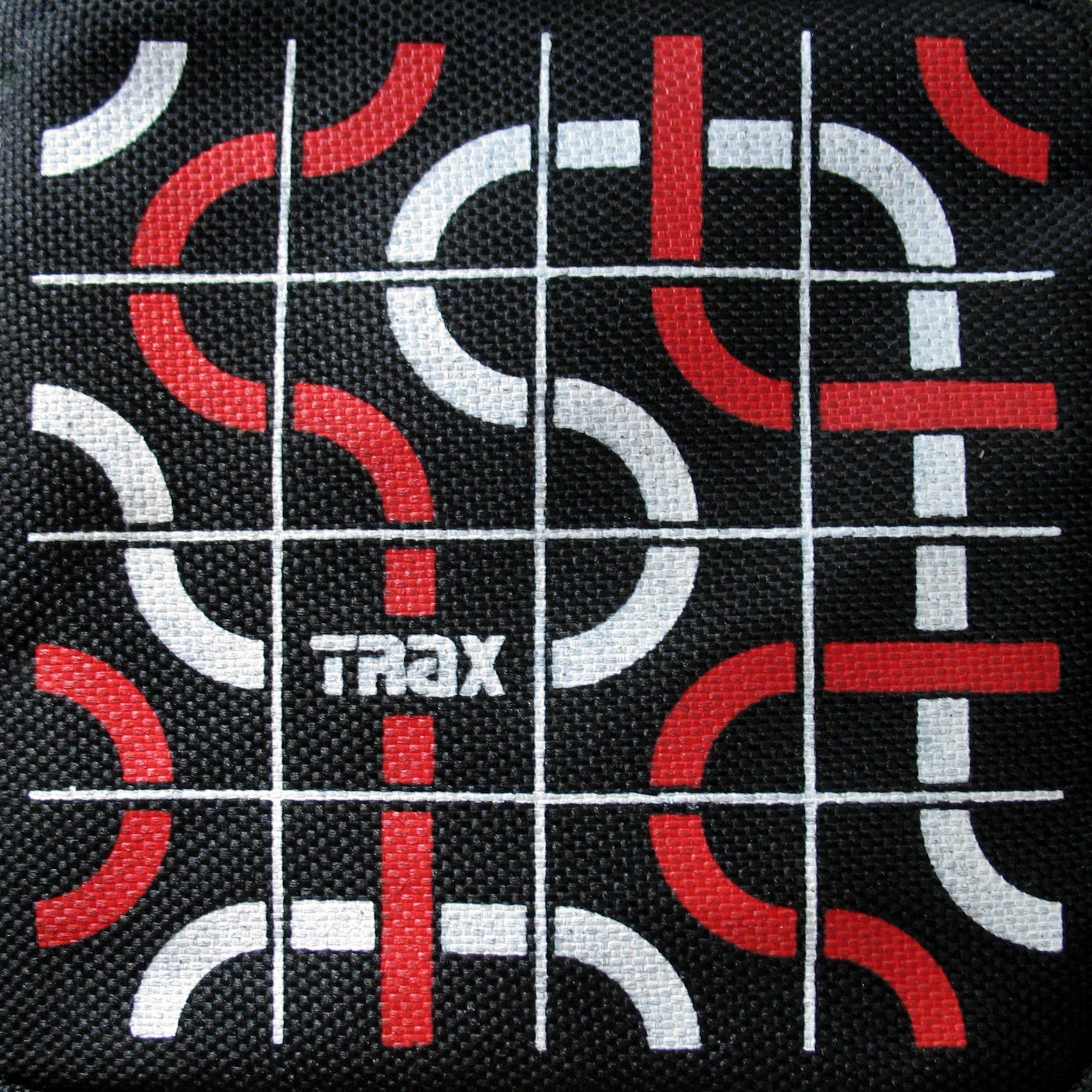
from the Trax site: Trax is a two player abstract strategy game of loops and lines. It can be played on any flat surface (no board). The square tiles have straights on one side and curves on the other. The rules of TRAX are simple: place tiles adjacent to those already in play such that the colours of the tracks match. The objective is to get a loop or line of your colour while attempting to stop your opponent in their colour. What gives Trax its strategic depth is the forced play rule which allows (or even requires) multiple tiles to be played in a turn.

What it feels like

Tile Placement Network and Route Building Square Grid Pattern Building Abstract Strategy

Explore these mechanics in Cardboard

Start an original prototype from reusable design patterns—not this game's content.

Open mechanics workbench

Game intelligence

Learn the game

100% knowledge coverage

Setup

1. Decide by prior agreement which player controls white track and which controls black track.\n2. White goes first.\n3. No board is used — tiles are placed on any flat surface, building the play area as the game progresses.\n4. (Optional) Agree before the game whether to play the standard variant, 8x8 Trax, or LoopTrax.

Turn flow

Starting with the White player, players alternate turns. On each turn, a player places one tile (either side up) edge-to-edge alongside any tile or tiles already in play, ensuring that all touching edges join sections of the same-coloured track. After placing, if any adjacent empty space now has the same-coloured track entering it from exactly two edges, the active player must immediately place a tile in that space to connect those tracks (Forced Play). A forced play may itself trigger further forced plays, all resolved as part of the same turn. If at any point a forced play would require a space where same-coloured track enters from more than two edges, the entire turn is illegal and must be replayed.

Scoring and victory

The first player whose track forms a qualifying loop or line at the end of a completed turn wins. There is no point scoring — it is a pure win/loss game. Target score: First to form a loop or line wins. Scoring sources: Forming a loop: a continuous track path of one colour that connects with itself., Forming a line: a continuous track path of one colour connecting opposite outermost tile edges across at least 8 rows/columns.

Source: Rulebook

Rules to know

The most useful rules for getting a first game right.

General

Each tile has two sides: one with curved tracks joining adjacent edges, one with straight tracks joining opposite edges.

Every Trax tile is square and identical. One side shows two curved track sections, each connecting two adjacent (perpendicular) edges of the tile — one curve in black, one in white. The other side shows two straight track sections, each connecting two opposite (parallel) edges of the tile — one straight in black, one in white. A player may place the tile with either side face-up.

Setup

Two players agree before the game which player is represented by white track and which by black track.

Before the game begins, the two players determine by prior agreement who shall be represented by white track and who by black track. This assignment is fixed for the entire game.

Turn structure

White places the first tile to start the game; no adjacency restriction applies to the very first tile.

The White player always takes the first turn of the game. The very first tile may be placed on any flat surface without any adjacency requirement, since there are no existing tiles yet. The tile may be placed either side up.

Turn structure

After the first turn, each tile must be placed edge-to-edge adjacent to existing tiles and must join same-coloured track on all touching edges.

From the second turn onward, a player places exactly one tile (either side up) onto the playing surface. The tile must be placed edge-to-edge alongside at least one tile already in play. Every edge of the newly placed tile that touches an edge of an existing tile must show track of the same colour as the track on the touching edge of the existing tile. A placement that would violate this colour-matching rule is illegal.

Turn structure

A player may advance track of either or both colours in a single turn.

There is no restriction on which colour of track is advanced when a player places a tile. A tile placement may extend white track, black track, or both simultaneously. This means a player may unintentionally (or intentionally) benefit their opponent's track while extending their own.

Special

If a placed tile creates an adjacent space where same-coloured track enters from exactly two edges, the active player must immediately fill that space — this is a Forced Play.

After a player places any tile (including as a result of a previous forced play), the active player must inspect all spaces adjacent to the newly placed tile. If any such space is empty and has same-coloured track entering it from exactly two of its edges (from already-placed neighbouring tiles), the active player is required to place a tile in that space to join up those two track segments. This is called a Forced Play and is resolved as part of the same turn. A forced play tile placement may itself create new adjacent spaces that satisfy the forced-play condition, requiring still further forced plays, all within the same turn. Forced plays are mandatory and automatic — the player has no choice about whether to make them, only about the orientation of the tile placed (if the forced space has same-coloured track entering from two specific edges, the tile orientation is actually fully determined by the need to connect those tracks; in practice the tile orientation may be fixed).

Restriction

If a forced play would create a space where same-coloured track enters from more than two edges, the entire turn is illegal and must be replayed.

During forced play resolution, if an empty adjacent space is created where same-coloured track enters it from more than two of its four edges, no legal tile can fill that space (no tile connects three or more edges of the same colour). In this case the entire turn — including the initial placement and all forced plays — is declared illegal and uncomplete. The active player must remove all tiles placed during that turn and choose a different placement. This situation is rare but possible.

Endgame

A player wins if their track forms a loop (a continuous path that connects with itself).

A loop is a continuous path of one player's track that connects back to itself, forming a closed circuit. If a player's track forms a loop at any point during a completed turn — whether from their own placement, forced plays, or even during the opponent's turn — that player wins, subject to the simultaneous-win tiebreaker rule.

Strategy briefing

Creating Double Threats

The most powerful attacking strategy is to create two simultaneous winning threats (two separate near-complete loops or lines) so the opponent cannot block both in a single turn. Many puzzles in the collection are solved this way — the notation shows branching lines (marked with '|') where each branch is a different threat the opponent must answer.

Exploiting Forced Plays Offensively

Forced plays are a core offensive weapon. By placing a tile that creates a forced play, you can cause your opponent to be obligated to extend your own winning track further, potentially completing your loop or line for you. Plan placements that chain forced plays in your favour.

Avoiding Self-Defeating Forced Plays

Forced plays triggered during your own turn can complete your opponent's winning track, causing you to lose. Before placing a tile, trace all downstream forced play consequences to ensure you don't inadvertently hand the game to your opponent.

Avoiding Illegal Turns

A turn that creates a three-edge same-colour conflict is illegal and must be replayed. While this is rare, setting up a position where the opponent's only available placements are all illegal is an advanced form of zugzwang.

LoopTrax — Focus Entirely on Loops

In LoopTrax, line threats are worthless. All strategic effort should be directed at forming or threatening loops, and at blocking the opponent's loop formations. A strong line position has no value and can be ignored.

8x8 Trax — Draw Awareness

In 8x8 Trax, the game can end in a draw. When behind, a player may aim to steer toward positions that fill the board without a win, forcing a draw rather than a loss. Conversely, a winning player should close out quickly rather than allowing the board to fill.

Turn Order and Simultaneous Wins

Because a player does not win if the opponent's track also forms a winning condition in the same turn, be careful when your winning track also nearly completes the opponent's. The non-active player wins a tie. This means as the active player you must ensure your winning path does NOT simultaneously complete the opponent's winning path.

Common questions and edge cases

A player places a tile that triggers forced plays. One of those forced plays completes a loop or line for the opponent. Does the active player lose?

Yes. A player can win during the opponent's turn if the opponent's completed turn (including all forced plays) creates a loop or line for them, provided the opponent's track does not also simultaneously form a loop or line. So if forced plays complete your opponent's winning condition without also completing yours, you lose.

At the end of a player's completed turn, both the active player's track and the opponent's track simultaneously form a loop or line. Who wins?

Neither player wins on a simultaneous condition formed during the active player's turn — the active player does NOT win when the opponent's track also forms a loop or line in the same turn. This effectively means the active player loses (the opponent wins), since forming a winning track for both players simultaneously counts as a win only for the non-active player.

A player places a tile, which forces another tile, which then creates a space where the same colour track enters from three edges. What happens?

The entire turn is illegal. The player must remove ALL tiles placed during that turn (the initial placement and all forced plays) and choose a completely different initial placement. The illegality of a cascade forced play invalidates the whole turn, not just the last forced play.

In a LoopTrax game, a player's track spans 8+ rows connecting opposite outermost edges. Does that player win?

No. In LoopTrax, the line win condition is removed entirely. Only forming a loop (a track that connects with itself) wins the game. The line formation is irrelevant in this variant.

In 8x8 Trax, all 64 spaces are filled and no player has formed a loop or a line. What happens?

The game is declared a draw. In 8x8 Trax, once all tiles that can be legally played have been played without a win condition being met, the result is a draw.

During a forced play, the active space has the same-coloured track entering from exactly two edges. Does the player choose how to orient the forced tile?

In practice the tile orientation is fully determined by the requirement to connect the two incoming same-colour track segments. The player must place the tile such that those two track segments are joined, which dictates a specific tile side and orientation. There is no player choice involved in a forced play tile's orientation.

Can tiles be placed to expand the playing area beyond the original tile location, and how is this tracked in notation?

Yes. The play area expands dynamically as tiles are placed. Columns expand left using '@' for the column immediately left of A, and rows expand upward using '0' for the row immediately above row 1. New lettered columns (AA, AB, etc.) handle rightward expansion. There is no hard boundary except in the 8x8 Trax variant.

Ask About This Game

Similar games