2019

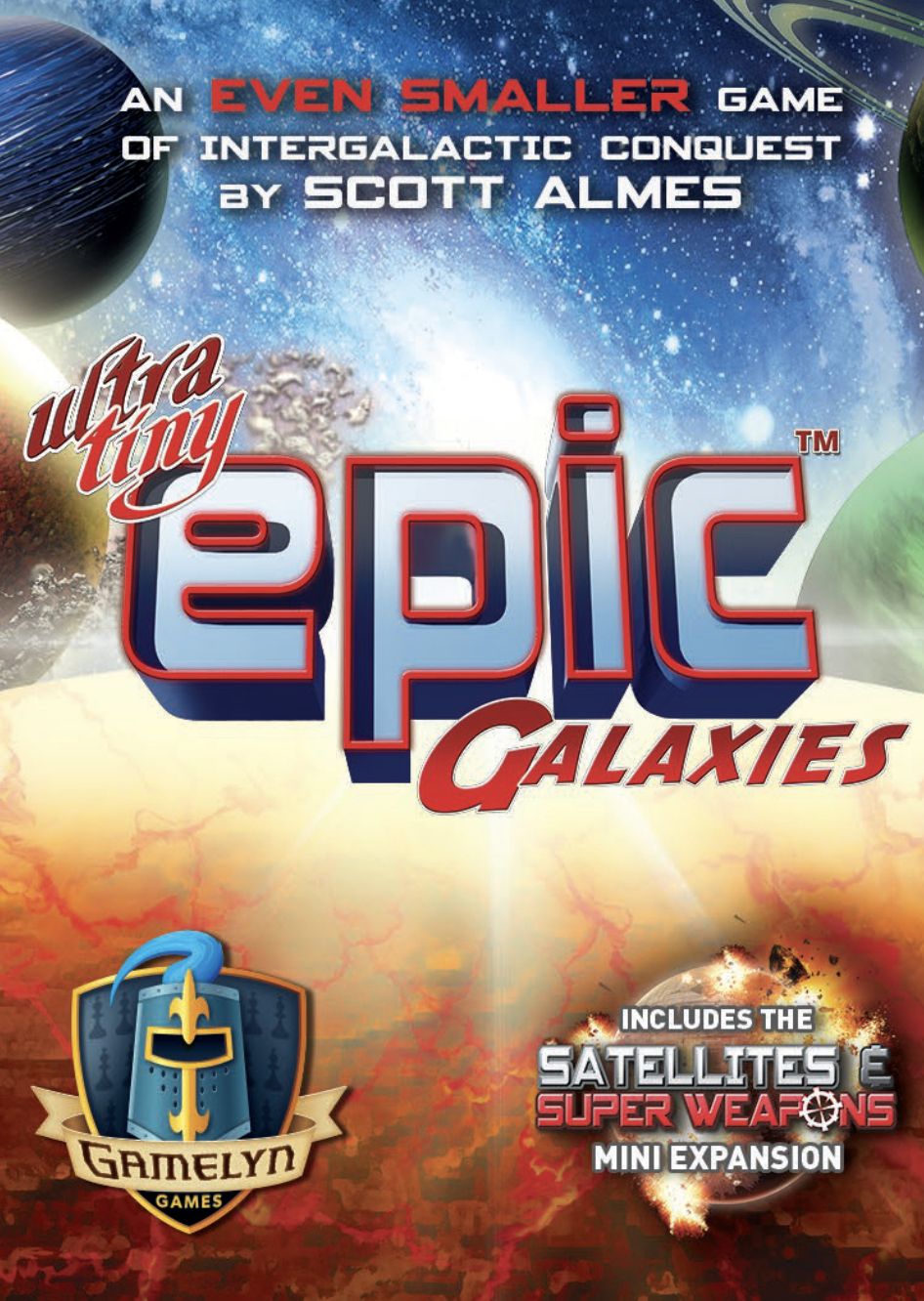
Ultra Tiny Epic Galaxies

1–5 players 30–45 min Ages 14+ 2.2/5 complexity 6.2/10 rating

About this game

Ultra-Tiny Epic Galaxies is a complete and unabridged version of Tiny Epic Galaxies in a box the size of a deck of cards. It plays the full spectrum of 1 to 5 players, has all 40 original planets, and even includes the Satellites & Super Weapons Mini-Expansion! Tiny Epic Galaxies FAQ

What it feels like

Solo / Solitaire Game Variable Player Powers End Game Bonuses Dice Rolling Area Majority / Influence Open Drafting Race Track Movement Re-rolling and Locking Variable Phase Order Follow Science Fiction Space Exploration Dice

Explore these mechanics in Cardboard

Start an original prototype from reusable design patterns—not this game's content.

Open mechanics workbench

Game intelligence

Learn the game

100% knowledge coverage

Setup

1. Separate and shuffle the Planet cards; deal a number appropriate to the player count face-up to form the galaxy row. 2. Shuffle the Secret Mission cards and deal one face-down to each player (kept secret until revealed). 3. Shuffle the Mission cards and make them available as a draw deck. 4. Place Super Weapon cards nearby as a shared supply. 5. Each player takes their set of Satellites and player dice. 6. Determine a starting player. 7. Each player sets their Empire Track to the starting position.

Turn flow

On your turn, roll all of your dice. You may use each die result to take a corresponding action (move a ship, gain energy, gain culture, colonize a planet, use a special ability, etc.). After using a die, you may re-roll remaining dice a limited number of times based on your Empire level. Other players may follow any action you take by spending 1 Culture, allowing them to benefit from your turn as well. Once all dice are resolved or you choose to stop, your turn ends and play passes clockwise.

Scoring and victory

Most victory points at game end wins. In case of a tie, the tied player with the most colonized planets wins. Target score: 21 Scoring sources: Victory points printed on colonized planet cards, Current Empire track level (1 VP per level), Fulfilled Secret Mission bonus VP, Fulfilled standard Mission bonus VP

Source: Rulebook

Rules to know

The most useful rules for getting a first game right.

Turn structure

Each die face corresponds to a specific action the active player may take.

On your turn, roll all your dice. Each die face maps to one of the following actions: Move a Ship (advance a ship along a planet's orbit track), Colonize (claim a planet your ship has fully orbited), Gain Energy (collect Energy resources), Gain Culture (collect Culture resources), Use Galaxy Cannon (attack or special ability), or Empire Advancement (move up your Empire track). You must take each chosen die's action before re-rolling unused dice.

Turn structure

The active player may re-roll unused dice a number of times equal to their Empire level.

After resolving one or more dice, the active player may re-roll any remaining unused dice. The number of re-rolls available equals the player's current Empire level (starting at 1). Each re-roll costs nothing but counts against the total re-roll allotment for the turn. The player may stop rolling at any time.

Turn structure

Any non-active player may follow one action per die the active player uses by spending 1 Culture.

When the active player uses a die to take an action, each other player may immediately pay 1 Culture to perform that same action. Each non-active player may follow at most once per die used. Following does not require the following player to have a die showing that face — only the Culture cost applies.

Movement

Using a Move Ship die result advances one of your ships one step along a planet's orbit track.

When you use the Move Ship action, choose one of your ships currently in orbit around a planet and advance it one space along that planet's orbit track. Each planet has a track of a fixed length (shown on the card). Ships must travel the full track before colonization is possible. A ship may orbit any planet currently in the galaxy row.

Building

When a ship completes a planet's orbit track, you may use a Colonize die result to claim it.

A ship that has advanced through all spaces of a planet's orbit track is eligible for colonization. On a turn when you roll (or keep) the Colonize die face, you may claim that planet: take the planet card and place it in front of you, gain its immediate bonus if any, and return your satellite to your supply. The planet's ongoing ability and victory point value are now yours for the rest of the game.

Resource management

Your Empire track level determines your die count and number of re-rolls per turn.

Each player has an Empire track with levels 1 through 6 (or similar). Your current level equals the number of dice you roll each turn AND the number of re-rolls you may take. Advancing on the Empire track costs an Empire Advancement die result. Higher Empire levels dramatically increase your action economy each turn.

Resource management

Use an Empire Advancement die result to move up one level on your Empire track.

When you use the Empire Advancement die face, move your marker up one space on your Empire track. This immediately increases the number of dice you roll and the number of re-rolls available to you starting next turn (the current turn's die count and re-rolls are fixed at the start of the turn).

Resource management

Energy is a resource used to trigger planet special abilities.

Gain Energy by using the Gain Energy die face. Energy is stored on your player board up to your current storage limit. Energy is spent to activate the special abilities of planets you have colonized that require Energy. Energy does not carry a direct victory point value.

Strategy briefing

Prioritize Empire Track Early

Advancing your Empire track (empire_advancement_action) as early as possible compounds throughout the game: each level gained increases both your dice count and re-roll budget (reroll_rule), dramatically expanding your action economy for all subsequent turns. A level-4 empire generates roughly twice the action throughput of a level-2 empire.

Culture as a Tempo Tool

Culture is the only resource that lets you act on opponents' turns via the follow mechanic (follow_action). Maintaining a small Culture reserve (1–2) lets you opportunistically copy high-value actions (Colonize, Move Ship) without spending your own dice, effectively gaining free actions. However, over-investing in Culture generation is wasteful if opponents aren't taking actions you want.

Target High-VP Planets Efficiently

Planets with longer orbit tracks yield more VP (scoring_planets) but require more Move Ship actions (ship_movement). Use the follow mechanic (follow_action) to advance ships on your opponents' turns, effectively halving the action cost of long-track planets.

Secret Mission Alignment

Your Secret Mission (secret_missions) should subtly steer your planet colonization choices. If your mission rewards colonizing planets of a specific type, prioritize those in the galaxy row even if their raw VP is slightly lower, since the combined score can outperform higher-face-value planets.

Empire Track Doubles as Score

Because your Empire track level scores 1 VP per level at game end (scoring_empire_track), advancing it serves two purposes simultaneously: action economy and direct scoring. Players who neglect Empire advancement often fall behind on both fronts.

Common questions and edge cases

Can a non-active player follow a Colonize action even if their ship is not yet fully around the orbit track?

No. Following a Colonize action still requires the following player to have a ship that has completed the full orbit track of a planet. The follow only waives the die face requirement, not the ship positioning prerequisite.

If a player advances their Empire track during their turn, do they immediately get more dice or re-rolls this turn?

No. The number of dice rolled and re-rolls available are fixed at the start of the turn based on the Empire level at that time. The new level takes effect from the next turn onward.

What happens if a player gains more Energy or Culture than their storage limit allows?

Any resources gained beyond the player's current storage capacity are immediately discarded. Players cannot bank excess resources.

Can a player follow an action if they have no Culture?

No. Following an action costs exactly 1 Culture. If a player has zero Culture, they cannot follow any action that turn.

When is the Secret Mission revealed and scored?

Secret Missions are kept face-down throughout the game and are only revealed at the very end, after all final turns are completed. Players then check if their condition is met and score accordingly.

Can a non-active player use a colonized planet's special ability when following an action?

No. Planet abilities are activated by spending the appropriate resource on your own turn (or when triggered passively). Following only replicates the die-face action being taken by the active player, not the planet ability activation.

Ask About This Game

Similar games