2013 BGG rank #14417

Word Whimsy

3–7 players 20–30 min Ages 15+ 1.0/5 complexity 5.5/10 rating

About this game

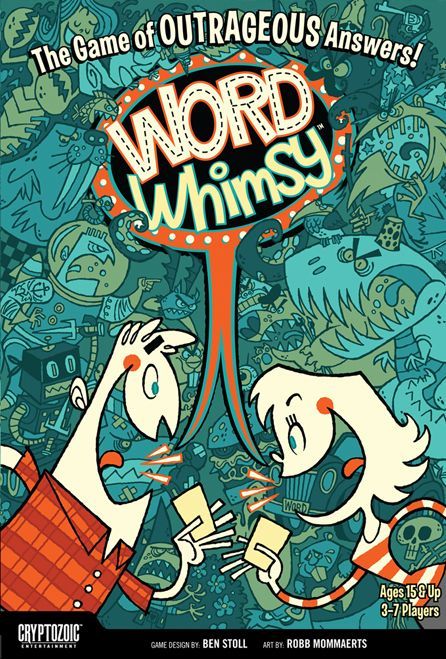
Word Whimsy is a party game that uses "prompt cards" to set the theme for each round, such as "Good Name for a Metal Band" or "Most Likely to Win in a Fight". Players then use word cards to build a title or phrase that fits the theme. One player is the judge and awards points to the best entry.

What it feels like

Word Game Party Game

Game intelligence

Learn the game

100% knowledge coverage

Setup

1. Shuffle all Word Cards thoroughly to form a single face-down draw deck and place it in the center of the table. 2. Deal an equal starting hand of Word Cards to each player (the exact hand size should be agreed upon before play — a recommended starting hand is 7 cards). 3. Determine a starting player by any mutually agreed method (e.g., the person who most recently laughed goes first). 4. Keep a notepad or scoring token set nearby to track points across rounds.

Turn flow

On their turn, a player draws one or more Word Cards from the deck, then uses cards from their hand to construct a phrase or title by laying cards face-up on the table in sequence. The combination is read aloud to all players. Other players then judge or vote on the phrase according to the agreed scoring method. After judging, the active player discards their played cards, and the turn passes clockwise. Play continues until the deck is exhausted or a target score is reached.

Scoring and victory

The player with the most points at the end of the game wins. Points are earned by having your phrase judged as the best (most votes) in each round. Target score: 7 Scoring sources: 1 point per round won by majority vote of other players, 1 point for winning a tiebreaker final round

Source: Rulebook

Rules to know

The most useful rules for getting a first game right.

General

Cards with two words (e.g., 'Bearded / Shaved') allow the player to choose exactly one word to use when playing that card.

Many cards in the deck display two alternate words separated by a slash or listed on the same card (e.g., 'Good / Bad', 'Gentle / Rough', 'Canadian / American'). When a player plays such a card, they must declare which of the two words they are using before finalizing their phrase. Once declared, the choice cannot be changed for that turn. The unused word is ignored.

General

Connector cards (e.g., 'And/Or', 'With/Of') are used to link two word groups into a longer phrase.

Cards labeled with connector words such as 'And / Or' or 'With / Of' serve a grammatical linking function. When played, the active player declares which connector word they are using. Connector cards may be used to join two sub-phrases or noun groups, allowing the construction of more complex and entertaining combinations (e.g., 'Zombie Unicorns And Exploding Kittens'). A connector card may not be played as the first or last card in a phrase.

Card play

Players combine cards from their hand to form a phrase, title, or name that is read aloud for judging.

On their turn, a player selects two or more Word Cards from their hand and arranges them in sequence to form a coherent (or hilariously incoherent) phrase, title, or name. The phrase is then read aloud clearly to all other players. There is no restriction on the type of phrase — it may be a character name (e.g., 'Sexy Robot Ninja'), a scenario title (e.g., 'Apocalypse Of Drunk Unicorns'), or any other creative combination. The goal is typically to generate the most amusing or creative phrase as judged by the group.

Drawing

At the start of each turn, the active player draws cards from the deck to replenish their hand.

At the beginning of their turn, the active player draws enough Word Cards from the top of the face-down deck to bring their hand back up to the agreed starting hand size (default: 7). If the deck runs out of cards, shuffle the discard pile to form a new draw deck. Drawing always happens before the player constructs and plays their phrase.

Scoring

After a phrase is read aloud, other players vote on or judge it, and the winner of each round scores a point.

After the active player reads their phrase aloud, all other players vote for their favorite phrase of the round (in variants where multiple players construct simultaneously) or simply award a point to the active player if their phrase meets the group's approval. The most common judging method is a simple majority vote: the phrase that receives the most votes wins the round and the player scores 1 point. Ties may be broken by the player who has scored the fewest points overall, or by a re-vote.

Restriction

Players may not hold more than the agreed maximum hand size at any time.

The maximum hand size is agreed upon before the game begins (recommended: 7 cards). If a player ever has more cards than the hand limit (e.g., due to a special rule or variant), they must immediately discard down to the limit before their turn begins. Discarded cards go face-down to the discard pile.

Restriction

A valid phrase must contain at least two Word Cards.

A player may not play a single Word Card as their entire phrase. At minimum, two cards must be combined to form a playable phrase. If a player cannot form a valid two-card phrase from their hand, they must draw additional cards (one at a time) until they can. Connector cards (e.g., 'And/Or') do not count toward the two-card minimum on their own.

Turn structure

All cards played to form a phrase are discarded face-down after judging.

Once judging is complete for a turn, all Word Cards that the active player used in their phrase are placed face-down in the discard pile. Cards that were in the player's hand but not played are retained. This keeps the game moving and prevents any single player from hoarding powerful combinations indefinitely.

Strategy briefing

Maximize Dual-Word Card Flexibility

Dual-word cards (e.g., 'Good/Bad', 'Gentle/Rough') are the most versatile cards in the deck because they give you two possible words in one card slot. Hold onto these and decide which word to declare only after reading the room — pick whichever gets the bigger reaction. Since you declare the word at play-time, you never lose flexibility until the moment you commit.

Use Connector Cards for Escalation

Connector cards ('And/Or', 'With/Of') let you build longer, more absurd phrases that typically generate bigger laughs. Since judging is social, longer, more elaborate combinations tend to win votes. Save connector cards to combine two separately strong sub-phrases into one unstoppable entry.

Manage Hand Size to Stay Flexible

Because you draw up to your hand limit at the start of your turn, playing more cards each round cycles your hand faster, giving you access to new combinations sooner. If your current hand is weak, play all the cards you can (even on a throwaway phrase) to maximize draws next turn.

Read the Room for Voting

Since judging is by majority vote of other players, tailor your phrase to your specific audience. The deck contains content ranging from absurd/silly (e.g., 'Wooly Mammoth Riding A Unicorn') to risqué. Choose the register that matches the current table mood rather than always defaulting to the most shocking combination.

Race to Target Score

With a recommended target of 7 points, the game can end suddenly. Track opponents' scores and shift strategy late-game: if someone is at 6 points, prioritize outshining them even if it means playing a riskier or more divisive combination that splits the vote rather than letting them win cleanly.

Common questions and edge cases

A player holds a dual-word card (e.g., 'And/Or') and also a dual-word descriptor card (e.g., 'Good/Bad'). Can they use both alternates in the same phrase?

No. Each dual-word card may only contribute ONE of its two words per play. The player must declare one word per card before finalizing the phrase. They cannot use both 'And' and 'Or' from the same card in a single phrase.

A player wants to play only a connector card (e.g., 'With/Of') as part of a two-card phrase. Is that valid?

No. Connector cards do not count toward the two-card minimum and cannot be played as the first or last card. A valid phrase requires at least two non-connector Word Cards, with connector cards only used between them.

The draw deck runs out while a player is drawing cards at the start of their turn. What happens?

Immediately shuffle the discard pile to form a new draw deck, then continue drawing. If the discard pile is also empty (all cards are in players' hands), the player takes whatever cards are available and the end-game condition is triggered after the current round concludes.

A player has fewer than two cards in hand and cannot form a valid phrase even after drawing. What happens?

The player draws one card at a time from the deck until they hold at least two non-connector Word Cards and can form a valid phrase. If the deck and discard are exhausted before this is possible, the player skips their turn and the end-game condition is evaluated.

Another player vetoes the active player's phrase as inappropriate. Does the active player lose their turn or their cards?

No penalty is applied. The active player reconstructs their phrase using different cards from their hand (the vetoed cards are returned to hand). If the player has no alternate cards to form a new phrase, they draw until they can. No points are lost and no cards are discarded from the vetoed attempt.

Ask About This Game

Similar games