1994 BGG rank #8632

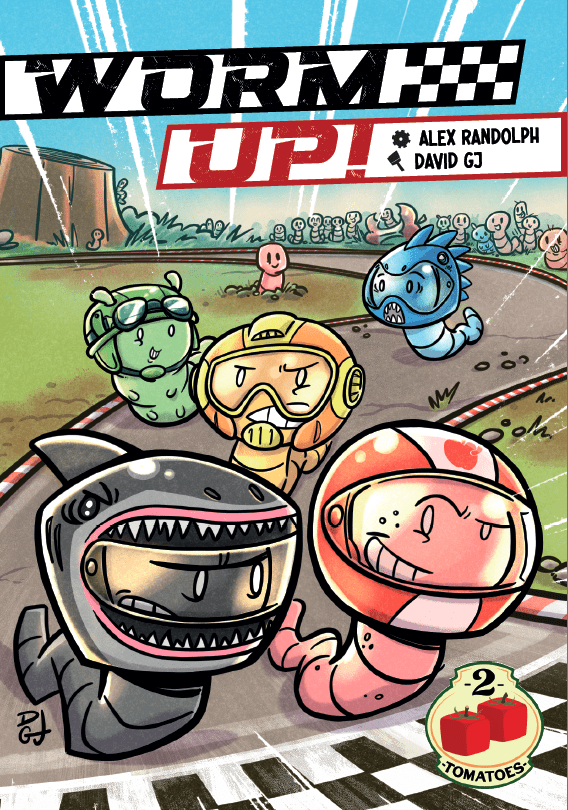
Worm Up!

3–5 players 15–20 min Ages 7+ 1.1/5 complexity 5.6/10 rating

About this game

In this fun, goofy game, each player controls a worm formed from several lined-up discs. A turn consists of all players secretly choosing on their dice the amount that they want to move. When the choices are simultaneously revealed, all players who chose the same number as someone else lose their movement for that turn. All other players move their worms according to their dice, taking the appropriate number of discs from the back of the worms and adding them to the front, sometimes curving a bit in an attempt to cut off other worms' movement.

What it feels like

Simultaneous Action Selection Racing Animals Children's Game

Game intelligence

Learn the game

100% knowledge coverage

Setup

1. Play on any smooth, flat surface.\n2. Place the finish line at one end of the course and insert 2 posts into its holes.\n3. Place the remaining 2 posts approximately 2 feet away from the finish line, spread 6–8 inches apart, to form the starting line.\n4. Each player selects a colored set of 7 worm segments and a matching colored die.\n5. Each player lines up their 7 worm segments behind the starting line, with each segment touching the one behind it, forming a compact worm.

Turn flow

Each round consists of two phases: Bidding and Moving.\n\nBIDDING PHASE: All players simultaneously and secretly select a face on their die (4, 5, 6, 7, or X) and place it face-down in front of them. When everyone has chosen, all dice are revealed at the same time. Players with unique bids (not matched by any other player) move successfully. Players who share a bid with one or more others are cancelled and do not move. The player with the lowest unique bid moves first, then the next lowest, and so on.\n\nMOVING PHASE: Each player with a successful bid moves their worm by repeatedly taking the rearmost segment and placing it at the front. They repeat this action a number of times equal to their bid number (or, if X, a chosen number). If blocked, a worm may move segments backward. Worms may bend in any direction but may not split, and worms may never touch each other.\n\nSuccessful bids are locked out for one round and cannot be repeated until the following round. Failed (cancelled) bids carry no such restriction.

Scoring and victory

First player whose worm touches the finish line wins. There is no point scoring — the game ends instantly on the winning condition. Target score: Touch the finish line first Scoring sources: Touching the finish line with any worm segment

Source: Rulebook

Rules to know

The most useful rules for getting a first game right.

Setup

Prepare the racecourse with finish line and starting line posts on a flat surface.

Worm Up! is played on any smooth, flat surface. Place the finish line at one end of the course and insert 2 posts into its holes. Place the other 2 posts approximately 2 feet away from the finish line, spread approximately 6–8 inches apart, to form the starting line.

Setup

Each player picks a colored set of 7 worm segments and a matching colored die.

Each player selects one of the 5 colored sets of 7 worm segments and a die of the matching color. Their 7 worm segments are lined up behind the starting line, each segment touching the one in front of it, forming a complete worm at the start of the race.

Turn structure

All players secretly and simultaneously select a die face to bid, then reveal together.

At the start of each round, every player secretly selects one face of their die (4, 5, 6, 7, or X) and places the die face-down in front of them. Once all players have made their selection, all dice are revealed simultaneously. This hidden simultaneous bidding is the core mechanic of each round.

Turn structure

Only unique bids (not shared with any other player) are valid; duplicate bids cancel each other.

After bids are revealed, only bids that are unique — not chosen by any other player — are valid and allow the bidder to move their worm. If 2 or more players bid the same number (or both bid X), all of those bids are invalid and none of those players move their worm that round.

Turn structure

The player with the lowest unique bid moves first, then ascending order.

Among all players with valid unique bids, the player who bid the lowest number moves their worm first. Movement then proceeds in ascending bid order (e.g., 4 before 5 before 6 before 7). The X bid is handled separately.

Restriction

A successfully used bid cannot be repeated for one round.

If a player's bid was valid and successful (i.e., it was unique and they moved their worm), that bid number is locked out for the next round — the player cannot bid it again until the round after. This restriction applies only to successful bids. If a bid was cancelled because another player matched it, the bid is NOT locked out and can be freely bid again next round.

Special

Bidding X lets the player advance any number of segments (4–7), provided that number wasn't bid by another player.

A player who bids X may choose to advance their worm any number of segments, provided the number they choose (4, 5, 6, or 7) has not been bid by another player in that same round. If all four numbers (4, 5, 6, and 7) have been bid by other players, the X bidder does not move their worm that turn.

Special

Bidding X also allows the player to move one finish line post, changing the course.

In addition to (or instead of) advancing their worm, a player who bids X may move one of the 2 finish line posts. To do so, the player places a finger on one post to keep it stationary and physically moves the other post. This changes the orientation and/or length of the finish line, potentially extending or redirecting the course to thwart opponents.

Strategy briefing

Bid Sequencing and Lockout Management

Because successful bids are locked out for one round, repeatedly winning with high numbers (6, 7) will eventually restrict your options. Mixing in lower bids (4, 5) keeps your full range available and makes you harder to predict. Save your X bid for moments when you want to manipulate the finish line or when you expect all number bids to collide.

Predicting Opponent Bids

Track which numbers opponents have successfully used recently — those are locked out for them and cannot be bid again until the following round. This narrows their available choices and lets you avoid collisions or intentionally mirror bids to cancel rivals who are close to winning.

Blocking with Worm Shape

Since worms can bend in any direction and opponents cannot touch your worm, you can snake your worm sideways across the course to create a wall that forces rivals to move backward. Executing this costs you forward momentum but can stall a leading opponent significantly.

Using the X Bid Strategically

The X bid's finish-line post manipulation is most powerful when an opponent is about to win. Pivoting or extending the finish line can instantly invalidate a rival's near-win. Bid X when rivals are close to the finish line, even if you'd otherwise prefer a number bid for pure movement efficiency.

Collision Warfare

In a 3–5 player game, intentionally mirroring another player's likely bid (e.g., both bidding 7) wastes both players' turns without triggering lockout for either. Use this to strategically stall a leading opponent by guessing and copying their bid, at the cost of your own movement.

Common questions and edge cases

A player bids X, but all four numbers (4, 5, 6, and 7) have been bid by other players. Can the X bidder still move or move a post?

The X bidder cannot advance their worm this turn since every number they could choose has been bid by another player. However, they may still move one of the finish line posts — the post-moving privilege from bidding X is not blocked by others' bids.

Two players both bid X. What happens?

Both X bids are duplicates and therefore both are invalid. Neither player moves their worm, and neither player may move a finish line post. The X lockout restriction does NOT apply since the bids were cancelled — both players may bid X again next round.

A player bids X and wants to use the number 6, but another player also bid 6. Can the X bidder use 6?

No. The X bidder cannot use any number that was bid by another player, including 6 in this case. The X bidder must pick a different number from those not bid by others, or forfeit movement if all numbers are taken.

A player has a valid bid of 7 but their worm is fully surrounded and cannot move any segments forward. What happens?

The player must still move their segments the full number of times (7). When blocked from moving forward, the player places the rearmost segment behind the worm (moving backward) to complete the required movement count. Worms may never touch another worm in doing so.

Player A and Player B both bid 5, cancelling each other. Can they bid 5 again next round?

Yes. The lockout restriction only applies to successful (unique) bids. Since both bids were cancelled, neither player is locked out and both are free to bid 5 again in the very next round.

If a player bids X and a valid number is available, must they move their worm, move a post, or both?

The X bid gives the player the option to advance their worm (if a valid number is available) AND move one finish line post. These are not mutually exclusive — the player may do both. The post move is an additional privilege of the X bid, not a replacement for movement.

Ask About This Game

Similar games