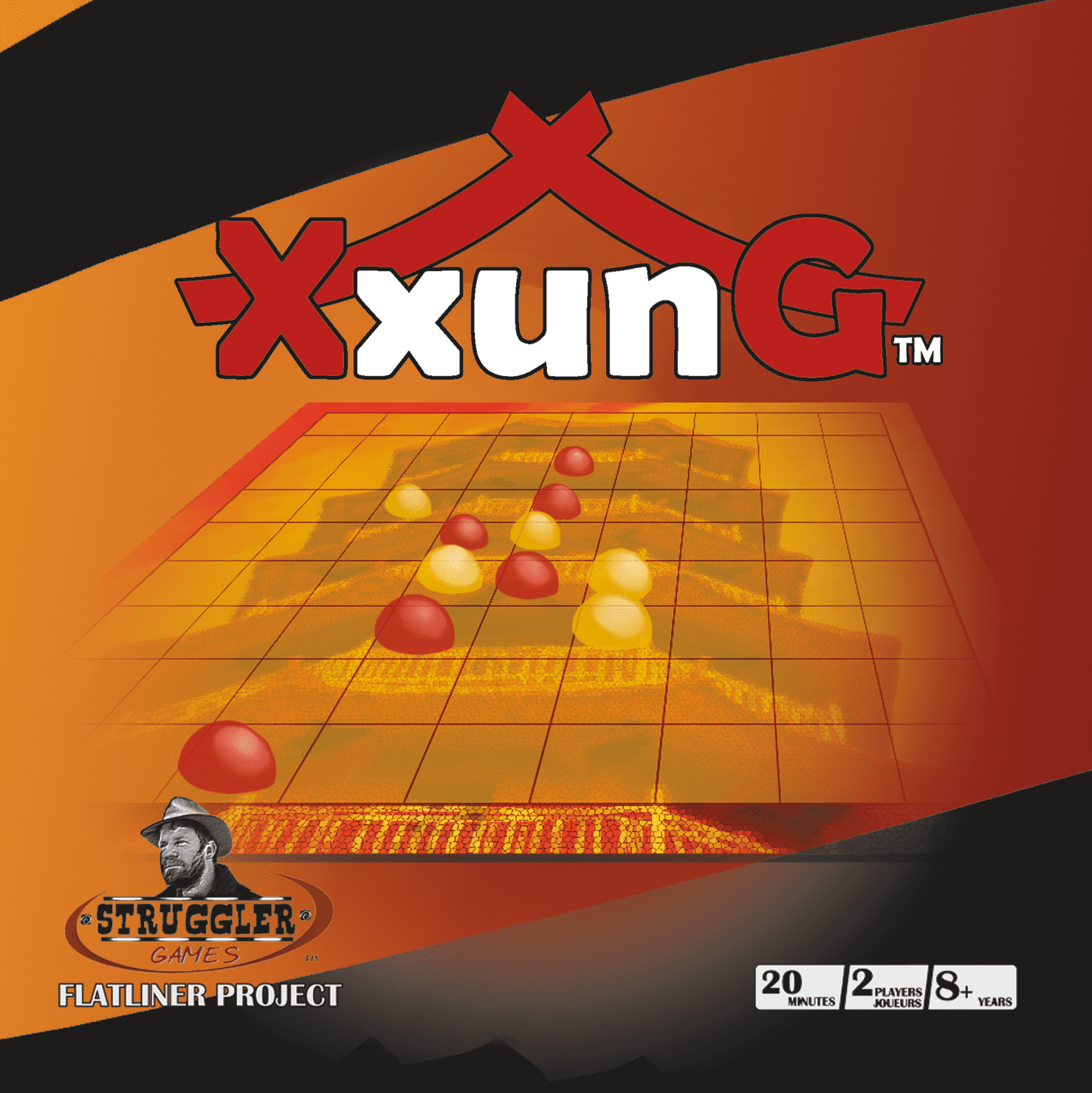
2016 BGG rank #27877

XXung

2 players 10–20 min Ages 12+ 0.0/5 complexity 5.5/10 rating

About this game

RULES: 1. The first player starts the game by placing one piece anywhere on the board. 2. Players take turns placing a piece horizontally or vertically in line with the last placed piece in the game. There must not be intervening pieces of either color between the last placed piece and the newly placed piece. 3. A player wins in one of two ways: by placing five pieces consecutively in a row horizontally, vertically or diagonally, or forcing the opponent into a position where he is unable to place a piece on the board. (blocking them in with intervening pieces).

What it feels like

Square Grid Abstract Strategy

Game intelligence

Learn the game

100% knowledge coverage

Setup

1. Place the board between both players. 2. Decide which player goes first. 3. Assign each player their color of pieces. The first player begins by placing one piece anywhere on the board to start the game.

Turn flow

On their turn, a player must place one piece on the board. The piece must be placed horizontally or vertically in line with the last piece placed in the game (by either player), and there must be no intervening pieces of either color between that last piece and the newly placed piece. The first turn of the game is a special case: the first player may place their piece anywhere on the board. After placing, the turn passes to the opponent.

Scoring and victory

The first player to satisfy either win condition on their turn wins the game immediately. There is no point scoring — the outcome is win or loss. Scoring sources: Placing five consecutive pieces in a row horizontally, vertically, or diagonally, Forcing the opponent into a position with no legal placement available

Source: Rulebook

Rules to know

The most useful rules for getting a first game right.

Setup

The first player places their opening piece anywhere on the board.

On the very first turn of the game, the first player may place one piece on any empty cell of the board. No placement restrictions apply to this opening move. After this, all subsequent placements are subject to the line-of-play rule.

Turn structure

Each piece (after the first) must be placed in the same horizontal or vertical line as the last placed piece.

After the opening move, every piece a player places must be in the same row (horizontal) or same column (vertical) as the piece most recently placed on the board — regardless of which player placed that last piece. Diagonal placement relative to the last piece is not allowed. The newly placed piece must share either the same row or same column as the last placed piece.

Restriction

There must be no pieces of either color between the last placed piece and the newly placed piece.

When placing a piece in line with the last placed piece, the path between the last placed piece and the new piece's position must be completely clear — no pieces of any color (neither the active player's nor the opponent's) may occupy any cell between them along that row or column. The new piece must be reachable from the last placed piece without 'jumping over' any existing pieces.

Endgame

A player wins by placing five of their pieces consecutively in a row horizontally, vertically, or diagonally.

A player immediately wins the game if, after placing a piece, they have five of their own pieces in an unbroken consecutive line. This line may be horizontal, vertical, or diagonal. The five pieces must be adjacent to one another with no gaps. Achieving this on your placement turn ends the game immediately.

Endgame

A player wins by forcing the opponent into a position where the opponent cannot legally place a piece.

A player wins if, after their placement, the opponent has no legal move available. This occurs when every cell that is in the same row or column as the last placed piece is either occupied or blocked by an intervening piece (i.e., all cells directly reachable along the row and column of the last piece are unavailable). The rulebook specifies this is achieved by 'blocking them in with intervening pieces.' If the opponent cannot place, the placing player wins.

Strategy briefing

Control the line of play

Because every piece must be placed in line with the last placed piece (rule: line_of_play_rule), where you place each piece dictates which row or column your opponent is forced to play in next. Strategically placing on rows or columns that are nearly full or heavily cluttered with pieces limits your opponent's options and steers toward the blocking win condition.

Use both win conditions simultaneously

The most powerful positions threaten both a five-in-a-row and a blocking trap at the same time. Since your opponent must always respond to the line of your last piece (line_of_play_rule), threatening a five-in-a-row along a heavily populated row can force them into that row, where your pieces also create intervening blocks, potentially leaving them no legal move.

Build diagonal fives incrementally

Diagonal five-in-a-row is a valid win condition (win_by_five_in_a_row), but pieces can never be placed diagonally (line_of_play_rule). Build diagonal lines gradually by placing pieces that are part of the diagonal through legal horizontal and vertical moves. This can be harder for opponents to see and defend.

Opening move positioning

The first player's free opening placement (first_turn_free_placement) is the only unconstrained move in the game. Placing near the center maximizes future flexibility, as it allows access to more rows and columns and makes it harder for the opponent to isolate you into a corner with the blocking win condition.

Create unavoidable intervening blocks

Since pieces of both colors act as blockers (no_intervening_pieces_rule), you can use your own pieces strategically to fragment the row or column your opponent will be forced into, leaving only isolated cells they cannot legally reach. This is the primary engine of the blocking win condition.

Common questions and edge cases

Can a player place a piece diagonally from the last piece to contribute to a diagonal five-in-a-row?

No. Placement is restricted to the same horizontal row or vertical column as the last piece — diagonal placement is never legal. However, a player CAN win with a diagonal five-in-a-row if they build it incrementally through legal horizontal and vertical placements over multiple turns.

Can a player's own pieces block the opponent, or only opponent pieces?

Both colors count as intervening pieces. Rule 2 explicitly states 'intervening pieces of either color' are not allowed between the last placed piece and the newly placed piece. Therefore, a player's own pieces can block the opponent's placement options just as effectively as the opponent's pieces.

How exactly does blocking win condition work? If the opponent can place somewhere in the same row/column but all cells directly adjacent to the last piece are taken, do they still have a legal move?

The opponent must place in the same row or column as the last placed piece, AND the path between the last piece and the chosen cell must be clear of any pieces. If every reachable empty cell along those lines has at least one intervening piece between it and the last placed piece, the opponent has no legal move and loses. Cells that are technically in the same row/column but separated by an intervening piece are NOT legal targets.

Does the first player's opening move have to follow the line-of-play rule?

No. The first move in the game is a free placement — the first player may place their piece anywhere on the board. The line-of-play and no-intervening-pieces restrictions only apply from the second move onward, when there is a 'last placed piece' to reference.

Ask About This Game

Similar games