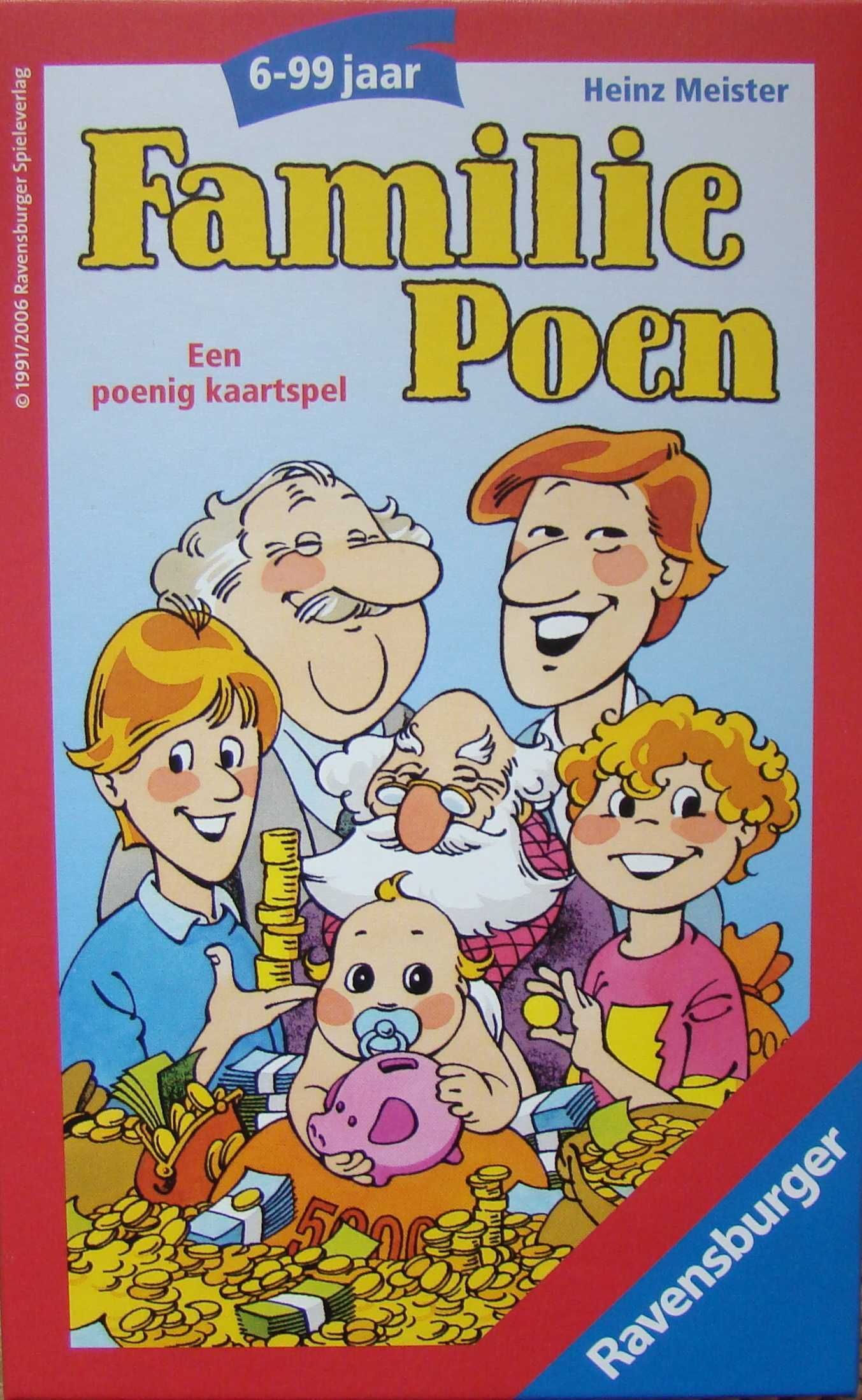
1994 BGG rank #26993

Zahlemann und Söhne

2–4 players 0 min Ages 7+ 1.0/5 complexity 5.5/10 rating

About this game

A simple game about getting rid of your hand of cards. All players must match a drawn card (by value or colour) in order to get rid of it. Higher valued cards (showing elder members of the Zahlemann family) take precedent over younger ones so getting rid of the baby is the toughest. Once one player goes out, the other players must pay the value of their remaining cards.

What it feels like

Card Game

Game intelligence

Learn the game

100% knowledge coverage

Setup

1. Distribute starting coins to each player: 1×50, 1×20, 2×10, 2×5, 4×2, and 4×1. 2. Shuffle the full deck of cards. 3. Deal 5 cards face-down to each player. Players hold their hand cards so no other player can see them. 4. Place the remaining cards face-down in the centre of the table as the draw pile. 5. Flip the top card of the draw pile face-up and place it next to the draw pile to start the discard pile. 6. The youngest player takes the first turn of the first round.

Turn flow

On your turn, you must play one card from your hand onto the discard pile, matching either the value or the colour of the current top card. If you have a matching card, play it and end your turn — the next player must now match the new top card. If you have no matching card, draw the top card from the draw pile; if it matches you may play it immediately, otherwise your turn ends and play passes left. When you play your second-to-last card you must announce 'Zahlemann'; failure to do so requires you to draw a penalty card (which cannot be played immediately). When you play your last card, announce 'Zahlemann und Söhne' to end the round and collect payments from all other players.

Scoring and victory

At game end (triggered by a player going bankrupt or being unable to pay), all players count their remaining coins. The player with the most coins wins. Scoring sources: Collecting coin payments from other players when you win a round by emptying your hand, Minimising your own payments by holding low-value cards when an opponent goes out

Source: Rulebook

Rules to know

The most useful rules for getting a first game right.

General

Each Family Poen character card has a fixed numeric value.

There are six card values, each represented by a different family member: Baby = 1, Boy = 2, Older Brother = 5, Dad Poen = 10, Grandpa Poen = 20, Great-Grandpa = 50. These values are fixed and never change. Each value exists in six different colours: red, blue, yellow, green, grey, and purple, giving 36 cards in total.

Setup

Each player begins with a fixed set of coins totalling 104.

At the start of the game each player receives the following coins: 1×50, 1×20, 2×10 (=20), 2×5 (=10), 4×2 (=8), and 4×1 (=4), for a total of 112 coins. These coins serve as both the currency for paying round winners and the measure of victory at game end.

Setup

Shuffle the deck and deal 5 cards face-down to each player; flip the top remaining card to start the discard pile.

The full deck is shuffled. Each player is dealt 5 cards face-down and holds them so opponents cannot see them. The remaining cards form the draw pile, placed face-down in the centre of the table. The top card of the draw pile is flipped face-up and placed beside the draw pile to form the discard pile. This face-up card sets the initial matching requirement for the first player.

Setup

The youngest player goes first in the opening round.

In the very first round, the youngest player takes the first turn. In all subsequent rounds, the player who paid the most coins to the previous round's winner becomes the starting player. In the event of a tie for most paid, the rules do not specify a tiebreaker — players may decide amongst themselves (e.g., youngest among those tied).

Card play

On your turn, play a card matching either the value or colour of the top discard card.

When it is your turn, you must play one card from your hand onto the discard pile. The card you play must match the current top card in one of two ways: (a) it has the same numeric value as the top card, regardless of colour, or (b) it has the same colour as the top card, regardless of value. Example: if the top card is a Blue 50, you may play any other 50-value card (of any colour) or any other blue card (of any value). After playing, your turn ends and the next player must match your newly played card.

Card play

If you cannot match the top card, draw one card from the draw pile; play it immediately if it matches, otherwise your turn ends.

If you have no card in hand that matches the top discard card (by value or colour), you must draw the top card from the draw pile. If this drawn card matches the top discard card, you may play it immediately on the same turn. If the drawn card does not match, your turn ends and the card stays in your hand. You may only draw one card per turn in this situation.

Special

When playing your second-to-last card, you must announce 'Zahlemann'.

When you play the card that leaves you with exactly one card in hand (i.e., your second-to-last card), you must announce 'Zahlemann' at the time of playing it. If you forget to announce 'Zahlemann' and another player notices before the next player takes their turn, you must draw the top card from the draw pile as a penalty. This penalty card cannot be played immediately even if it would match the top discard card.

Special

Playing your last card ends the round; announce 'Zahlemann und Söhne'.

When you play your final card from your hand, you announce 'Zahlemann und Söhne'. This immediately ends the current round. You are the winner of the round. All other players must now pay you coins equal to the total value of the cards remaining in their hands.

Strategy briefing

Prioritise emptying your hand over maximising card value plays

Since you collect coins equal to opponents' remaining card values (rule: round_payment), it is almost always better to go out quickly — even discarding low-value cards — than to hold high-value cards hoping for a bigger payout. A fast win with opponents holding mid-value hands beats a slow win with opponents holding only 1s.

Never forget 'Zahlemann'

Forgetting to announce 'Zahlemann' forces you to draw a penalty card that you cannot immediately play (rule: zahlemann_announcement). This not only adds a card to your hand but also signals to opponents that you are close to winning, giving them time to prepare. Stay alert, especially in fast turns.

Monitor opponents' coin reserves to anticipate game end

The game ends the moment any player goes bankrupt (rule: game_end_trigger). Watch how many coins opponents have. If a player is low on coins, winning one more round against them could end the game — which is great if you are ahead, but dangerous if you are behind. Timing your round wins relative to opponent wealth is key.

Manage coin denominations carefully

You pay opponents exact amounts and may make change (rule: making_change), but change requires cooperation. Hoarding large denominations can be risky if you owe an odd amount and no one will make change. Keep a variety of denominations when possible.

Variant: Use value-1 cards to chain plays and accelerate going out

In the variant, a value-1 (Baby) card lets you play an additional card immediately (rule: variant_value_1_bonus_play). This is a powerful hand-thinning tool. Saving a value-1 card for late in your hand — especially as your second-to-last card — lets you go from two cards to zero in one turn, potentially catching opponents off guard before they can react.

Variant: Value-50 cards are weapons, not just high-value pays

In the variant, playing a value-50 card skips the next player entirely and forces them to draw (rule: variant_value_50_draw_penalty). This is especially powerful when an opponent has just one or two cards and is close to winning. Use 50s offensively to stall frontrunners, not just as colour/value matches.

Variant: Value-2 hand-passing can save or sink you

The value-2 card causes all players to pass their entire hand to the left (rule: variant_value_2_pass_hands). This is a double-edged sword: it can rescue you from a terrible hand but gift a great hand to your left neighbour. Assess whether the player to your left is a bigger threat than the player to your right (who receives your current hand) before playing a 2.

Common questions and edge cases

I forgot to say 'Zahlemann' when I played my second-to-last card. I draw the penalty card and it matches the top discard. Can I play it right away?

No. The penalty card drawn for forgetting 'Zahlemann' cannot be played immediately, even if it matches the top discard card. It stays in your hand and you must wait for your next turn.

I have no matching card and draw from the draw pile. The drawn card matches. Can I play it, and if doing so leaves me with one card, must I say 'Zahlemann'?

Yes, you may play the drawn card immediately if it matches. And yes, if playing it leaves you with exactly one card in hand, you must announce 'Zahlemann' at that moment, just as you would on any other play.

Variant: I play a value-1 card as my second-to-last card and use its bonus to play my last card. When do I say 'Zahlemann' and 'Zahlemann und Söhne'?

When you play the value-1 card (your second-to-last), you should announce 'Zahlemann'. You then immediately play your last card and announce 'Zahlemann und Söhne', ending the round. Both announcements happen in quick succession on the same turn.

Variant: The previous player played a 50 and forced me to draw. Can I still play the drawn card or any card from my hand?

No. When a value-50 card is played against you, you must draw a card and your entire turn is skipped — you may not play any card, including the drawn card or any card already in your hand.

Variant: I play a value-2 card. Do I also have to pass my hand cards to the left, even though I just played a card?

Yes. Every player — including you — simultaneously passes all remaining hand cards to the left. You pass whatever remains in your hand after playing the 2. The 2 itself is on the discard pile and is not passed.

A player cannot pay the full amount owed to the round winner. Does the game end immediately, and does the partial payment still go to the winner?

The game ends immediately as soon as any player cannot pay their full debt. The rules state the game is over at that point and everyone counts remaining money. The rules do not explicitly address partial payment — the most reasonable interpretation is that any coins the bankrupt player does have are paid out before counting, but the game ends regardless.

Two players paid the same (highest) amount last round. Who goes first in the new round?

The rules do not specify a tiebreaker for the new-round starting player. Players should agree on a method before the game (e.g., youngest among those tied, or a quick coin flip).

Ask About This Game

Similar games