1998 BGG rank #4899

Zero Down

2–5 players 20 min Ages 8+ 1.2/5 complexity 5.8/10 rating

About this game

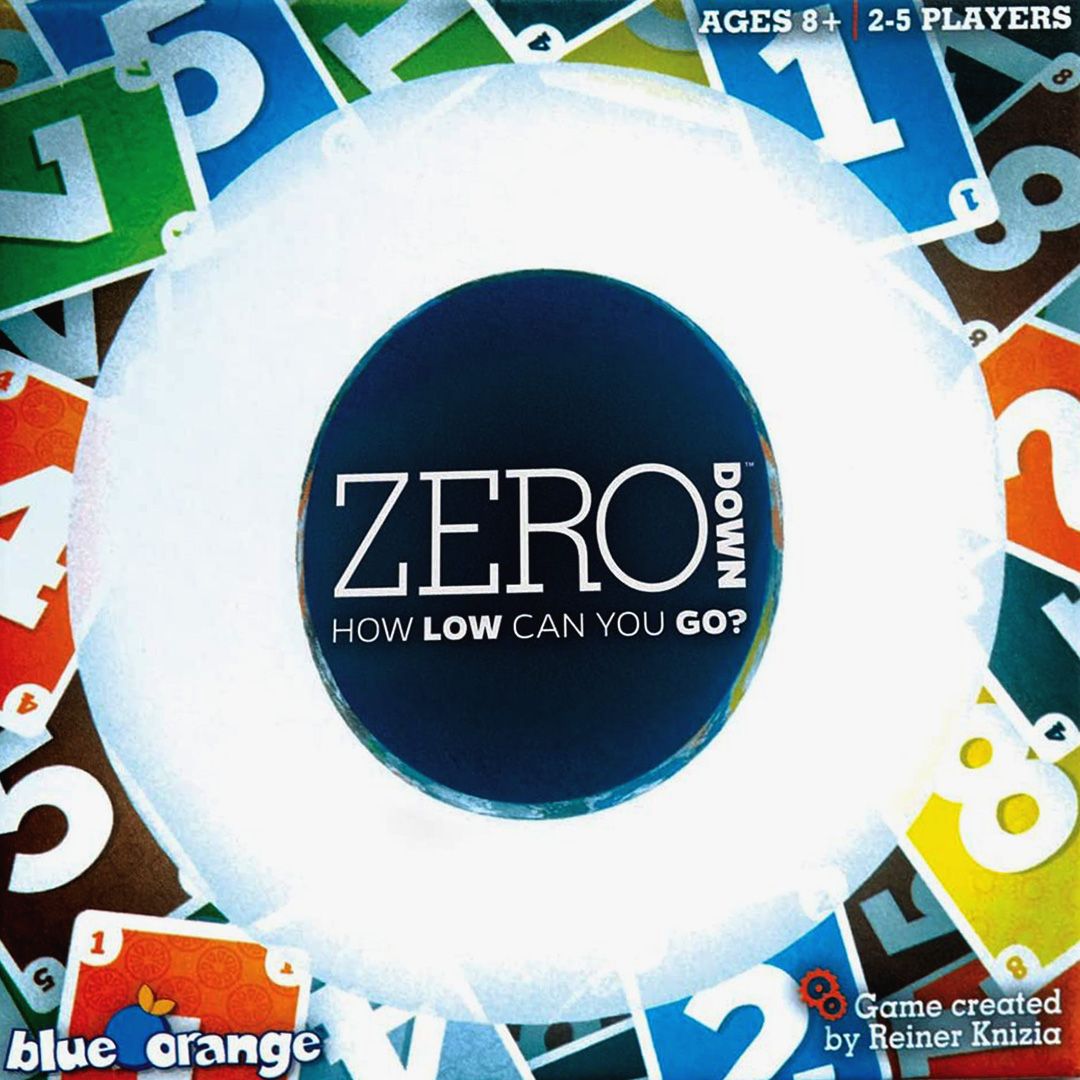
How low can you go? In Zero, you want to score as few points as possible, but to do that you need to collect the right cards in hand. The deck consists of 56 cards, with cards numbered 1-8 in seven colors. Each player starts with nine cards in hand, and five, seven or nine cards start face-up on the table depending on the number of players. On a turn, you either knock on the table to pass or you swap one card in hand for one card on the table. After the second knock, whether from the same player or a different one, all players other than the second knocker have one final chance to swap, after which they reveal and score their hands. If you have five or more cards of the same color or number in hand, then those cards score 0 points. For each other number you have, no matter how many copies, you score points equal to that card's value. Thus, having one to four 7s in hand is worth 7 points. If, however, you manage to collect both five cards of a color and five cards of a number in hand (with one card fitting in both sets), then you can declare "Zero!" and end the round immediately, with everyone else scoring points as usual. After a number of rounds equal to the number of players, whoever has the lowest score wins!

What it feels like

Set Collection Open Drafting Card Game

Explore these mechanics in Cardboard

Start an original prototype from reusable design patterns—not this game's content.

Open mechanics workbench

Game intelligence

Learn the game

100% knowledge coverage

Setup

1. Use a deck of 56 cards: seven colours (red, yellow, green, blue, violet, grey, black), each with cards numbered 1–8. 2. Shuffle all cards thoroughly. 3. Deal nine cards to each player. Players keep their hand values hidden from opponents. 4. Place five cards face-up in the centre adjacent to each other to form the pool (variant: use seven cards; for two players use nine cards). 5. Set the remaining cards aside face-down — they are not used during the current round. 6. The player to the left of the dealer takes the first turn; play proceeds clockwise.

Turn flow

On your turn you must take exactly one of two actions: **Swap:** Choose one card from your hand, place it face-up into the pool, then take any different card from the pool into your hand. Your turn ends. **Knock:** Knock once on the table. Your turn ends. The first knock of a round has no effect and play continues normally. The second knock of the round (by any player) triggers the end-game sequence: every other player gets one final turn (in clockwise order), but the player who made the second knock does not. Players who do not wish to swap on their final turn may knock and pass instead. The round ends immediately — before any further turns — if a player achieves a ZERO at any point.

Scoring and victory

Lowest cumulative score across all rounds wins. Each round, score each unique number present in your hand once at face value, unless you hold five or more of that number or five or more cards of the same colour (either scores 0). A ZERO declaration scores 0 for that player. Scoring sources: Each unique number represented in hand scores its face value (1–8), Five or more cards of the same number: scores 0 for that number, Five or more cards of the same colour: scores 0 for those cards' number values, Declaring ZERO: scores 0 for the entire hand

Source: Rulebook

Rules to know

The most useful rules for getting a first game right.

Setup

The deck contains 56 cards: 8 cards in each of 7 colours, numbered 1–8.

There are seven colours: red, yellow, green, blue, violet, grey, and black. Each colour has exactly eight cards numbered 1 through 8, giving 56 cards total.

Setup

Each player is dealt nine cards face-down into their hand at the start of each round.

At the start of every round, after shuffling all 56 cards, deal nine cards to each player. Players hold their cards so that values are hidden from all other players.

Setup

Five cards (standard), seven (variant), or nine (two-player) are placed face-up in the centre to form the pool.

After dealing hands, place cards face-up in the centre adjacent to each other to form the pool. Standard game: 5 pool cards. Variant: 7 pool cards. Two-player game: 9 pool cards. All remaining cards are set aside face-down and are not used in the current round.

Turn structure

The player to the left of the dealer goes first; play proceeds clockwise.

Each round begins with the player immediately to the left of the dealer. Play then proceeds clockwise for the remainder of the round.

Turn structure

On your turn you may swap one card from your hand with one card from the pool.

Choose one card from your hand and place it face-up into the pool. Then select any different card currently in the pool and take it into your hand. You cannot take back the card you just placed. This constitutes your entire turn.

Turn structure

Instead of swapping, you may knock once on the table to pass your turn.

If you do not wish to swap, you knock once on the table. This ends your turn. Knocking has special significance depending on whether it is the first or second knock of the round (see rules knock_first and knock_second).

Turn structure

The first knock of a round has no effect; play continues normally.

When the first knock of a round occurs, it is noted but has no immediate consequence. The next player simply takes their turn as normal. Only the second knock of the round triggers the end-game sequence.

Endgame

The second knock of the round (by any player) triggers the final round of turns for all other players.

When a second knock is made during a round — regardless of whether it is by the same player who made the first knock or a different player — it signals the last opportunity for all other players to swap. Every player except the one who made the second knock gets one more turn (in clockwise order). Players who do not wish to swap on their final turn may simply knock and pass. After all those final turns are complete, the round ends and all hands are scored.

Strategy briefing

Prioritise reducing high-value unique numbers

Since each unique number in your hand scores its face value regardless of duplicates (e.g., four 8s still scores only 8), the highest-priority swaps are eliminating high numbers (7, 8) that appear as singletons. Adding a duplicate of a number you already hold costs nothing extra in points.

Build towards a five-of-colour or five-of-number set to score 0

Accumulating four or more cards of the same colour or number is a strong strategy because reaching five eliminates that number's point contribution entirely. Track the pool for cards matching your near-complete sets.

Pool management: place cards opponents need

When you swap, you add a card to the pool. Place a card that is unlikely to help opponents (low-value cards they probably already have duplicates of) while taking a card that benefits your hand. Conversely, avoid placing cards that complete opponents' sets.

Timing the knock strategically

The first knock has no effect, but the second knock ends the round (after one final turn for others). Knock first when your hand is near-optimal to 'warn' others, or delay both knocks to take more swaps. Never make the second knock if your hand still has significant room for improvement — you lose your own final turn.

Pursuing ZERO ends the round on your terms

A ZERO declaration ends the round immediately, scoring you 0 and potentially catching opponents with poor hands. Prioritise building toward a ZERO if you can identify both a five-colour and five-number group with a shared card in your nine-card hand.

Duplicate cards are safe to trade away

Because duplicates of a number you already hold add no extra points, extra copies beyond four are safe discard candidates unless you are chasing a five-of-a-kind set bonus. Use duplicates as swap fodder to acquire cards that reduce other unique values.

Common questions and edge cases

Can a player take back the same card they just placed into the pool when swapping?

No. The rule states you must select 'a different card from the pool'. You cannot retrieve the card you just placed.

Can the same player make both the first and second knock of the round?

Yes. The rulebook states the second knock triggers the end-game sequence 'irrespective of whether by the same or a different player'. If the same player knocks twice (on two separate turns), the second knock still ends the round after all other players have taken one final turn.

Does the player who makes the second knock get a final turn before the round ends?

No. The player who performs the second knock does not receive an additional turn. All other players get one final turn, but not the second knocker.

What happens if a player achieves ZERO before the second knock has occurred?

The round ends immediately when ZERO is declared, regardless of how many knocks have occurred. No further turns are taken by any player.

If a player declares ZERO, do the other players also score 0?

No. Only the player who declared ZERO scores 0. All other players score their hands normally using the standard scoring rules.

A player has five cards of one colour AND five cards of one number in a nine-card hand. Is this a ZERO, or just a scoring bonus?

This is a ZERO only if the two groups share exactly one card (i.e., one card is both the qualifying colour and the qualifying number), making the total nine cards. If both groups are present in a nine-card hand with one overlapping card, the player should immediately declare ZERO and end the round. If somehow both groups could coexist without overlap (requiring more than nine cards), that is impossible in a nine-card hand and does not arise.

On their final turn (after the second knock), can a player simply knock instead of swapping?

Yes. Players who do not wish to swap on their final turn may simply knock and pass. This does not count as another game-affecting knock — it is just a pass.

A player has five cards of one colour AND five cards of a different number in their hand. How is this scored?

Both bonuses apply independently. The five same-colour cards score 0, and the five same-number cards score 0. Any remaining cards in the hand are scored normally (each unique number represented scores its face value once).

Ask About This Game

Similar games