2002 BGG rank #11066

Alien City

2 players 40 min Ages 8+ 3.2/5 complexity 5.6/10 rating

About this game

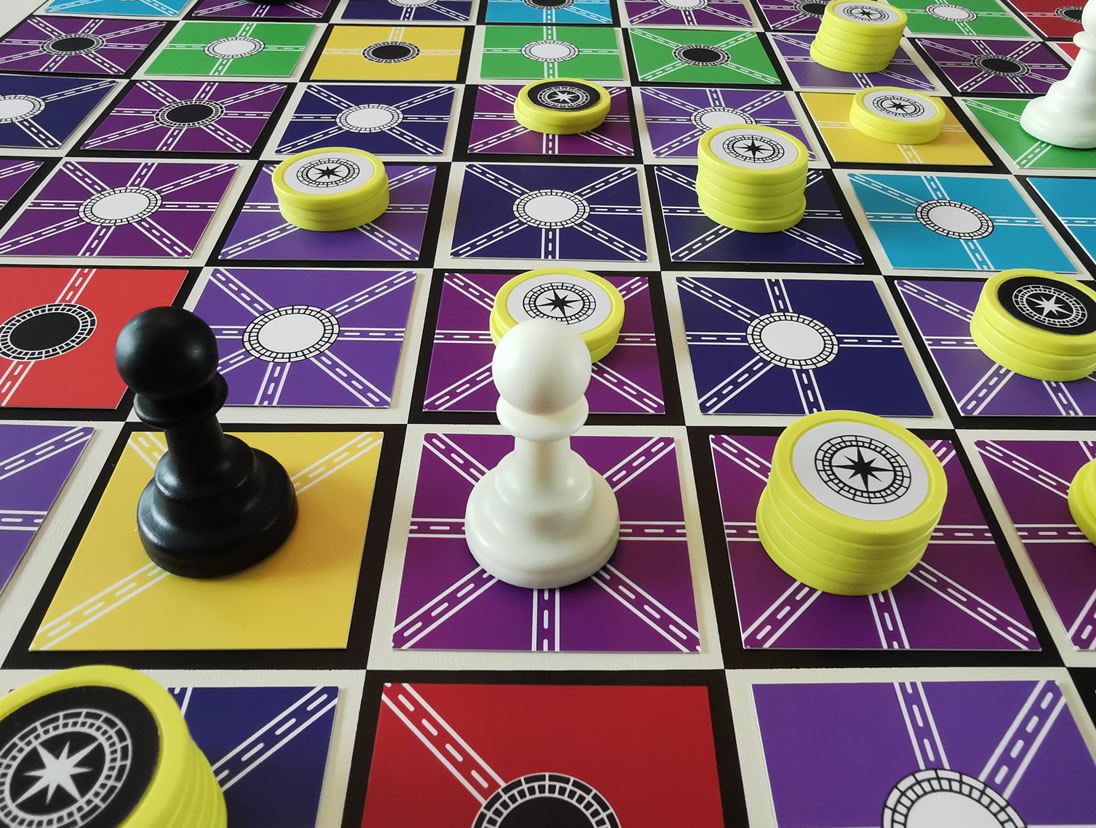
Alien City is a game that is set in the far future and concerns the building of a city on a newly colonized world. Society in this distant time is divided into four powerful guilds. These are the Energy Guild (symbolized by a red sun), the Synthesis Guild (symbolized by a blue fountain), the Control Guild (the most powerful guild of all, symbolized by a green crown), and the Builder's Guild (symbolized by a black tool---yes, that's how tools look in the far future). Cities in this future contain two types of structures, towers and domes. Towers are owned by the various guilds. These are the power plants (energy), factories (synthesis), and government facilities (control). Domes are smaller structures used to house the citizens. As with the towers, domes are always associated with a particular guild. Both towers and domes are color-coded to identify guild affiliation; red for energy, blue for synthesis, green for control, and black for builders. Each of the guilds wants its towers positioned close to the towers and domes of other guilds (their customers) and far away from its own other towers (to avoid competing with other towers of their own guild). Location, location, location! Some things never change, even in the distant future. The Builder's Guild is unique because there are no Builder's Guild towers, i.e., no black towers. Instead, the Builders are compensated for their efforts by being given the profits of some of the other guilds’ towers that the Builders choose as they construct the city. The players in this game are competing builders working to construct the city. At the same time, they are choosing towers for themselves that they hope will be profitable with many close customers and little competition. The choices must be made with care because each builder may only choose three. Red, blue, and green large Icehouse Pieces are used for the towers, and piecepack coins with the suit side up represent red, blue, green, and black domes. The land area of the city is defined by a 4x5 array of piecepack tiles, suit side up, with each tile representing four building sites. The game-play consists of the players alternating turns, placing a tower or dome each turn until either all available towers and domes have been placed or until there are no legal construction sites remaining within the city. Then scores are determined based upon the relative positions of the towers and domes.

What it feels like

Tile Placement Modular Board Square Grid Science Fiction Abstract Strategy Territory Building City Building Print & Play City

Explore these mechanics in Cardboard

Start an original prototype from reusable design patterns—not this game's content.

Open mechanics workbench

Game intelligence

Learn the game

100% knowledge coverage

Setup

1. Take all 20 tiles, turn them face-down, shuffle, then arrange them into a 4×5 grid. Flip them all face-up one by one, preserving their orientation. The result is a randomly laid out, randomly oriented, tightly packed grid that forms the city playing board. 2. Divide components between the two players: - Player 1 receives: 3 red domes, 3 blue domes, 3 green domes, 3 black domes, 3 large red towers, 2 large blue towers, 2 large green towers, and 3 small WHITE hat markers. - Player 2 receives: 3 red domes, 3 blue domes, 3 green domes, 3 black domes, 2 large red towers, 3 large blue towers, 2 large green towers, and 3 small BLACK hat markers. 3. All components of both players are kept openly visible throughout the game. 4. The player with the black hat markers takes the first turn.

Turn flow

The player with black hat markers goes first; players then alternate turns. On each turn, a player MUST place exactly one building (tower or dome) onto a legal plot on the board. After placing a building, the active player MAY optionally occupy one unoccupied tower on the board by covering it with one of their hat markers. A player may occupy at most 3 towers total across the entire game. A player cannot occupy a tower on the very last turn of the entire game (i.e., no occupation is allowed during the final action before end-game scoring). If a player has no legal placement available while their opponent still can place, the opponent continues playing alone until no further legal placements exist.

Scoring and victory

The player with the higher total point score wins. Points are totaled after the game ends. Scoring sources: Occupied tower score: customer base (number of differently-colored buildings within 1–2 road steps) × competition distance (road steps to nearest same-colored tower), Bonus points from unoccupied green towers: 10 − (2 × road distance) awarded to the owner of the nearest occupied red tower and/or nearest occupied blue tower per unoccupied green tower

Source: Rulebook

Rules to know

The most useful rules for getting a first game right.

Setup

The player with black hat markers always takes the first turn.

The player who received the black hat markers goes first. Players then alternate turns for the rest of the game.

Turn structure

A player must place exactly one tower or dome on each turn.

On every turn, the active player must place exactly one building — either a tower (large pyramid) or a dome (small building) — onto a legal plot on the board. Placing a building is mandatory; a player cannot skip their placement action.

Turn structure

After placing a building, a player may optionally occupy one unoccupied tower.

At the end of their turn (after placing a building), the active player has the option to occupy one currently unoccupied tower on the board by covering it with one of their own hat markers (white or black). This is optional. A player may occupy any unoccupied tower on the board, not just ones they own. Each player has only 3 hat markers, so each player can occupy at most 3 towers over the course of the game.

Turn structure

Players may place their towers and domes in any order they choose.

There is no required order in which a player must place their towers versus their domes. A player may freely decide each turn whether to place a tower or a dome from their available components.

Restriction

Only one building (tower or dome) may occupy any single plot.

Each plot on a tile may contain at most one building — either a tower or a dome. Since each tile has 4 plots, a tile can theoretically hold up to 4 buildings. A building cannot be placed on an already-occupied plot.

Restriction

Domes must be placed on tiles of matching color, unless no matching plots remain.

Domes may only be placed on plots belonging to a tile of the same color (e.g., a red dome must go on a red tile). However, if no legal plots of the required color remain anywhere on the board, a dome of that color may be placed on a plot of any other color.

Restriction

The first two buildings on any tile must match the tile's color; after that, towers of any color may be placed.

The first two buildings placed on any tile must be of the same color as the tile (as indicated by the guild symbol). Once a tile already has two buildings on it, any further towers placed on that tile may be of any color. Important exception: this relaxed rule applies only to towers, not domes. Domes placed on a tile must still follow the dome color-matching rule (rule dome_color_matching) regardless of how many buildings are already on that tile.

Special

Black (Builders' Guild) tiles allow towers of any color to be placed at any time.

Black tiles are an exception to the first-two-buildings color rule. On a black tile, a tower of any color may be placed at any time, regardless of how many buildings are already on the tile. This exception applies to towers only. Domes placed on black plots must still generally be black (unless no black plots remain).


Strategy briefing

Tower selection timing

Because each player can claim only 3 towers (rule: occupation_limit) and cannot occupy on the very last turn (rule: no_occupation_last_turn), delaying occupation is risky. An opponent's final placement could end the game unexpectedly, costing you your last occupation. Secure your key towers early when possible.

Maximizing competition distance

Competition distance (road steps to the nearest same-colored tower) is a multiplier on your score (rule: scoring_tower_formula). Placing your opponent's same-colored towers close together — or placing domes that force the road network into a longer path between competing towers — can dramatically increase your score from a single tower.

Customer base density

The customer base only counts buildings within 1–2 road steps (rule: scoring_customer_base). Towers placed in the dense center of the city, where many buildings cluster nearby, earn higher customer bases. Conversely, an isolated corner tower might have a long competition distance but a tiny customer base.

Road network manipulation

Since road distance determines both customer base reach and competition distance (rules: scoring_customer_base, scoring_competition_distance), strategically placing buildings to force winding roads between competitor towers — or between an opponent's tower and its nearest same-color competitor — can dramatically shift scoring in your favor.

Unoccupied green tower bonuses

Unoccupied green towers can award up to 8 bonus points (at distance 1: 10−2=8) to the owner of the nearest occupied red and blue towers (rule: scoring_green_tower_bonus). Deliberately leaving green towers unoccupied while positioning your red and blue towers close to them on the road network is a powerful secondary scoring strategy.

Black tile flexibility

Black tiles allow towers of any color to be placed at any time (rule: black_tile_exception). This makes black tiles valuable for placing towers in positions that would otherwise be blocked by color restrictions on other tiles, especially early in the game before two buildings of the required color have been placed.

Blocking opponent occupations

Since a player may occupy any unoccupied tower — not just their own — there is no explicit 'ownership' of towers until a hat marker is placed. Occupying a tower your opponent was planning to claim denies them that position entirely. With only 3 occupations each, every hat marker decision is critical.

Common questions and edge cases

A tile already has 2 buildings on it. Can I now place a dome of any color on the remaining plots?

No. The relaxed 'any color tower' rule that applies after 2 buildings are on a tile only applies to towers, not domes. A dome placed on any tile must still match the tile's color (unless no plots of that color remain anywhere on the board).

Can I place a dome of any color on a black tile?

Generally no. Domes placed on black plots must be black. The black tile exception (any color tower at any time) applies only to towers. If no black plots remain on the board, a black dome may be placed on another color's plot.

All other plots on a tile are illegal (would violate road connectivity). Can I now build on the guild symbol plot?

Yes. The guild symbol plot restriction only prevents building there while other *legally buildable* plots exist on the tile. If all other plots on the tile are illegal to build on (e.g., would disconnect the road network), the guild symbol plot becomes a valid building location.

It's my last turn and I want to place my 3rd hat marker. Can I?

Only if your turn is NOT the very last action of the game. If your opponent still has a legal move after your turn, you may occupy a tower at the end of your turn. If your placement is the final action before scoring (no further legal moves exist for either player), you cannot occupy a tower.

I planned to occupy a tower on my next turn, but my opponent's move ended the game. Do I get to occupy?

No. If your opponent's placement results in no further legal placements being available, the game ends immediately. You do not get another turn and cannot occupy the tower.

Two red towers are equidistant from an unoccupied green tower, and each is owned by a different player. Does either player get the bonus?

No. When two or more towers of the same color are tied for nearest distance to an unoccupied green tower, no bonus is awarded unless one player owns ALL of those tied towers. Since the two tied towers are owned by different players, neither receives the red bonus from that green tower.

The nearest red tower to an unoccupied green tower has no hat marker on it. Is any red bonus paid?

No. A bonus is only paid to the owner of the nearest tower. If the nearest red tower is unoccupied (no hat marker), no red bonus is awarded for that unoccupied green tower.

A red tower I own has another red building within 2 road steps. Does it count toward my customer base?

No. Buildings of the same color as the scored tower are never counted as customers. Only differently-colored buildings within 1–2 road steps contribute to the customer base.

Two buildings are in adjacent plots on the grid. Are they always 1 road step apart?

Not necessarily. Road distance is measured along the road network (empty plots). If no empty plot connects the two adjacent buildings directly (e.g., both plots share an edge but the path between them requires going around many occupied plots), the road distance can be much greater than 1. Two visually adjacent buildings may be many road steps apart.

The nearest red tower is 5 or more road steps from an unoccupied green tower. Is any bonus paid?

No. The bonus formula is 10 − (2 × distance). At distance 5, this yields 10−10=0; at distance 6 or more it is negative. Therefore, no bonus is awarded for towers 5 or more road steps away from an unoccupied green tower.

Ask About This Game

Similar games