1997 BGG rank #544

Bohnanza

2–7 players 45 min Ages 12+ 1.7/5 complexity 7.0/10 rating

About this game

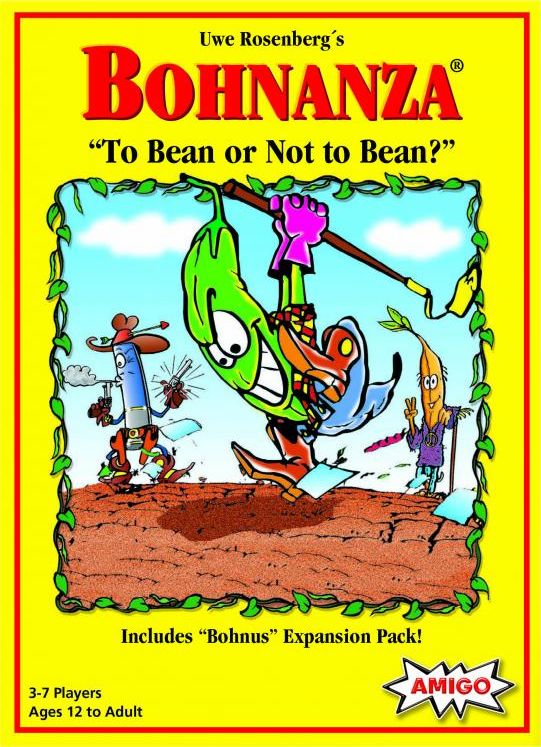
Bohnanza is the first in the Bohnanza family of games and has been published in several different editions, including a 2023 version with flowers. This entry lists a few different major card sets for Bohnanza: the base game for 3-5 players, the expanded game with the same name for 2-7 players (that is, first expansion included), and Bohnanza Pocket. In the game, you plant, then harvest bean cards in order to earn coins. Each player starts with a hand of random bean cards, and each card has a number on it corresponding to the number of that type of beans in the deck. Unlike in most other card games, you can't rearrange the order of cards in hand, so you must use them in the order that you've picked them up from the deck — unless you can trade them to other players, which is the heart of the game. On a turn, you must plant the first one or two cards in your hand into the "fields" in front of you. Each field can hold only one type of bean, so if you must plant a type of bean that's not in one of your fields, then you must harvest a field to make room for the new arrival. This usually isn't good! Next, you reveal two cards from the deck, and you can then trade these cards as well as any card in your hand for cards from other players. You can even make future promises for cards received right now! After all the trading is complete — and all trades on a turn must involve the active player — then you end your turn by drawing cards from the deck and placing them at the back of your hand. When you harvest beans, you receive coins based on the number of bean cards in that field and the "beanometer" for that particular type of bean. Flip over 1-4 cards from that field to transform them into coins, then place the remainder of the cards in the discard pile. When the deck runs out, shuffle the discards, playing through the deck two more times. At the end of the game, everyone can harvest their fields, then whoever has earned the most coins wins. The original German edition supports 3-5 players. The English version from Rio Grande Games comes with the first edition of the first German expansion included in a slightly oversized box. One difference in the contents, however, is that bean #22's Weinbrandbohne (Brandy Bean) was replaced by the Wachsbohne, or Wax Bean. This edition includes rules for up to seven players, like the Erweiterungs-Set, but also adapts the two-player rules of Al Cabohne in order to allow two people to play Bohnanza.

What it feels like

Trading Set Collection Multi-Use Cards Hand Management Negotiation Farming Card Game Negotiation Flowers

Explore these mechanics in Cardboard

Start an original prototype from reusable design patterns—not this game's content.

Open mechanics workbench

Game intelligence

Learn the game

100% knowledge coverage

Setup

1. Adjust the deck based on player count: remove Cocoa beans for 3 players; remove Coffee beans for 4–5 players; remove both Cocoa and Garden beans for 6–7 players.\n2. Shuffle the deck and deal 5 cards face-down to each player (except in 6–7 player games: deal 3/4/5/6/6/6/6 cards respectively).\n3. Set the 3rd bean field cards aside. In a 3-player game, all players start with their 3rd bean field already in play.\n4. Players must keep their hand cards in the exact order they were dealt — no sorting allowed. New cards drawn are always placed at the back of the hand.

Turn flow

Each turn has four mandatory steps executed in order:\n\n1. PLANT BEAN CARDS: The active player MUST plant the first card from their hand, and MAY also plant the second. Cards are planted into an empty field or a field already containing the same bean type. If no valid field exists, the player must harvest a field first, then plant.\n\n2. DRAW, TRADE & DONATE: The active player draws the top 2 cards from the deck and places them face-up. The active player may keep any of these face-up cards (to plant in step 3) or trade/donate them. The active player may also trade cards from their hand. Other players may only trade or donate cards from their own hand. All trades must involve the active player.\n\n3. PLANT DRAWN, TRADED & DONATED BEANS: All players who received cards via trade or donation must immediately plant all received cards. Cards may be planted in any order, harvesting fields as necessary.\n\n4. DRAW 3 NEW CARDS: The active player draws 3 cards one at a time, placing each at the back of their hand (6–7 players draw 4 cards).

Scoring and victory

Most gold coins at game end wins. Tiebreaker: most cards remaining in hand among tied players. Scoring sources: Harvesting bean fields during play, Harvesting bean fields at game end

Source: Rulebook

Rules to know

The most useful rules for getting a first game right.

Restriction

Hand cards must stay in dealt order; no sorting or rearranging is allowed.

Players must keep their hand cards in the exact order in which they were dealt or received. Sorting is strictly forbidden. When new cards are drawn at the end of a turn (Step 4), each card is taken one at a time and placed at the back of the hand, maintaining order.

Turn structure

The active player MUST plant the first card from their hand in Step 1.

In Step 1 of their turn, the active player is required to plant the first (frontmost) card in their hand. This is not optional. They may additionally choose to plant the second card in their hand, but planting the first card is mandatory.

Turn structure

The active player MAY plant the second card from their hand in Step 1.

After planting the mandatory first card from their hand, the active player may optionally plant the second card in their hand. This is the only card beyond the first that can be voluntarily planted during Step 1.

Building

A card may only be planted into an empty field or a field containing the same bean type.

When planting a bean card, the active player must place it into either (a) an empty bean field, or (b) a bean field that already contains at least one card of the same bean type. You cannot mix different bean types in the same field.

Building

If no valid field exists for a card that must be planted, the player must first harvest a field.

If the active player must plant a bean (e.g., the mandatory first card in Step 1, or a received card in Step 3) but has no empty field and no field of that bean type, they must harvest one of their fields to make room, then plant the card. The player chooses which field to harvest.

Resource management

A player can harvest a bean field at any time during their turn.

The active player may harvest any of their bean fields at any point during their turn, not just when forced. To harvest, count the cards in the field, consult the bean-o-meter on that bean card, and flip the appropriate number of cards face-down to earn that many gold coins. Any remaining cards in the field are discarded. Harvested coin cards are kept face-down as the player's score.

Restriction

You must have 2 or more cards in a field to harvest it, unless ALL your fields have only 1 card.

A player may not voluntarily harvest a field that contains only 1 card, unless every one of their bean fields contains only 1 card. If all fields have exactly 1 card, the player may harvest a single-card field (earning 0 coins and discarding the card) in order to free up a field.

Scoring

The bean-o-meter on each card shows how many cards must be sold to earn each level of gold coins.

Each type of bean card has a bean-o-meter printed on it indicating the number of cards of that type required to earn 1, 2, 3, or 4 gold coins when harvesting. When harvesting, consult the bean-o-meter of the harvested bean type to determine how many cards are 'sold' (flipped face-down as coins) and how many are discarded.

Strategy briefing

Hand Order Management

Because you cannot rearrange your hand, you should trade away cards in Step 2 that would block a desirable card from reaching the front of your hand. Accepting a donation that forces you to harvest a valuable field may be worse than negotiating to pass it to someone else.

When to Buy the 3rd Bean Field

The 3rd bean field is most valuable early in the game when you are frequently forced to harvest prematurely. Spending 3 coins (or 2 in 6–7p) buys flexibility for the rest of the game, but spending them too early means fewer coins scored in the early rounds.

Rare Beans Are High-Value Targets

Beans with fewer copies in the deck (as shown by the number on the card) have bean-o-meters that pay out coins for fewer cards. Concentrating on rare bean types lets you earn more coins from smaller fields, reducing the risk of being forced to harvest early.

Donating Strategically

Since received cards must be planted immediately and can force costly harvests, donating an unwanted bean to an opponent who has no matching field can disrupt their engine. Be cautious about accepting donations that would destroy your most valuable fields.

Harvesting Timing

Harvesting a field before it reaches its maximum coin threshold wastes potential gold. Track how many cards of your bean types have already been played or discarded to judge when it is no longer worthwhile to wait for more cards.

End-Game Field Management

As the deck approaches exhaustion (3rd pass for 4–7 players, 2nd for 3 players), prioritize filling fields to their coin thresholds before the game ends, since all fields are harvested at game end regardless of size.

Common questions and edge cases

The active player's mandatory first card doesn't match any existing field and they have no empty fields. Can they just not plant it?

No. The player must harvest one of their existing fields to create an empty field, then plant the card. If all fields have only 1 card each, they may harvest a single-card field (earning 0 coins) to make room. They cannot skip planting the first card.

A player receives a bean via trade in Step 2. They have no matching field and no empty field. What happens?

The receiving player must plant the card immediately in Step 3. If they have no valid field for it, they must harvest one of their existing fields first (choosing which one), even if it means losing a nearly complete field. The harvest-minimum restriction also applies: they can only harvest a single-card field if all fields contain just 1 card.

Can the active player offer a card from the middle of their hand, or only the front card?

Yes, the active player may offer and trade any card from their hand during Step 2 (the trade step), not just the first or second card. The hand-order restriction applies to planting in Step 1, but during trading the active player may access any card in hand. Non-active players may also offer any card from their hand.

The deck runs out while the active player is drawing the 2 face-up cards in Step 2. Does the game end immediately?

No. If the deck is exhausted during Step 2, the current player still completes Step 3 (planting all traded/donated cards). The game then ends. Players harvest all remaining fields and count coins.

How much does the 3rd bean field cost in a 6 or 7 player game?

In a 6 or 7 player game, the 3rd bean field costs only 2 gold coins (instead of the standard 3). Additionally, in a 3-player game the 3rd field is free and in play from the start.

A player donates a bean card to another player who doesn't want it. Must the receiver plant it?

Yes. All cards received through trade or donation must be immediately planted in Step 3. The receiver has no choice — they must plant every card they received, harvesting fields as needed to make room.

Two players are tied for most coins at the end of the game. Who wins?

Among the tied players, the one with the most cards remaining in their hand wins.

Ask About This Game

Similar games