2019 BGG rank #9398

Haiclue

2–12 players 30 min Ages 14+ 1.4/5 complexity 5.6/10 rating

About this game

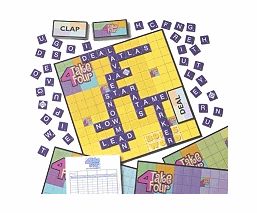
In Haiclue, players combine random word tiles to make clues. Each round, every player uses 15 random word tiles to make a clue for one of the four words in the center of the table. When everyone has finished, the group reads the clues out loud, and everyone guesses which of the four words belongs to each player. If a player guesses correctly, they score a point for themselves and a point for the author of the clue. 3-12 players (competitive) 2 players (co-op) 30 minute playtime. -description from publisher

What it feels like

Tile Placement Party Game Deduction Word Game

Explore these mechanics in Cardboard

Start an original prototype from reusable design patterns—not this game's content.

Open mechanics workbench

Game intelligence

Learn the game

100% knowledge coverage

Setup

1. Shuffle the 44 cards and place the deck face down in the center of the table. Pour the scoring tokens into a pile next to the deck. 2. On one side of the table, line up four cards, one of each color, as markers. Next to each card, build a stack of random word tiles (white-side up) as follows: • 2 players (cooperative): 2 tiles per stack • 3–5 players: 3 tiles per stack • 6–8 players: 2 tiles per stack • 9–12 players: 1 tile per stack 3. Each player draws 15 random word tiles from the box and lays them out in front of themselves, white-side up. 4. Each player takes four guessing tiles, one of each color.

Turn flow

Each round proceeds through the following steps simultaneously and then in sequence: 1. DRAW A CARD – Every player draws a card from the deck, looks at it privately, and places it face down. The card reveals which of the four target words (the word on top of each stack) belongs to that player. 2. MAKE A CLUE (simultaneous) – All players simultaneously arrange word tiles from their personal hand to form a clue about their target word. The clue must use at least two word tiles. When finished, the player rotates the clue so others can read it, then flips all unused tiles face down (revealing the opposite side). 3. READ AND GUESS – Starting with the youngest player, each player reads the clue of the player to their left out loud. All other players (except the clue's author) secretly place a guessing tile face down near the center to indicate which of the four target words they think the clue refers to. This repeats clockwise until every clue has been read and guessed. 4. SCORE – All players simultaneously reveal their guesses; the clue author reveals their card. Each player who guessed correctly takes 1 point from the center. The clue author takes 1 point per correct guess. The author then discards their card. (In 2-player cooperative mode, the team earns 1 point each time a player guesses correctly.) 5. REPEAT – The reading, guessing, and scoring process continues clockwise until every clue has been resolved. BETWEEN ROUNDS: • After a WHITE round: Flip the top tile of each stack to black-side up. Each player flips all tiles in their clue so all tiles in play are black-side up. A new round begins. • After a BLACK round: Discard the top tiles from the stacks (revealing four new target words). Each player flips their clue tiles white-side up. Each player passes their 15 word tiles to the player on their left (2-player: swap tiles). A new round begins.

Scoring and victory

The player with the most scoring tokens at the end of the game wins. In case of a tie, all tied players win together. In the two-player cooperative mode, the team wins by reaching 6 cumulative points (8 is a perfect score). Target score: 6 points (2-player cooperative mode only) Scoring sources: Correct guess: each guesser who correctly identifies the clue's target word takes 1 point from the central supply., Successful clue: the clue author takes 1 point for each player who guessed their target word correctly.

Source: Rulebook

Rules to know

The most useful rules for getting a first game right.

Setup

Shuffle the card deck and place it face down in the center; pour scoring tokens beside it.

Shuffle all 44 cards and place the deck face down in the center of the table. Empty all 96 scoring tokens from their bag and place them in a pile next to the deck, forming a central supply.

Setup

Build four word-tile stacks (white-side up) beside four color-coded card markers; stack size depends on player count.

Line up four cards (one of each color) along one side of the table as target-word markers. Beside each card, build a stack of random word tiles, all white-side up. Stack sizes: 2 players = 2 tiles per stack; 3–5 players = 3 tiles per stack; 6–8 players = 2 tiles per stack; 9–12 players = 1 tile per stack.

Setup

Each player draws 15 word tiles from the box and places them white-side up in front of themselves.

Each player draws 15 random word tiles from the box and lays them out in front of themselves, white-side up. These tiles form the player's personal hand for making clues throughout the game.

Setup

Each player takes one guessing tile of each of the four colors.

Each player takes four guessing tiles from the bag, one of each color. These tiles are used every round to secretly indicate which of the four target words a player thinks a clue refers to.

Turn structure

At the start of each round, every player privately draws a card that assigns them one of the four target words.

Each player draws one card from the deck, looks at it privately without showing other players, and places it face down in front of themselves. The card designates which of the four target words (the word on top of each color-coded stack) is that player's assigned target for this round.

Card play

All players simultaneously arrange at least two word tiles to form a clue about their target word.

All players act at the same time. Each player arranges word tiles from their personal hand to construct a clue that hints at their assigned target word. The clue must contain at least two word tiles. There is no restriction on which tiles are used beyond the minimum count. When a player finishes, they rotate the clue arrangement so that other players can read it easily, then flip all remaining unused tiles face down (to the opposite side).

Turn structure

Starting with the youngest player, each player reads the clue to their left aloud; all other players secretly guess the target word with a guessing tile.

When all players have finished making their clues, the youngest player reads the clue of the player to their left out loud. Every player except the author of that clue then secretly selects one guessing tile (matching the color of the stack they believe is the target) and places it face down near the center. The author of the clue does not guess. This process repeats clockwise until every clue has been read and guessed.

Scoring

Reveal guesses; correct guessers take 1 point each, and the clue author takes 1 point per correct guesser.

After all guesses are placed for a given clue, all guessers reveal their guessing tiles simultaneously, and the clue author reveals their card. Each player whose guess matches the author's target word takes one 1-point scoring token from the central supply. The clue author takes one 1-point scoring token for each player who guessed correctly. After scoring, the author discards their card.

Strategy briefing

Clue Precision vs. Clue Breadth

Because all four target words are visible to everyone (they are the tops of the four stacks), your clue must be distinctive enough to point to exactly one of them. Overly generic clues risk splitting guesses across multiple plausible targets, reducing both guesser and author scores.

Tile Management Across Rounds

Since all 15 personal tiles are passed to the left after every black round, the specific tiles you have are temporary. Prioritize using tiles that work well for the current target word rather than hoarding tiles for a future round, since you will not keep them.

Reading Incoming Tiles

Because tiles are passed left after a black round, you will receive the tiles of the player to your right. Pay attention to what words that player tends to use in their clues — you will soon have their vocabulary and can anticipate which tiles may arrive.

Exploiting the White/Black Flip Cycle

Word tiles are double-sided, so after a white round your unused tiles become black-side up — effectively giving you access to a new set of words on the black side. When constructing a clue, consider which side of your unused tiles will be available in the next round.

Two-Player Cooperative: Maximize Every Guess

In the two-player game the team needs only 6 points to win (out of a maximum of 8). Since the team scores 1 point per correct guess and the stack sizes are small (2 tiles per stack), every single correct guess matters enormously. Spend extra care crafting unambiguous clues.

Minimum Two-Tile Rule and Clue Construction

You must use at least two word tiles. A well-chosen two-tile clue is often stronger than a longer one, because more tiles can introduce noise and misdirect guessers toward the wrong target word.

Common questions and edge cases

When a player finishes their clue, what happens to the tiles they did not use?

All word tiles not included in the clue are flipped face down (to the opposite side) once the player finishes their clue. This means unused white-side tiles become black-side up and vice versa.

Do the tiles used in clues get flipped or passed between rounds?

Yes. After a white round, all tiles in clues are flipped to black-side up along with the stacks. After a black round, all clue tiles are flipped to white-side up, and then all 15 personal tiles (including those used in the previous clue) are passed to the left (or swapped in a 2-player game).

How many rounds does the game last, and how does player count affect this?

Each stack is discarded one tile at a time after every black round (i.e., every two rounds: one white, one black). Stack sizes vary by player count (1–3 tiles per stack). The game ends when all stack tiles are discarded, so the total number of rounds is 2× the initial stack size (e.g., 3-5 players with 3 tiles per stack play 6 rounds).

In a two-player game, does the author still score for correct guesses?

In the two-player cooperative mode, scoring works differently: the team earns 1 point each time a player guesses correctly. There is no separate author-scoring mechanic; all points go to the shared team total.

What exactly is the 'target word'? Is it always the same word throughout a round?

The target word is the word printed on the top tile of each color-coded stack. At the start of each round, a player's card tells them which color stack is theirs, and the target word is whichever word is currently on top of that stack. After a white round the top tile is flipped (revealing its black side with a new word); after a black round the top tile is discarded (revealing a new tile beneath). So the target word can change between rounds.

In the Haiku Variation, do the between-rounds passing rules still apply?

Yes. All between-rounds rules (flipping and passing/swapping tiles) still apply in the Haiku Variation. The only changes are that each player starts with 20 tiles instead of 15, and clues must follow the 5-7-5 haiku syllable structure.

Ask About This Game

Similar games