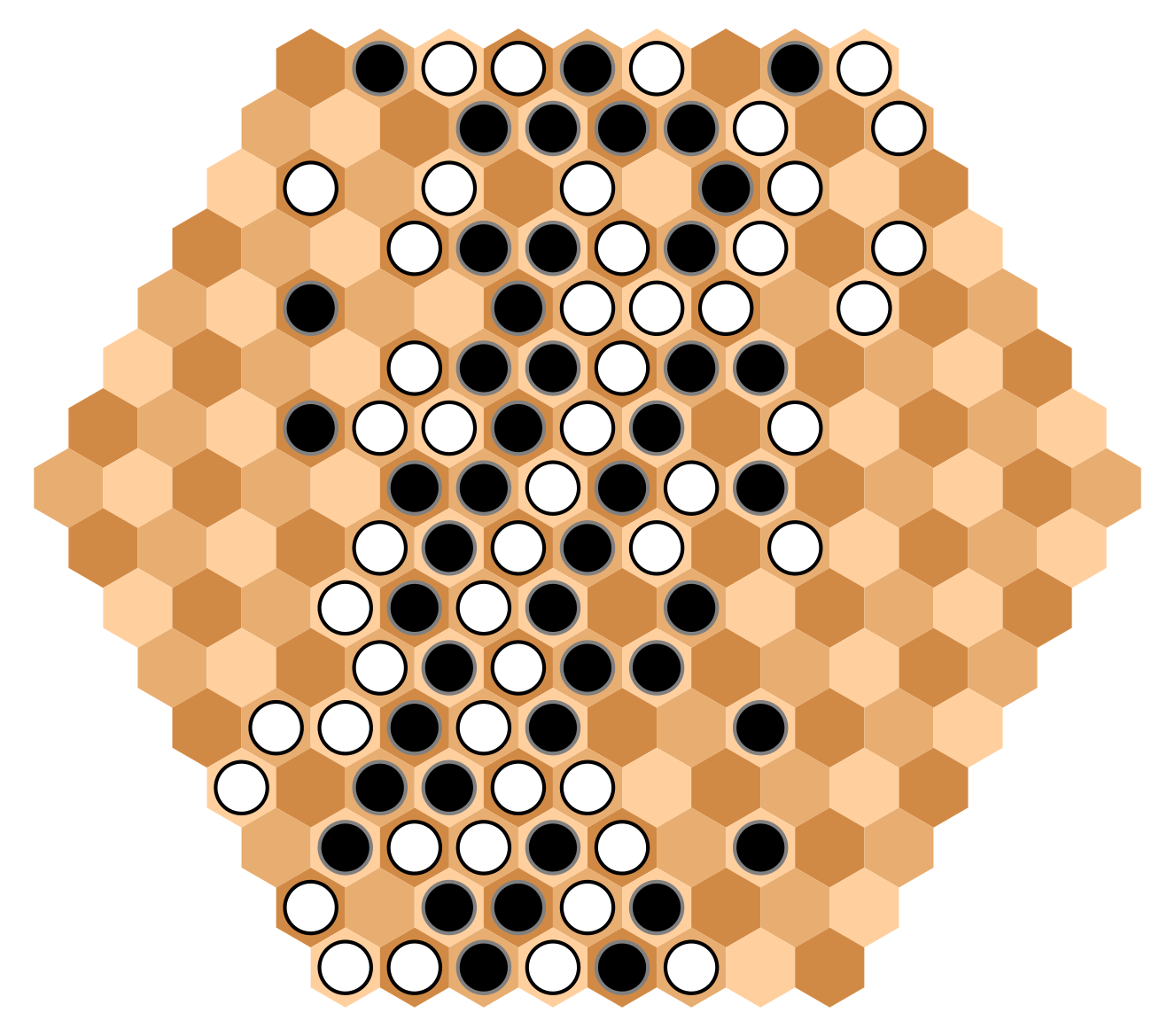
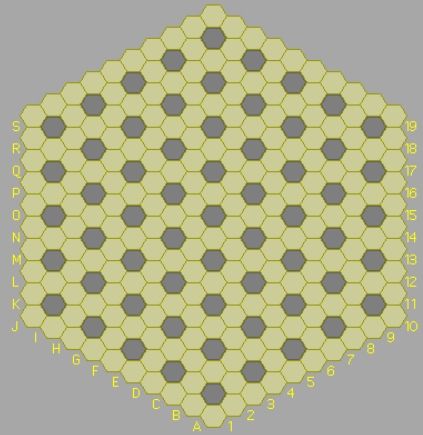
General
A group is a set of like-colored stones all connected to each other through adjacency.
A group is a set of like-colored (same-color) stones that are adjacent to each other. Adjacency means directly next to each other on the board (not diagonal). A single stone with no adjacent friendly stones is still considered a group — a singleton group of size 1.
General
A path is an empty point or uninterrupted straight line of empty points connecting two like-colored stones that are not part of the same group.
A path exists between two like-colored stones when there is either a single empty point or an uninterrupted straight line of empty points that runs directly between them, and the two stones are NOT part of the same group. If the two stones are already in the same group, the empty points between them do not constitute a path. A group is said to 'have a path' if at least one stone belonging to that group has a path to any other like-colored stone outside that group.
General
A dead group is a group where every stone in it has no path to any same-colored stone outside the group.
A group becomes dead when all stones belonging to it have no path — meaning there is no empty point or uninterrupted straight line of empty points connecting any stone in the group to a same-colored stone that is not already part of the same group. If even one stone in the group has a path to an outside same-colored stone, the entire group is considered to have a path and is NOT dead. Dead groups are removed from the board by the opponent at the start of the opponent's turn.
Setup
On each player's first turn, they place one stone of their color on any empty point.
Light goes first. On their very first turn, Light places one stone of their color on any empty point on the board — no restrictions apply. Then Dark takes their first turn and also places one stone of their color on any empty point on the board. No path requirement applies to these first placements.
Setup
On each player's second turn, they must place their second stone such that their two stones have a path.
On a player's second turn, they place a second stone of their color on any empty point, but with the requirement that their two stones (the one already on the board from their first turn, and the newly placed one) must have a path between them. A path exists when the two stones are connected by an empty point or an uninterrupted straight line of empty points, and the stones are not part of the same group (which they cannot be yet, since they are not adjacent). This ensures every player enters normal gameplay with at least one valid group that has a path.
Turn structure
At the start of your turn, you must remove all of your opponent's dead groups from the board.
The first action of every normal turn (after both players have completed their two setup turns) is mandatory: the active player removes all of their opponent's dead groups from the board. A dead group is any group of opponent stones where no stone in the group has a path. All such groups are removed simultaneously before the active player places a stone. This step cannot be skipped.
Turn structure
Each normal turn consists of two mandatory steps: (1) remove all opponent dead groups, then (2) place one friendly stone on a legal point.
After both players have completed their two setup turns, each turn proceeds in strict order: Step 1 — Remove all opponent dead groups (see capture_rule). Step 2 — Place one stone of your own color on an empty point that is (a) on at least one straight line with an existing friendly stone, and (b) has no opponent stone between it and that friendly stone on that line. Both steps are mandatory. Passing is only allowed if there is absolutely no legal placement available.
Turn structure
A stone may only be placed on an empty point that shares a straight line with a friendly stone, with no opponent stones in between.
On your turn, you must place one stone of your own color on an empty point that satisfies both conditions: (1) The point lies on at least one straight line (horizontal, vertical, or diagonal — as defined by the board) with at least one existing friendly (same-colored) stone already on the board. (2) There is no opponent stone located between the placed point and that friendly stone along that line. A placement point only needs to meet these conditions with respect to one friendly stone — it can be valid even if it would not qualify relative to other friendly stones. Note: placing a stone that causes your own group to become dead (lose its path) is a legal move, but will result in that group being captured on the opponent's next turn.