General
Each tile has two sides: one with curved tracks joining adjacent edges, one with straight tracks joining opposite edges.
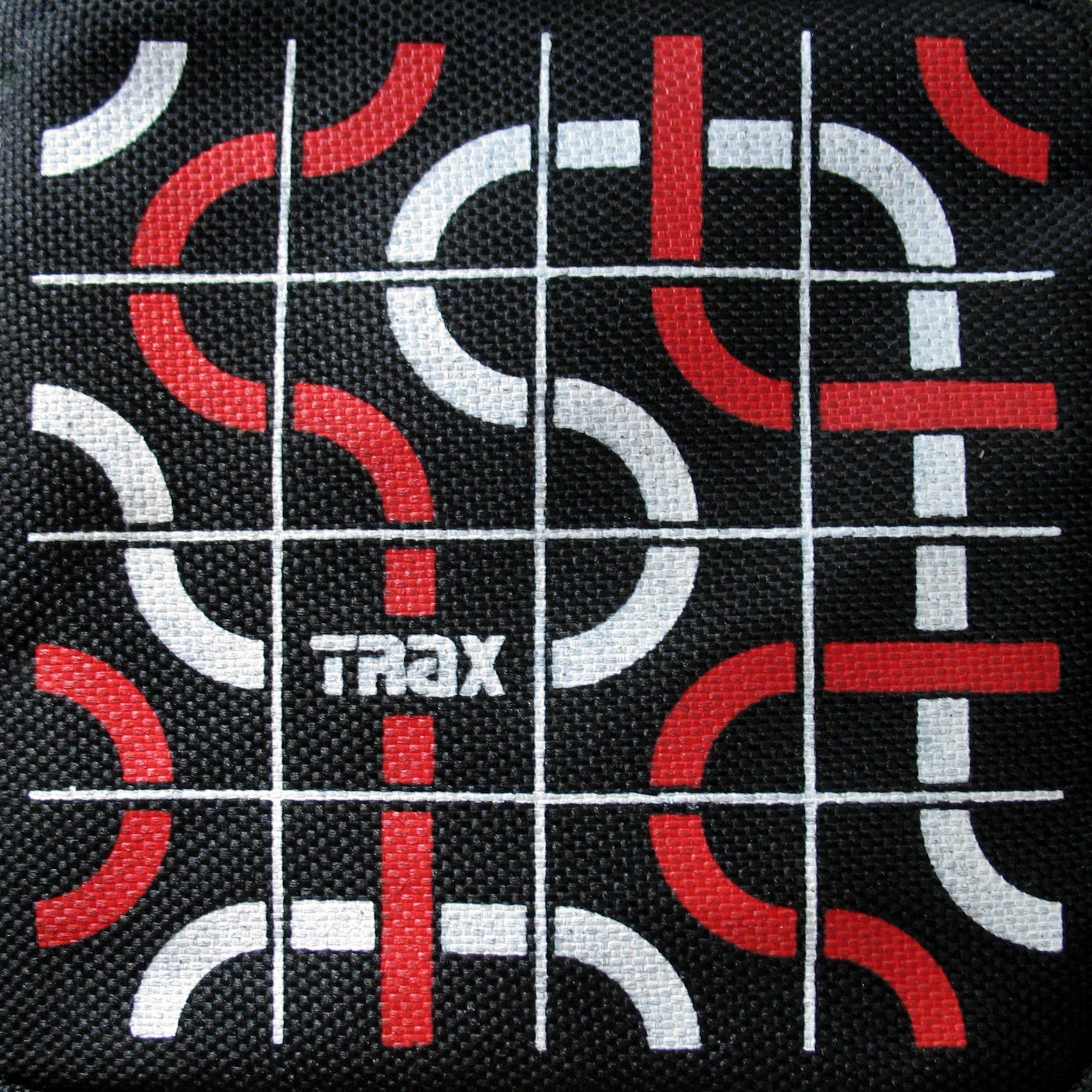
Every Trax tile is square and identical. One side shows two curved track sections, each connecting two adjacent (perpendicular) edges of the tile — one curve in black, one in white. The other side shows two straight track sections, each connecting two opposite (parallel) edges of the tile — one straight in black, one in white. A player may place the tile with either side face-up.
Setup
Two players agree before the game which player is represented by white track and which by black track.
Before the game begins, the two players determine by prior agreement who shall be represented by white track and who by black track. This assignment is fixed for the entire game.
Turn structure
White places the first tile to start the game; no adjacency restriction applies to the very first tile.
The White player always takes the first turn of the game. The very first tile may be placed on any flat surface without any adjacency requirement, since there are no existing tiles yet. The tile may be placed either side up.
Turn structure
After the first turn, each tile must be placed edge-to-edge adjacent to existing tiles and must join same-coloured track on all touching edges.
From the second turn onward, a player places exactly one tile (either side up) onto the playing surface. The tile must be placed edge-to-edge alongside at least one tile already in play. Every edge of the newly placed tile that touches an edge of an existing tile must show track of the same colour as the track on the touching edge of the existing tile. A placement that would violate this colour-matching rule is illegal.
Turn structure
A player may advance track of either or both colours in a single turn.
There is no restriction on which colour of track is advanced when a player places a tile. A tile placement may extend white track, black track, or both simultaneously. This means a player may unintentionally (or intentionally) benefit their opponent's track while extending their own.
Special
If a placed tile creates an adjacent space where same-coloured track enters from exactly two edges, the active player must immediately fill that space — this is a Forced Play.
After a player places any tile (including as a result of a previous forced play), the active player must inspect all spaces adjacent to the newly placed tile. If any such space is empty and has same-coloured track entering it from exactly two of its edges (from already-placed neighbouring tiles), the active player is required to place a tile in that space to join up those two track segments. This is called a Forced Play and is resolved as part of the same turn. A forced play tile placement may itself create new adjacent spaces that satisfy the forced-play condition, requiring still further forced plays, all within the same turn. Forced plays are mandatory and automatic — the player has no choice about whether to make them, only about the orientation of the tile placed (if the forced space has same-coloured track entering from two specific edges, the tile orientation is actually fully determined by the need to connect those tracks; in practice the tile orientation may be fixed).
Restriction
If a forced play would create a space where same-coloured track enters from more than two edges, the entire turn is illegal and must be replayed.
During forced play resolution, if an empty adjacent space is created where same-coloured track enters it from more than two of its four edges, no legal tile can fill that space (no tile connects three or more edges of the same colour). In this case the entire turn — including the initial placement and all forced plays — is declared illegal and uncomplete. The active player must remove all tiles placed during that turn and choose a different placement. This situation is rare but possible.
Endgame
A player wins if their track forms a loop (a continuous path that connects with itself).
A loop is a continuous path of one player's track that connects back to itself, forming a closed circuit. If a player's track forms a loop at any point during a completed turn — whether from their own placement, forced plays, or even during the opponent's turn — that player wins, subject to the simultaneous-win tiebreaker rule.