2019 BGG rank #38

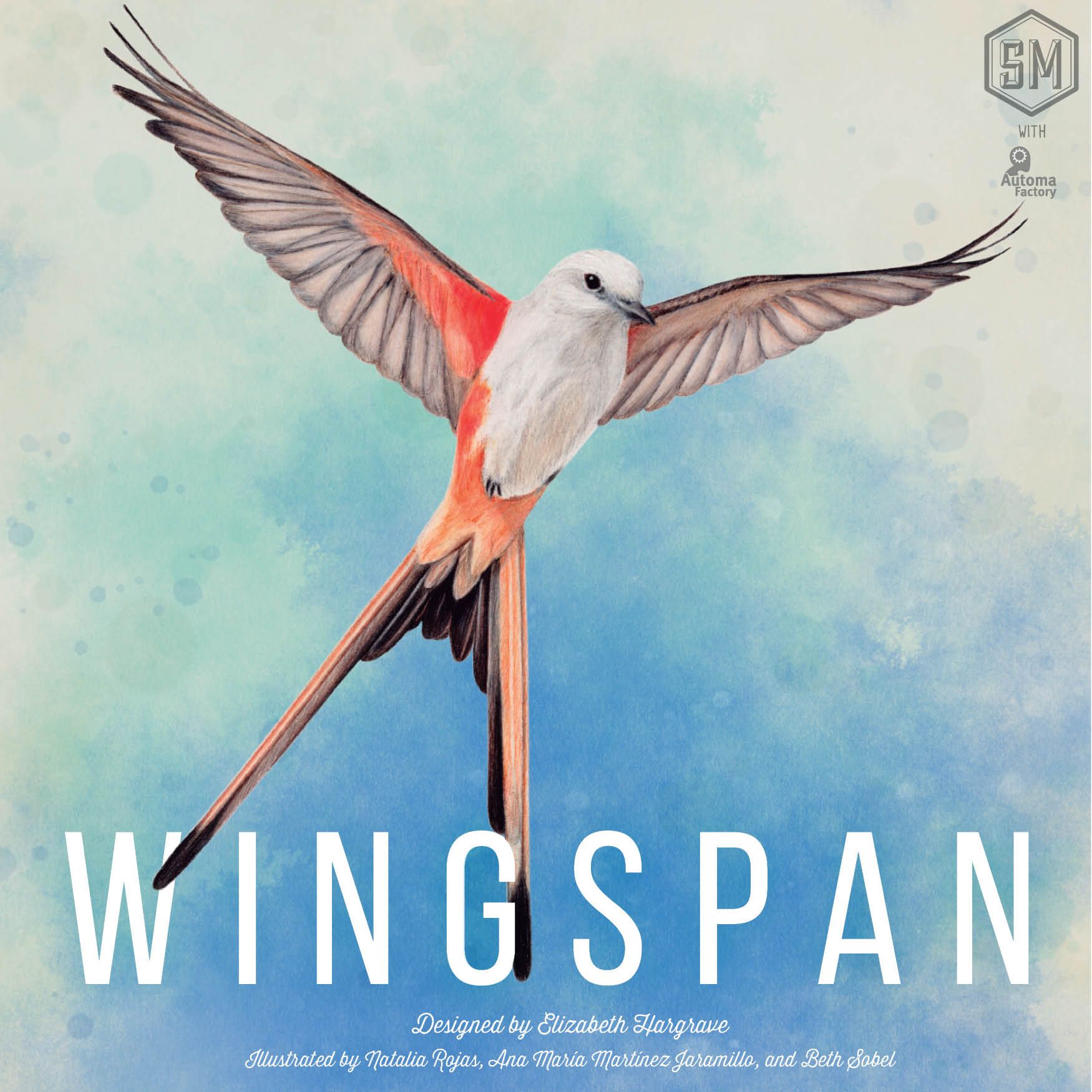
Wingspan

1–5 players 40–70 min Ages 10+ 2.5/5 complexity 7.8/10 rating

About this game

Wingspan is a competitive, medium-weight, card-driven, engine-building board game from Stonemaier Games. It's designed by Elizabeth Hargrave and features 180 birds illustrated by Natalia Rojas and Ana Maria Martinez. You are bird enthusiasts—researchers, bird watchers, ornithologists, and collectors—seeking to discover and attract the best birds to your network of wildlife preserves. Each bird extends a chain of powerful combinations in one of your habitats (actions). These habitats focus on several key aspects of growth: Gain food tokens via custom dice in a birdfeeder dice tower Lay eggs using egg miniatures in a variety of colors Draw from hundreds of unique bird cards and play them The winner is the player with the most points after 4 rounds. —description from the publisher From the 7th printing on, the base game box includes Wingspan: Swift-Start Promo Pack.

What it feels like

Set Collection End Game Bonuses Once-Per-Game Abilities Solo / Solitaire Game Dice Rolling Action Queue Hand Management Open Drafting Turn Order: Progressive Animals Card Game Educational Biology Ecology Nature

Explore these mechanics in Cardboard

Start an original prototype from reusable design patterns—not this game's content.

Open mechanics workbench

Game intelligence

Learn the game

100% knowledge coverage

Setup

Standard setup: Each player draws 5 bird cards from the shuffled bird deck and keeps any number, discarding the rest. For each bird card kept, the player discards one food token from their starting allotment of 5 food tokens. Players also choose 1 of 2 dealt Bonus cards to keep. Place end-of-round goal tiles on the goal track. Set up the bird tray with 3 face-up bird cards and the bird feeder dice tray with all 5 food dice (rolled to start). Each player takes a player mat and 8 action cubes. House Rule — Alternative Starting Hand ('Start with ≤10'): Either (A) deal 10 bird cards to each player, who chooses 5 and discards the other 5, OR (B) deal 6 cards to each player, each picks 1 and passes the rest, repeating until each player has 5 (last remaining card is discarded). In both variants, players keep all 5 food tokens (no food-for-card trade-off).

Turn flow

Wingspan is played over 4 rounds. Each round, players take turns in order, each placing one action cube to take one of four actions on their player mat: (1) Play a Bird — pay the bird's food and egg costs to place it in the matching habitat column. (2) Gain Food — take food dice from the birdfeeder. (3) Lay Eggs — place eggs on birds already in your habitats. (4) Draw Bird Cards — draw from the face-up tray or the top of the deck. Each successive action in the same row is more powerful because earlier birds in that row activate ("cascade") when you take that row's action. The round ends when all players have used all their action cubes. After each round, end-of-round goals are scored and action cubes are returned.

Scoring and victory

Highest total point score after Round 4 wins; ties broken by unused food tokens. Scoring sources: Bird cards (face value of each bird played), Bonus cards (end-of-game objective fulfillment), End-of-round goals (accumulated across all four rounds), Eggs (1 point each, on any bird at end of game), Food on birds / tucked cards (as granted by individual bird powers)

Source: Rulebook

Rules to know

The most useful rules for getting a first game right.

Setup

Standard rule: draw 5 bird cards, keep any number, discard food equal to birds kept.

At game start each player is dealt 5 bird cards. They may keep any number of them. For each bird card they keep, they must discard 1 food token from their starting pool of 5 food tokens. Any bird cards not kept are discarded. This creates an opening trade-off between hand size and food resources.

Setup

House rule: start with up to 10 cards (choose 5) OR draft 6-pass-1 down to 5; keep all 5 food tokens.

This optional house rule replaces the standard starting hand procedure with one of two variants: Option A — Draw 10, Choose 5: Deal 10 bird cards to each player. Each player selects 5 to keep and discards the other 5. Option B — Draft: Deal 6 cards to each player. Each player picks 1 card and passes the remaining cards to the next player. Repeat until each player has 5 cards. The final leftover card is discarded. In both variants, players keep ALL 5 of their starting food tokens (the normal food-for-card discard rule does not apply). Impact: engines establish slightly quicker; starting hands are more evenly balanced between players.

Setup

Standard rule: each player is dealt 2 Bonus cards and keeps 1 at game start.

During setup, each player is dealt 2 Bonus cards and must choose 1 to keep, discarding the other immediately. The kept Bonus card provides a scoring objective fulfilled at end of game.

Setup

House rule: keep both Bonus cards at start; discard your 2nd Bonus card at the end of Round 1.

Normally players discard their unwanted Bonus card immediately during setup. With this house rule, players keep both dealt Bonus cards throughout Round 1, then must discard one of the two at the end of Round 1 (after end-of-round scoring). This gives players a better sense of their engine's direction before committing. Impact: opens up more strategic thinking and reduces early-game regret.

Scoring

End-of-round goals are scored at the end of each round using a descending point track.

At the end of each round, players compare their progress on the active end-of-round goal tile. Players rank from highest to lowest. Points are awarded in descending order based on rank (e.g., 1st place receives the most points, with ties splitting values). Players mark their scores by moving a scoring marker on the goal track.

Setup

House rule: place the 'NO GOAL' end-of-round tile first on the goal track (covering Round 1's goal).

The Wingspan box includes a 'NO GOAL' end-of-round goal tile. With this house rule, this tile is placed first on the end-of-round goal track, meaning Round 1 has no end-of-round goal scoring. The remaining standard goal tiles fill Rounds 2, 3, and 4. Impact: players gain an extra 3 turns of engine-building before goals matter (since no actions are 'wasted' optimizing for Round 1's goal), allowing engines to grow more smoothly.

Turn structure

House rule: each player takes 8 turns per round (instead of the standard decreasing turns).

Standard Wingspan gives each player 8 turns in Round 1, 7 in Round 2, 6 in Round 3, and 5 in Round 4 (26 total). With this house rule, every player takes 8 turns in every round (32 total — 6 more than standard, or 3 more if also using 'No Goal First'). When scoring end-of-round goals, use a substitute marker to record scored points for each player, and all 8 player action cubes are retained and returned each round. Impact: substantially more engine-building time; engines can grow larger and run through more activations.

Turn structure

Each player has 8 action cubes; spending one takes your turn for that round.

Each player has a set of 8 action cubes in their player color. On your turn, you place one action cube on one of the four action spaces on your player mat (Play a Bird, Gain Food, Lay Eggs, Draw Bird Cards) and resolve that action. Once all your cubes are placed, your round is over. At the end of each round all cubes are returned to players.

Strategy briefing

Early Engine Investment

Playing birds into a single habitat row early maximizes the cascade effect (engine_cascade rule): every subsequent action in that row activates all previously played birds left-to-right. Prioritizing one row before diversifying amplifies returns on every turn.

House Rule — Drafting vs. Draw-10 Start

The draft variant of 'Start with ≤10' produces more evenly balanced starting hands because card quality is distributed across all players. The draw-10/choose-5 variant is faster but may produce luckier outcomes. If competitive balance matters, prefer the draft.

Bonus Card Commitment (Delayed Discarding)

With 'Delayed Discarding', spend Round 1 evaluating which habitat and bird types you're naturally gravitating toward before committing to a Bonus card. A Bonus card misaligned with your engine direction is nearly worthless at end of game.

No Goal First — Free Engine Round

With 'No Goal First', Round 1 requires no goal optimization. Use all 8 turns purely to play foundational birds and establish your most important habitat row without sacrificing turns to chase ranking metrics.

Food Efficiency with Start-with-10 House Rule

Because the 'Start with ≤10' house rule grants all 5 food tokens regardless of hand size, players have more flexibility to play expensive birds early without depleting resources. Prioritize high-cost, high-value birds in Round 1 that you couldn't normally afford under standard setup.

Birdfeeder Management

Depleting the birdfeeder strategically can trigger a reroll on your turn or set up the 'Birdfeeder Fun' bonus for everyone. Be aware that forcing a reroll may benefit opponents equally under the house rule, so consider the board state before deliberately exhausting the feeder.

Egg Management for Late-Game Scoring

Eggs serve a dual purpose: they are a cost to play new birds AND score 1 point each at end of game. Under '8 Turns a Round', the extra turns allow you to build a larger grassland row and farm eggs more efficiently — stockpiling eggs late (Rounds 3–4) after your bird costs are paid is a strong endgame push.

Common questions and edge cases

If we're using both '8 Turns a Round' AND 'No Goal First', how many extra turns do we get total?

Using '8 Turns a Round' alone adds 6 turns over the course of the game compared to standard. Using 'No Goal First' alone adds 3 turns (no Round 1 goal to optimize for). Using both together yields 3 additional turns from '8 Turns a Round' on top of the 'No Goal First' baseline, for a combined benefit, not a full 9 extra. The rulebook states 8-turns gives '6 extra turns, or 3 if playing just with NO GOAL goal', meaning the two house rules partially overlap in benefit.

If using the 'Start with ≤10' house rule, do I still discard food for the bird cards I keep?

No. The 'Start with ≤10' house rule explicitly states that players keep ALL 5 food tokens regardless of how many bird cards they keep. The normal trade-off of discarding 1 food per kept card does not apply under this house rule.

When exactly do I discard my 2nd Bonus card under the 'Delayed Discarding' house rule?

You discard your unwanted Bonus card at the END of Round 1 — after end-of-round goal scoring for Round 1 has been resolved. You keep both Bonus cards in hand and available for reference throughout the entire first round before committing.

Does the 'Birdfeeder Fun' house rule trigger every time the feeder is rerolled, or only under specific conditions?

It triggers only when the reroll result shows ALL 5 dice displaying the same food type. The reroll itself is triggered by the standard rule (all remaining dice show the same face, or feeder is empty). The bonus payout is a second condition that must be met after the reroll. It is intentionally rare.

Under 'No Goal First', does anything happen at the end of Round 1 where the NO GOAL tile is placed?

No points are scored for end-of-round goals at the end of Round 1. The round simply ends, action cubes are returned, and play proceeds to Round 2. The NO GOAL tile means that round's goal slot is intentionally blank.

Why is a substitute marker needed for end-of-round goals under the '8 Turns a Round' house rule?

In standard Wingspan, players use their action cubes on the goal track to mark end-of-round goal scores. Because the '8 Turns a Round' rule requires all 8 action cubes to be returned to players after each round (rather than some staying on the goal track), a substitute/proxy marker is used instead to preserve the scored goal points on the track.

Ask About This Game

Similar games