2021 Puesto n.º 11835 en BGG

Meridians

2 jugadores 20–40 min A partir de 10 años 2.0/5 de complejidad 5.6/10 de valoración

Acerca de este juego

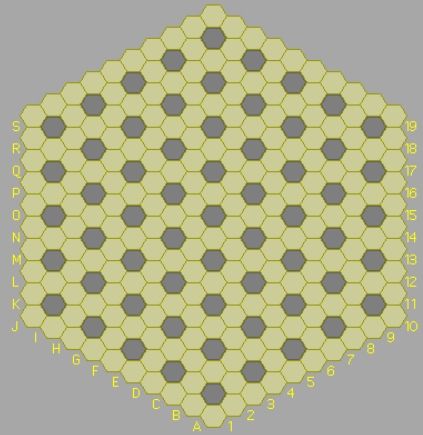
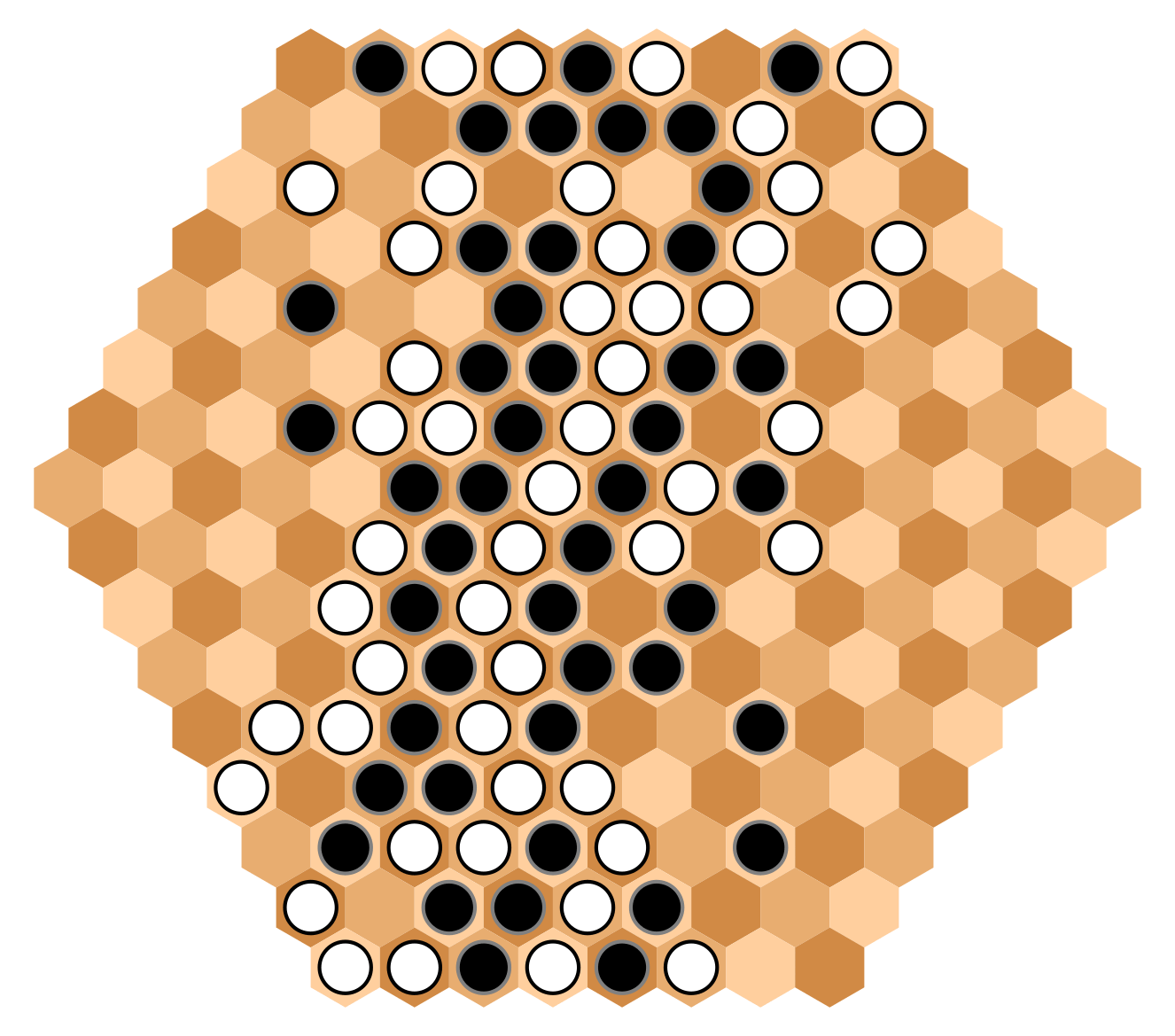
Meridians is an abstract strategy game for 2 players. It has a territorial nature, but the goal is to annihilate opponent's stones. "Meridians" is named after the meridians system. Meridians won BEST COMBINATORIAL 2-PLAYER GAME OF 2021 in BGG Abstract Games forum. COMPONENT A centerless hexagonal board tessellated with triangles (any size. The regular size board has 6 points to 2 sides and 7 points to 4 sides) Sufficient stones of 2 colors DEFINITIONS Group: like-colored stones adjacent to each other. Singletons are considered groups of size 1. Path: an empty point, or an uninterrupted straight line of empty points that have a pair of like-colored stones on both ends, which are not part of the same group. Such a pair is said to have a path. Dead group: a group in which all stones belonging to it have no path. If any stone belonging to a group has a path, the group is said to have a path. GAME PLAY (Overview) Decide which player plays as which color (Light or Dark) in any adequate way. Light goes first, then alternate turns. On each player's first turn, players place a stone of their own color on any empty point. On each player's second turn, players place another stone of their color so that their own two stones have a path. Then players take actions below on each turn, in this order. 1. Remove all opponent’s dead groups. 2. Place a stone of their own color on an empty point that is on at least one same straight line with an existing friendly stone, and no opponent's stone in between. Passing is not allowed. After the second turn, the player with no stones of their color on the board at the beginning of their turn loses. Optionally, pie rules can be used to reduce the first player's advantage. The first player places one stone of each color and the second player decides which color to play. Play then continues as usual. -description from designer

Qué sensaciones ofrece

Chaining Hexagon Grid Enclosure Line of Sight Abstract Strategy Print & Play

Inteligencia del juego

Aprende el juego

100% de cobertura de conocimiento

Preparación

1. Determine which player is Light and which is Dark.\n2. Light places one stone on any empty point (first turn).\n3. Dark places one stone on any empty point (first turn).\n4. Light places a second stone such that their two Light stones have a path between them (second turn).\n5. Dark places a second stone such that their two Dark stones have a path between them (second turn).\n6. Normal play begins: players alternate turns, Light going first within the normal rotation.\n7. OPTIONAL — Pie Rule: One player places one stone of each color; the other player then picks which color to play. Light always moves first.

Flujo del turno

After each player's first two setup turns, players alternate turns (Light goes first). Each turn proceeds in this mandatory order:\n\n1. CAPTURE PHASE: Remove all of the opponent's dead groups from the board. A dead group is one where every stone in the group has no path. This step is mandatory.\n2. PLACEMENT PHASE: Place one stone of your own color on an empty point that satisfies both of the following conditions:\n a. The point is on at least one straight line with an existing friendly (same-color) stone.\n b. There is no opponent's stone between the placed stone and that friendly stone on that line.\n\nPassing is not allowed unless there is no legal move available. The game ends when a player has no stones of their color on the board at the beginning of their turn.

Puntuación y victoria

Elimination: the player who has no stones remaining on the board at the start of their turn loses. Alternatively, if territories have been established, the player who can legally place stones on more intersections without losing their group wins. Fuentes de puntuación: Elimination of all opponent stones via dead group capture, Territory counting of safe legal placements (secondary method)

Fuente: Rulebook

Reglas que debes conocer

Las reglas más útiles para jugar bien la primera partida.

General

A group is a set of like-colored stones all connected to each other through adjacency.

A group is a set of like-colored (same-color) stones that are adjacent to each other. Adjacency means directly next to each other on the board (not diagonal). A single stone with no adjacent friendly stones is still considered a group — a singleton group of size 1.

General

A path is an empty point or uninterrupted straight line of empty points connecting two like-colored stones that are not part of the same group.

A path exists between two like-colored stones when there is either a single empty point or an uninterrupted straight line of empty points that runs directly between them, and the two stones are NOT part of the same group. If the two stones are already in the same group, the empty points between them do not constitute a path. A group is said to 'have a path' if at least one stone belonging to that group has a path to any other like-colored stone outside that group.

General

A dead group is a group where every stone in it has no path to any same-colored stone outside the group.

A group becomes dead when all stones belonging to it have no path — meaning there is no empty point or uninterrupted straight line of empty points connecting any stone in the group to a same-colored stone that is not already part of the same group. If even one stone in the group has a path to an outside same-colored stone, the entire group is considered to have a path and is NOT dead. Dead groups are removed from the board by the opponent at the start of the opponent's turn.

Setup

On each player's first turn, they place one stone of their color on any empty point.

Light goes first. On their very first turn, Light places one stone of their color on any empty point on the board — no restrictions apply. Then Dark takes their first turn and also places one stone of their color on any empty point on the board. No path requirement applies to these first placements.

Setup

On each player's second turn, they must place their second stone such that their two stones have a path.

On a player's second turn, they place a second stone of their color on any empty point, but with the requirement that their two stones (the one already on the board from their first turn, and the newly placed one) must have a path between them. A path exists when the two stones are connected by an empty point or an uninterrupted straight line of empty points, and the stones are not part of the same group (which they cannot be yet, since they are not adjacent). This ensures every player enters normal gameplay with at least one valid group that has a path.

Turn structure

At the start of your turn, you must remove all of your opponent's dead groups from the board.

The first action of every normal turn (after both players have completed their two setup turns) is mandatory: the active player removes all of their opponent's dead groups from the board. A dead group is any group of opponent stones where no stone in the group has a path. All such groups are removed simultaneously before the active player places a stone. This step cannot be skipped.

Turn structure

Each normal turn consists of two mandatory steps: (1) remove all opponent dead groups, then (2) place one friendly stone on a legal point.

After both players have completed their two setup turns, each turn proceeds in strict order: Step 1 — Remove all opponent dead groups (see capture_rule). Step 2 — Place one stone of your own color on an empty point that is (a) on at least one straight line with an existing friendly stone, and (b) has no opponent stone between it and that friendly stone on that line. Both steps are mandatory. Passing is only allowed if there is absolutely no legal placement available.

Turn structure

A stone may only be placed on an empty point that shares a straight line with a friendly stone, with no opponent stones in between.

On your turn, you must place one stone of your own color on an empty point that satisfies both conditions: (1) The point lies on at least one straight line (horizontal, vertical, or diagonal — as defined by the board) with at least one existing friendly (same-colored) stone already on the board. (2) There is no opponent stone located between the placed point and that friendly stone along that line. A placement point only needs to meet these conditions with respect to one friendly stone — it can be valid even if it would not qualify relative to other friendly stones. Note: placing a stone that causes your own group to become dead (lose its path) is a legal move, but will result in that group being captured on the opponent's next turn.

Informe estratégico

Maintain mergeability of groups

Avoid letting your stones get split into isolated smaller groups by opponent stones. Proactively position stones so that your groups can merge into larger ones when needed. Because each merging stone requires a path from a different intersection to facilitate the merge, plan two stones with paths from distinct points so that blocking one path still leaves another route to merge.

Threatening opponent paths

Place stones that simultaneously extend your own network AND block straight lines between opponent stone pairs. Since a path requires an uninterrupted straight line of empty points with no opponent stone in between, a single well-placed stone can eliminate multiple opponent paths at once, pushing groups toward dead status.

Avoid self-defeating placements

Before placing a stone, verify that doing so does not cut off any of your own groups' last paths. A legal placement can make your own group dead, which the opponent will immediately capture on their next turn. Always check that each of your groups retains at least one path after your placement.

Second-turn path setup

On your second turn, choose a position for your second stone that not only satisfies the mandatory path requirement but also maximizes flexibility — place it so the resulting pair of stones can influence multiple lines, making it harder for the opponent to simultaneously block all paths in the early game.

Secondary endgame — territory counting

When the game transitions to a territory-counting endgame, the player who has secured more intersections where they can safely place stones wins. Prioritize building stone networks that dominate large regions of the board and minimize the spaces where the opponent can legally place without being cut off.

Preguntas frecuentes y casos límite

Two like-colored stones are adjacent (in the same group). Do the empty points between them in a straight line count as a path?

No. A path only connects two like-colored stones that are NOT part of the same group. If two stones are already in the same group, the empty points between them do not form a path. This is critical — a group can only 'have a path' via connections to stones outside itself.

A player places a stone that blocks an opponent's last path, making an opponent group dead. When is that group removed?

The group is not removed immediately. It is removed at the start of the opponent's next turn (the opponent being the player who now owns the dead group). Specifically, the active player who caused the group to die placed their stone in Step 2 of their turn; the dead group removal happens in Step 1 of the NEXT player's turn.

A player places a stone that causes one of their OWN groups to lose its path (become dead). Is this allowed, and what happens?

Yes, the placement is legal — there is no rule preventing a player from making their own group dead. However, at the start of the opponent's very next turn, the opponent will remove that dead group in the mandatory capture phase. This is a strategic risk to avoid.

There is an empty point on the same straight line as a friendly stone, but an opponent's stone sits between them. Can a player place on that empty point using that friendly stone to satisfy the placement rule?

No. A placement point is only legal if there is NO opponent stone between it and the qualifying friendly stone along that line. The opponent stone blocks the line. The player would need another friendly stone on a different line without obstruction to justify the placement.

On a player's second turn, can they place their stone anywhere, or must it specifically create a path with their first stone?

The stone must be placed such that the player's two stones have a path between them. This means the second stone must be placed on a point where an uninterrupted straight line of empty points (or a single empty point) connects it to the first stone, and the two stones are not adjacent (not in the same group yet). The placement is constrained to points that satisfy this path requirement.

A player's last group is removed as dead at the start of their turn. Do they lose immediately, or do they still get to place a stone?

They lose immediately. The loss condition is checked at the beginning of the player's turn — if they have no stones on the board at that point (after dead groups are conceptually removed), they lose. The capture phase (Step 1) happens before placement (Step 2), so if capturing the dead groups leaves the player with no stones, the game ends without them placing.

In a serious game, a player forgets to remove an opponent's dead group on their turn. Can they go back and remove it?

No — once the turn has proceeded past the capture phase, the overlooked dead group is treated as a live group until the beginning of the next opponent's turn. The opponent who owns that group effectively gets a reprieve for one turn cycle. Both players sharing responsibility to spot dead groups is recommended for casual play.

Pregunta Sobre Este Juego

Juegos similares