2015

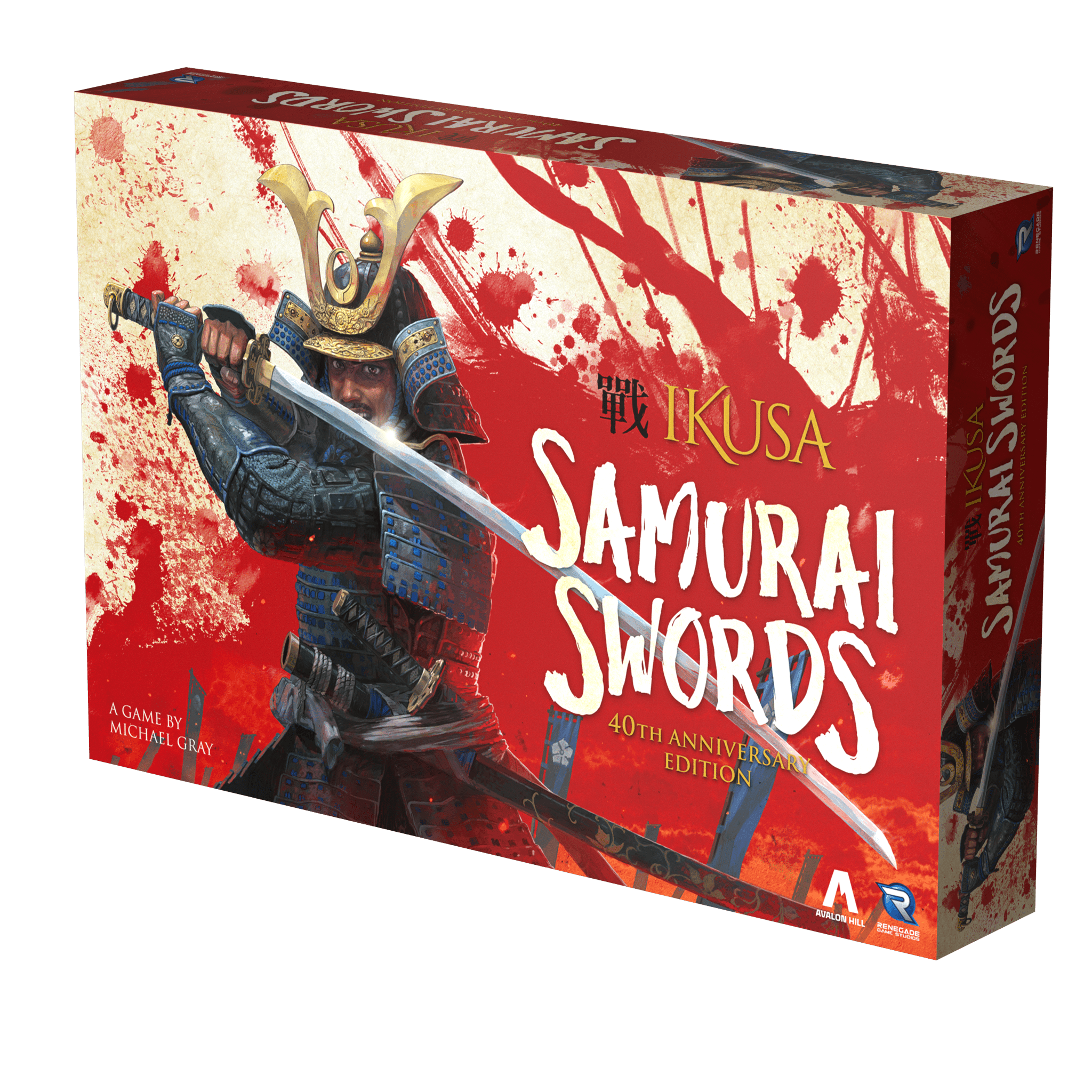
Shogun Big Box

3–5 jugadores 120–150 min A partir de 12 años 3.3/5 de complejidad 6.0/10 de valoración

Acerca de este juego

Shogun Big Box includes the base game of Shogun and its expansion Shogun: Tenno's Court, as well as three small modules: Samurai, Military Leaders and Chambers, with the latter two unique to this release. With Samurai, each player receives a stack of cards showing progressively better bonuses. At the beginning of each round, if a player controls provinces in at least four regions, they reveal the next card in their stack and select one of the bonuses depicted on it. These bonuses include war chests, armies placed directly into the tower tray, rice and victory points. With Military Leaders, every player is given one military leader figure to place on one of their controlled provinces. A player's leader provides extra benefits for performing actions in their province, such as reducing the cost for buildings or providing extra resources when collecting rice or taxes. At the end of a player's turn, they move their leader to an adjacent province they control and leave a marker at the old location - if they don't control any provinces adjacent to where their leader is, they move their leader to any of their controlled provinces without leaving a marker behind. The more markers a player has on the board at the end of the game, the more points will be awarded! For Chambers, many offices have to be taken in order to rule the land. At the beginning of each round, six chamber markers are revealed and placed on the corresponding spaces on the chamber tableau, representing available offices that can be filled by the players. Whoever controls the most provinces in each region can fill the position by exchanging the chamber marker on the tableau with one of their own player markers. At the end of the game, players are awarded extra points for majorities in horizontal and vertical lines on the chamber tableau.

Qué sensaciones ofrece

Area Majority / Influence Simultaneous Action Selection Area Movement Action Queue Auction / Bidding Variable Phase Order Cube Tower Economic Territory Building

Explora estas mecánicas en Cardboard

Crea un prototipo original con patrones de diseño reutilizables, no con el contenido de este juego.

Abrir el taller de mecánicas

Inteligencia del juego

Aprende el juego

80% de cobertura de conocimiento

Preparación

1. Choose a game mode: (A) Austere – Samurai module; (B) Basic – Samurai + Tenno's Court; (C) Classic – Samurai + Tenno's Court + Military Leaders; (D) Daimyo – all four modules. 2. Player 1 takes Yellow + Blue Alliance boards; Player 2 takes Purple + Black Alliance boards. 3. Use the Sun side of the game board (3 regions, 27 provinces in light green, violet, and tan). 4. Configure individual boards front-side: 1 full board (Yellow or Purple) plus the right part of the allied color board (Blue or Black) showing 3 additional action columns. 5. Each player has 11 countryside areas (7 on main board, 4 on allied board: armies of 4, 3, 2, 2). 6. Each player receives: 1 Daimyo card, 5 Chest cards, and 3 Battle Tower cards (from Tenno's Court). 7. Initial Chests: 18 in Austere mode (A); 21 in Basic mode (B). 8. Set aside 1 Permanent Event card (neutral provinces always enter battle with 2 green cubes) – place it visibly or place 2 green cubes on empty provinces as a reminder. 9. Set aside 3 Special Event cards: two rice confiscation and one "min. 6" tax collection card – used in the 1st Winter round. 10. Shuffle 8 regular Event cards (0 to -7 Rice loss), excluding special and permanent cards. 11. (Optional Thematic Variant): Player 1 receives Aki card with a Castle, yellow military leader, and 5 yellow armies. Player 2 receives Owari card with a Castle, purple military leader, and 5 purple armies. 12. Shuffle 27 province cards. Draw 1 per region (3 total); place 2 green cubes and 1 Revolt marker on each to mark them as neutral starting provinces. 13. Load the Battle Tower with 7 yellow cubes, 7 purple cubes, and 10 green cubes. 14. Determine First Player: the player with the most armies on the tower tray goes first. On a tie, Player 1 goes first in the thematic variant; otherwise the weakest player goes first. 15. First Player places their Daimyo card on turn order position 1; second player on position 2. 16. Return all cubes from the tower tray to supply. 17. First Player begins claiming starting provinces; each player claims 11 provinces total. 18. The 2 unclaimed provinces may have 2 green cubes placed on them. 19. Daimyo mode only: Shuffle the 3 Region tiles (Chambers module) and place them on turn order positions 3, 4, and 5. 20. Tenno's Court module: Shuffle Favor cards, place deck face down next to the board (used in First Winter). 21. Samurai module: Arrange 7 cards as a column/row bonus path (3-2-1-empty-1-2-3) between players; place 2 red court officials on the "empty" card. 22. To mark board limits, optionally place a red court official on adjacent provinces not part of the game (next to tan provinces).
Flujo del turno

Each non-Winter round (Spring, Summer, Autumn) proceeds as follows: 1. SAMURAI BONUS (Summer and Autumn only): Each player receives one benefit per red court official on their side of the bonus path. 2. FIRST PLAYER CHECK: Count province majorities per region. The player with fewer majorities becomes First Player (Daimyo card to position 1). 3. LAY OUT ACTION CARDS: As in the original Shogun rules. 4. PLAN ACTIONS: Each player plans 13 individual actions and places 2 cards on each of the 3 auction bid spaces (Deploy 1 Army, A, B) on their second board. 5. DETERMINE ROUND EVENT: Draw and reveal Event card. In the Second Spring, players also play their Favor cards. 6. CARRY OUT ACTIONS: Actions are resolved simultaneously except for the 3 auctioned actions (Deploy 1 Army, A, B). Revolts are resolved by First Player first. After any battle between players, apply Samurai module rules. 7. DAIMYO MODE ONLY: Resolve Chambers module tile claiming after all actions. Winter Round: 1. SAMURAI BONUS: Each player receives one benefit per red court official on their side of the bonus path. 2. RICE SUPPLY: Allied provinces (Blue and Black cubes) require 2 rice units instead of 1. 3. REVOLTS: The player who loses more provinces in First Winter randomly receives Special Event cards equal to the difference in lost provinces between players. 4. SCORE VICTORY POINTS: Both players score as in the original Shogun rules. 5. TENNO'S COURT (First Winter only): The player with fewer points draws Favor cards equal to the gap in points. They may keep any subset whose total does not exceed the opponent's current score. All taken cards must be played at the start of the Second Spring. 6. AUSTERE MODE (First Winter only): The gap in points divided by 3 equals the number of times the trailing player moves a red court official on the Samurai bonus path.

Puntuación y victoria

Most Victory Points at the end of the Second Winter wins the game. Victory Points are scored at the end of each Winter round as in the original Shogun rules. The Tenno's Court Favor cards (Basic+ modes) can reduce the point gap going into the Second Year. Fuentes de puntuación: Province control at end of Winter, Buildings (Castles, Temples, Theaters) in controlled provinces, Regional majorities, Favor cards played (Tenno's Court module), Chambers tiles (Daimyo mode)

Fuente: Rulebook

Reglas que debes conocer

Las reglas más útiles para jugar bien la primera partida.

Setup

Four modular game modes determine which expansion modules are added to the base game.

Players choose one of four game modes before setup: (A) Austere – adds only the Samurai module; (B) Basic – adds Samurai and Tenno's Court modules; (C) Classic – adds Samurai, Tenno's Court, and Military Leaders modules; (D) Daimyo – adds all four modules: Samurai, Tenno's Court, Military Leaders, and Chambers. Any rule not specifically modified by the Alliance variant uses the original Shogun game rules.

Setup

Player 1 controls Yellow+Blue; Player 2 controls Purple+Black as alliances.

This is a 2-player Alliance variant. Player 1 controls the Yellow and Blue Alliance; Player 2 controls the Purple and Black Alliance. Each player has an individual board for their primary color (Yellow or Purple) and attaches the right portion of their allied color board (Blue or Black) showing 3 additional columns of action spaces. Alliance colors are never mixed during battles or deployment/movement of armies – original game rules for army separation apply.

Setup

Each player uses a full primary board plus the right part of the allied color board (3 extra action columns).

Each player's playing area consists of: one full individual board (Yellow or Purple, front side) and the right portion of the allied color board (Blue or Black), aligned on its back side to display 3 additional columns of action spaces. The additional action spaces on the allied board are: building a theater, confiscating rice, and collecting taxes. The back side of the allied board also contains 3 auction spaces: 'Deploy 1 army', 'A', and 'B'. The original game's auction space on the main board may be used to hold unused cards during the round.

Setup

Each player has 11 countryside areas: 7 on their main board and 4 on their allied board.

Each player has 11 countryside areas total. 7 are located on the player's own primary board (as in a 5-player game configuration). 4 are located on the allied forces board, corresponding to armies of their allied color in quantities of 4, 3, 2, and 2.

Setup

Each player starts with 1 Daimyo card, 5 Chest cards, and 3 Battle Tower cards.

At the start of the game, each player receives: 1 Daimyo card (Yellow or Purple), 5 Chest cards, and 3 Battle Tower cards from the Tenno's Court expansion. Initial Chests are 18 in Austere (A) mode and 21 in Basic (B) mode.

Setup

Neutral provinces always enter battle with 2 green cubes (permanent rule).

There is 1 Permanent Event card that modifies neutral province rules: all neutral provinces always enter battle with 2 green cubes. This rule is always active. Players may place this card visibly as a reminder, or place 2 green cubes on any empty province during the game as a visual indicator.

Setup

3 Special Event cards are set aside for use in the First Winter round.

Three Special Event cards are separated from the main Event deck at setup: the two rice confiscation cards and the one tax collection card with the text 'min. 6'. These are not shuffled into the regular Event deck. They are used only in the First Winter round as described in the Special Event Cards rules.

Setup

The regular Event deck contains 8 cards (0 to -7 Rice loss), excluding special and permanent event cards.

The regular Event deck consists of 8 cards representing rice loss from 0 to -7. It does not include the 3 Special Event cards (rice confiscation and 'min. 6' tax) nor the 1 Permanent Event card (neutral provinces). These special and permanent cards are handled separately.

Pregunta Sobre Este Juego

Juegos similares