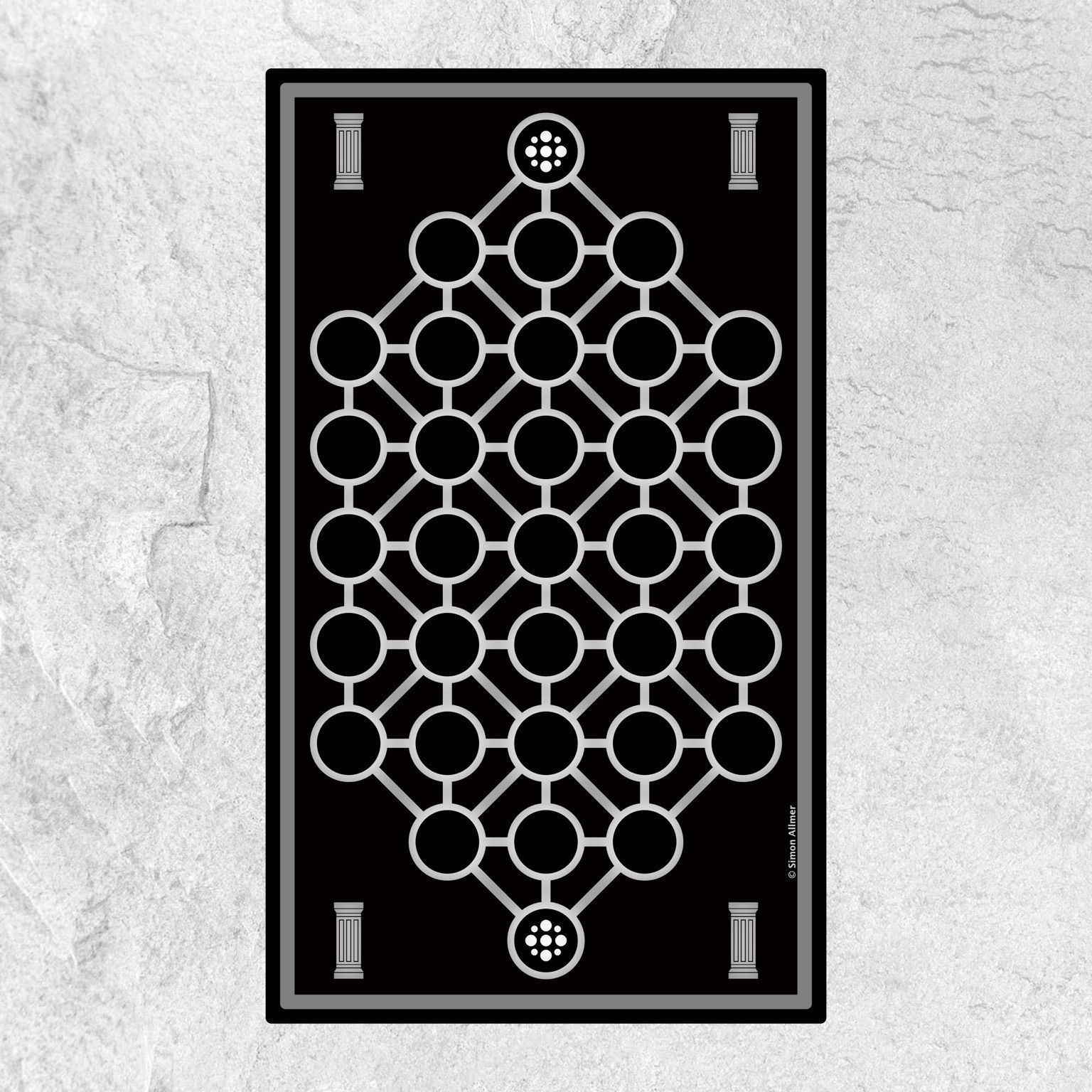
Preparación
1. Place all 33 wooden marbles into the holes on the board. 2. Leave the center hole empty. 3. Optional: Marbles may instead be arranged in a different starting pattern of the player's choosing.
A family of games designed for a single player. These puzzle-games challenge the player to clear a grid of tokens or pegs. Typically all but one space on the board is filled. The game is played by jumping a peg over one other into an empty space. The peg jumped over is removed from the board. This continues until no more jumps can be made. The object is to leave only a single peg or token left on the board. The two most common boards are the 33-peg English cross and the 37-peg French octagon boards. Ostensibly, this is Outside the Scope of BGG, but is kept in the database by fiat due to history.
Inteligencia del juego
1. Place all 33 wooden marbles into the holes on the board. 2. Leave the center hole empty. 3. Optional: Marbles may instead be arranged in a different starting pattern of the player's choosing.
There are no formal turns in the traditional sense. The player continuously selects any marble on the board that can jump over an adjacent marble (horizontally or vertically) into an empty hole directly on the other side. The jumped-over marble is removed. The player keeps making moves until no legal jumps remain.
The player wins outright by ending with exactly one marble in the center hole. In the competitive variant, the player with the fewest remaining marbles at game end wins the tournament. Puntuación objetivo: 1 marble remaining in the center hole (classic mode) Fuentes de puntuación: Classic mode: binary win/loss — one marble in center = win, Variant mode: count of marbles removed (fewer remaining = better score)
Fuente: Rulebook
Las reglas más útiles para jugar bien la primera partida.
To set up the standard game, place all 33 wooden marbles into the holes on the board. The center hole must be left empty. This is the required starting position for the classic game.
As an optional variant, players may arrange the marbles in any starting pattern they choose rather than filling all holes except the center. This allows for custom puzzle configurations.
A legal move consists of one marble jumping over exactly one adjacent marble, either horizontally or vertically (never diagonally), landing in the empty hole directly on the other side of the jumped marble. The hole the jumping marble lands in must be empty. Both the jumping marble and the destination hole must be in a straight horizontal or vertical line with the marble being jumped.
Whenever a marble is jumped over as part of a legal move, that marble is immediately removed from the board and takes no further part in the game. It is not returned to the board for the rest of the game.
Marbles may only jump horizontally or vertically. Diagonal jumps — at any angle — are strictly forbidden regardless of whether an empty hole exists diagonally beyond another marble.
The destination hole (the hole the jumping marble lands in) must be empty before the jump. A marble may not jump over another marble if the hole on the far side is occupied by another marble.
The game ends immediately when there are no more legal moves — that is, no marble on the board can jump over an adjacent marble into an empty hole horizontally or vertically. The player then evaluates the result based on the number and position of remaining marbles.
The game is completed successfully (won) if, when no more moves are possible, exactly one marble remains and it is located in the center hole of the board. Any other outcome — more than one marble remaining, or a single marble not in the center — is considered an incomplete or failed solution.
Since marbles on the outer edges have fewer adjacent marbles to jump or be jumped over, they are hardest to remove late in the game. Prioritize creating jump chains that clear edge marbles early.
The win condition requires the last marble to be in the center hole. Avoid using the center hole as an intermediate landing spot late in the game, as this can strand the final marble off-center.
A marble with no adjacent marbles and no empty hole beyond any neighbor can never be moved or removed. Any marble left isolated early becomes a permanent blocker that guarantees failure in classic mode.
The rulebook does not explicitly address chain jumping. It only describes individual jumps. Based strictly on the rules as written, each move is described as a single jump. Players should decide before the game whether chain jumps are allowed, as this is a common house-rule variant in Solitaire.
No. The game is only considered successfully completed if the single remaining marble is in the center hole. Ending with one marble anywhere else on the board is still a failed solution.
The standard win condition specifies ending with one marble in the center. When using a custom starting pattern, the classic win condition may not be applicable or achievable. The competitive variant (most marbles removed) is the more appropriate objective for custom patterns.
No podemos encontrar la conexión a internet
Intentando reconectar
¡Algo salió mal!
Intentando reconectar