2000 BGG rank #23290

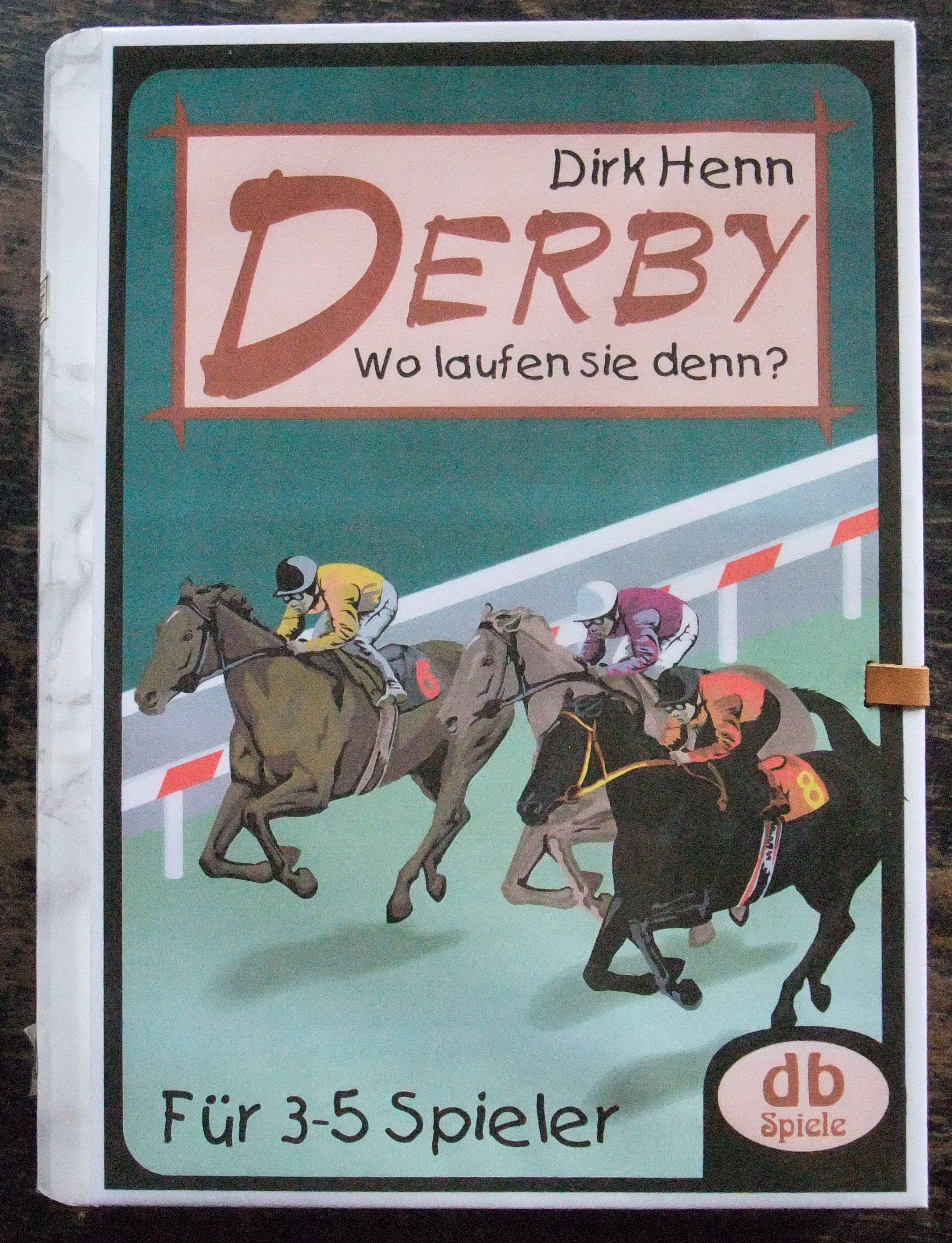
Derby

3–5 players 60 min Ages 0+ 1.6/5 complexity 5.5/10 rating

About this game

Players represent bettors at a horse track. The state of the betting is handled via a set of non-intersecting bet cards which players may draft. Movement of the horses is controlled by a combination of cards, one of which indicates which horses may move, the other which indicates how fast. Players must consider the probable goals of their opponents as well as what opportunities they may provide to the player on the left.

What it feels like

Betting and Bluffing Bluffing Racing Sports

Game intelligence

Learn the game

100% knowledge coverage

Setup

1. Shuffle the movement card deck and place it face down on the pale space in the upper left of the board. Flip the top two cards face up onto the two spaces to the right of the draw pile.\n2. Separate the betting tickets by color and shuffle each color deck individually. Deal one betting ticket of each color to every player. Place the remaining color decks face down on their corresponding board spaces, then flip the top card of each deck face up.\n3. Deal number cards to each player according to player count:\n - 3 players: two 1s, three 2s, three 3s, three 4s, three 5s, two 6s\n - 4 players: two each of 1–6\n - 5 players: one 1, two 2s, two 3s, two 4s, two 5s, one 6\n Each player shuffles their number cards, places them face down as a personal deck, and flips the top card face up.\n4. Place all 9 horse markers on the starting space of the track.\n5. The player who most recently attended a horse race goes first.

Turn flow

A turn has two phases: Movement and (optionally) Exchanging Betting Tickets.\n\n**Phase 1 – Movement:**\nThe active player selects one number card and one movement card to play. They may choose which type to play first.\n- Number card: The player may play the face-up card from the top of their personal deck. If they decline, they place it face down at the bottom of their deck, flip the next card, and must play that card instead.\n- Movement card: The player may choose either of the two face-up movement cards on the board. If they decline both, they may flip the top card of the movement draw pile and must play it — they can no longer choose from the two previously open cards.\nOnce both cards are played onto the designated blue spaces, horses are moved. The movement card designates which horses move (race arrow = moves; red X = does not move) and in what order (bottom to top on the card). Each designated horse advances forward by the number of spaces shown on the number card. Horses may share spaces. If a horse crosses the finish line, it is immediately placed on the next available finishing position. Multiple horses can finish on the same turn — because movement resolves bottom-to-top on the card, the lower horse on the card finishes one place ahead of the higher horse.\n\n**Phase 2 – Exchanging Betting Tickets (optional):**\nAfter movement, the player may exchange one betting ticket. The eligible colors for exchange are listed on the gray 'Exchange/Tauschen' section at the bottom of the movement card just played — these are always the colors NOT involved in the movement phase that turn. To exchange: place the unwanted ticket face down under its color's stock on the board, then either take the currently face-up ticket of that color into hand, OR decline it (place it face down under the stock) and take the top face-down card from that stock instead. Either way, a new ticket is flipped face up to replace the taken/moved card.\n\n**End of Turn:**\nSet aside the two played cards separately (to ease later sorting). Flip the next card from the player's number deck face up. Betting tickets for horses that have already finished the race may no longer be exchanged.

Scoring and victory

Each player sums the profit values of all their fulfilled betting tickets. A bet is fulfilled if the horse finishes at or better than the position indicated on the ticket. The player with the greatest total wins. Scoring sources: Profit value printed on each fulfilled betting ticket

Source: Rulebook

Rules to know

The most useful rules for getting a first game right.

Turn structure

The active player chooses one of two face-up movement cards, or draws blind from the top of the movement deck.

At the start of their turn, the active player may choose one of the two face-up movement cards on the board to play. If the player does not want either face-up card, they may flip the top card of the movement draw pile and must play that card — once this blind draw is made, the player can no longer select one of the two previously open face-up cards. The chosen card is placed on the designated blue space on the board.

Turn structure

The player plays their current face-up number card or declines it and must play the next revealed card.

Each player maintains a personal face-down number card deck with one card always face up on top. On their turn, the player may play this face-up number card. If they decline, they place it face down at the bottom of their personal deck, flip the next top card face up, and must play that card — they cannot decline the second card. The played number card is placed on the designated blue space on the board.

Turn structure

The player may choose whether to play the number card or movement card first.

When taking a turn, the active player decides which type of card to play first — number card or movement card. The order matters because information about the first card played may influence which second card the player selects. Both cards must be played before horses are moved.

Movement

Horses indicated by a race arrow on the movement card advance by the number shown on the number card; horses with a red X do not move.

After both cards are played, horses are moved. The movement card shows which horses move: a race arrow means that horse moves, a red X means it does not move. Each horse that moves advances forward by the number of spaces shown on the number card. Movements are resolved in order from the bottom of the movement card to the top. Any number of horses may occupy the same space at the same time.

Movement

A horse that crosses the finish line is immediately placed on the next free finishing position; the bottom-to-top resolution order determines finishing rank when multiple horses finish in the same turn.

If a horse's movement takes it past or onto the finish line, it is immediately removed from the track and placed on the next available (lowest-numbered unoccupied) finishing position on the board. Because movements resolve from the bottom of the movement card to the top, the horse listed lower on the card finishes one place ahead of any horse listed higher that also crosses the finish line on the same turn.

Card play

After the movement phase, a player may optionally exchange one betting ticket of an eligible color.

After moving horses, the active player may exchange one betting ticket. The colors eligible for exchange are the three colors listed in the gray 'Exchange/Tauschen' section at the bottom of the movement card just played. These are always the colors not involved in movement that turn. To exchange: place the unwanted ticket face down under its color's stock on the board. The player may then take the currently face-up ticket of that color into hand. If the player does not want the face-up ticket either, they place it face down under the stock and instead take the top face-down card from that stock, then flip a new ticket face up. If the player took the face-up ticket, a new ticket is also flipped face up to replenish the display. Exchanging is optional — the player may skip it entirely.

Restriction

Betting tickets for horses that have already finished the race may no longer be exchanged.

Once a horse crosses the finish line and is placed in a finishing position, all betting tickets for that horse are locked. Players may no longer exchange those tickets, regardless of whether they appear in the eligible exchange colors on the movement card.

Turn structure

At end of turn, set played cards aside separately and flip the next number card face up.

To end a turn, the active player places the two played cards (number card and movement card) in separate discard areas (keeping them separated saves sorting effort later). The player then flips the next card from their personal number card deck face up, making it available for their next turn.

Strategy briefing

Card Play Order

Play the card type you are less flexible on first. If you already know which movement card you want, reveal your number card first to lock in movement strength. If your number card choice is clear but you're deciding between movement cards, play the number card first to pressure yourself least. This is especially valuable when you might want to blind-draw a movement card — you'll know the number of spaces before committing to an unknown movement pattern.

Managing Your Number Card Deck

Your number cards are fixed and finite — you have no way to gain new ones. Declining a card sends it to the bottom of your deck but forces you to play the next card. Use declines sparingly and strategically to avoid being forced to play a high or low number at a bad moment. Near the end of the game, your remaining cards determine exactly how many turns are left, so plan finishes accordingly.

Timing Betting Ticket Exchanges

Betting tickets for finished horses are permanently locked — exchanging them becomes impossible the moment they cross the finish line. Prioritize exchanging tickets on horses you expect to finish poorly before those horses finish the race. Once the race is over for a horse, you're stuck with whatever ticket you hold.

Blind Draw as a Risk Tool

Opting to blind-draw a movement card can yield a card that moves horses you want to advance, but it permanently forecloses choosing either open card. Use the blind draw when both open cards are unfavorable and the expected value of a random card is better — but accept that you have no recourse if the result is also poor.

Leveraging Exchange Eligibility

The colors eligible for exchange are always those horses NOT moving that turn. Choose movement cards that advance the horses you care about while simultaneously unlocking exchange access to the ticket colors you need to improve. A movement card that advances your favored horses AND lets you exchange a weak ticket in an important color is doubly efficient.

End-Game Horse Positioning

When the last number card is played, horses on the track are ranked by current position, with ties sharing a place and skipping subsequent places. If you hold a ticket requiring a horse to finish 4th or better, engineering a three-way tie for 4th eliminates 5th and 6th — but your horse still satisfies a 4th-place threshold. Conversely, forcing a tie among rival horses can eliminate a place that would otherwise fulfill opponents' tickets.

Common questions and edge cases

A player flips the top card of the movement draw pile because they didn't want either open card. Can they change their mind and take an open card after seeing the drawn card?

No. Once the player decides to draw blind from the top of the movement pile, they must play that card regardless of what it shows. They can no longer select either of the two previously open face-up movement cards.

A player doesn't want their current face-up number card and places it at the bottom of their deck. Must they play the newly revealed card?

Yes. After declining the first face-up number card and placing it at the bottom, the player flips the next card and must play it — there is no further option to decline.

Two horses on the same movement card both cross the finish line on the same turn. How is their finishing order determined?

The horse listed lower on the movement card is moved first (bottom-to-top resolution) and therefore finishes one place ahead of the horse listed higher on the card that also crosses the finish line on the same turn.

Three horses are on the same space when the game ends. How are places assigned?

All three horses are assigned the same finishing place. The equivalent number of subsequent places are left unoccupied. For example, if three horses tie for 4th place, there are no 5th or 6th places.

A player holds a betting ticket for a horse to finish 5th or better, and the horse finishes 3rd. Is the bet fulfilled?

Yes. A bet is fulfilled if the horse finishes at the indicated position or better (i.e., a lower place number). Finishing 3rd when the ticket requires 5th or better is a fulfilled bet and scores full profit.

How does a player know which betting ticket colors they are allowed to exchange on their turn?

The eligible exchange colors are printed in the gray 'Exchange/Tauschen' section at the bottom of the movement card just played. These are always the colors of horses that were NOT involved in movement that turn (i.e., showed a red X on the movement card).

A horse has already crossed the finish line. Its color appears in the exchange section of the movement card. Can a player exchange their betting ticket for that horse?

No. Betting tickets for horses that have already finished the race may no longer be exchanged, regardless of what the movement card's exchange section shows.

A player wants to exchange a betting ticket but doesn't want the currently face-up ticket for that color. What happens?

The player places both their unwanted ticket and the face-up display ticket face down under the color's stock, then draws the top face-down card from that stock. A new ticket is then flipped face up to replenish the display.

Ask About This Game

Similar games