2006 BGG rank #10036

Emira

3–5 players 100 min Ages 12+ 2.8/5 complexity 5.6/10 rating

About this game

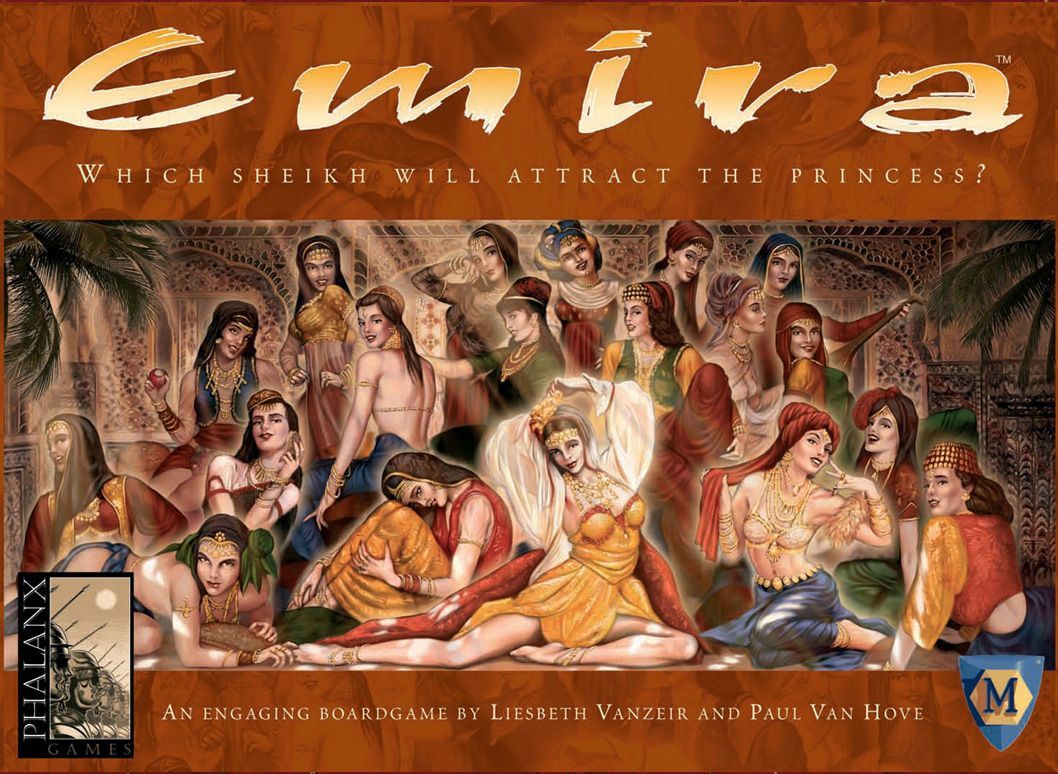
In Emira the players are Arabian Sheiks looking to expand their harem with more princesses. They try to make themselves more attractive to convince as many princesses as possible to come to live in their harem. Each round, another princess with different preferences comes into play and chooses the sheik that she is most attracted to. The game is played in several rounds. The 3 to 5 players have auctions where they bid to perform actions: play event cards, buying spice caravans, palace sections, camels, or improve his appearance and status. After all players have performed an action the princess will chose which sheik she prefers (according to her preferences). Each player has a goal card that defines his goal for the game, for example acquire 4 princesses with three specific skills or 6 princesses. 1st Place 2004 Hippodice Spieleautorenwettbewerb (as Harem).

What it feels like

Set Collection Variable Player Powers Auction / Bidding Economic Arabian Harems

Explore these mechanics in Cardboard

Start an original prototype from reusable design patterns—not this game's content.

Open mechanics workbench

Game intelligence

Learn the game

100% knowledge coverage

Setup

1. Lay out the auction board with 5 columns, each representing a tile up for auction. 2. Each column has 7 rows; the minimum starting bid corresponds to the picture/image row at the bottom. 3. Each player takes their bid-disk in their player colour. 4. Distribute starting gold to each player as per the game's starting conditions. 5. Place the auction tiles face-up above their respective columns. 6. Begin the first auction phase.

Turn flow

During the auction phase, players alternate placing their bid-disk in one of the 5 columns. The initial bid must be placed on the picture (lowest row) of a column. Opponents may then outbid by placing their disk 1, 2, or 3 steps higher than the current bid. Bidding 2 steps higher costs an immediate surcharge of 20 gold to the bank; bidding 3 steps higher costs an immediate surcharge of 50 gold to the bank. A player whose disk is displaced receives their disk back and must wait until it is their turn again, at which point they may place their disk in any column. Once every player has placed one marker in one column, the auction is resolved. Resolution order: lowest bidder first (rows 0–7), then columns left to right. Each row number acts as a multiplier of 100 gold (e.g., row 3 = 300 gold). The player who reaches or triggers row 7 in a column wins that tile. After resolution, any column that received no bids during the round gets a small wooden coloured cube, representing a 60-gold discount in the next auction phase.

Scoring and victory

Players win tiles through the auction; the winner is determined by overall game scoring from acquired tiles and remaining gold. The specific end-game victory condition is not detailed in this rulebook excerpt. Scoring sources: Tiles won through auction columns, Camel tile (purchased for 150 gold + column cost), Gold efficiency from overbid surcharges and discounts

Source: Rulebook

Rules to know

The most useful rules for getting a first game right.

Turn structure

Players alternate placing bid-disks in one of 5 columns to win auction tiles.

The auction uses a table with 5 columns, each corresponding to a tile available for purchase. Players take turns alternately placing their bid-disk into one of the 5 columns. Each column has 7 rows (plus a starting picture row), and the first bid in a column must be placed on the picture (the initial/lowest position). The auction in a column concludes when any bid reaches row 7.

Turn structure

The first bid in a column must be placed on the picture (lowest row).

When a player is the first to bid in a column during an auction round, they must place their bid-disk on the picture position, which is the starting/lowest row of that column. This establishes the minimum opening bid for that column.

Turn structure

Players may bid 1, 2, or 3 steps higher than the current bid; higher jumps cost extra gold paid immediately to the bank.

When a player wishes to outbid the current top bid in a column, they may advance the bid by 1, 2, or 3 steps (rows). Advancing by 1 step costs no surcharge beyond the row value. Advancing by 2 steps costs an additional immediate payment of 20 gold to the bank. Advancing by 3 steps costs an additional immediate payment of 50 gold to the bank. These surcharges are paid at the moment the bid is placed, regardless of whether the player ultimately wins the tile.

Turn structure

A player whose bid-disk is displaced receives their disk back and waits for their next turn to re-bid.

When a player's bid-disk is replaced by a higher bid in a column, that player's disk is returned to them immediately. They must wait until it is their turn again before placing their disk in any column of their choice. There is no restriction on which column a displaced player may re-enter.

Special

Auction resolves once every player has one marker in one column; resolved lowest-bidder first, then left to right.

The auction phase ends and resolves once every player has placed exactly one bid-disk in one column. Resolution proceeds in the following order: first by bid value from lowest to highest (rows 0 through 7), then by column position from left to right for tied bid levels. Each row number (1 through 7) serves as a factor multiplied by 100 gold to determine the final tile cost (e.g., row 4 = 400 gold).

Special

A tile is won when a bid reaches row 7 of a column.

Each column has 7 rows. When a bid-disk is placed on row 7 of a column, that column's auction is won by the player whose disk occupies row 7. The final cost is 7 × 100 = 700 gold, plus any overbid surcharges paid during the bidding process.

Scoring

The row number (1–7) is multiplied by 100 gold to determine the tile's purchase price.

The final cost to purchase a tile is determined by the row in which the winning bid-disk rests at the time of resolution. Row numbers 1 through 7 each represent a factor of 100 gold. For example: row 1 = 100 gold, row 2 = 200 gold, ..., row 7 = 700 gold. Any overbid surcharges (20 or 50 gold) were already paid to the bank at the time of bidding and are not refunded.

Special

Any one player may purchase a camel tile for 150 gold plus their column's full cost, instead of the tile they originally won.

During auction resolution, any single player who has won a tile may instead choose to purchase a camel tile. To do so, they pay 150 gold in addition to the full gold cost of the column they won (i.e., the row number × 100 gold). Only one player per resolution phase may exercise this option. The camel tile replaces the tile the player would have otherwise received.

Strategy briefing

Exploiting Unchosen Columns

Deliberately avoiding a column for one round causes it to accumulate a 60-gold discount cube. If a tile is only marginally desirable, waiting one round to bid on it can save 60 gold on the purchase price — a meaningful saving given the 100-gold-per-row cost structure.

Overbid Surcharge Management

Jumping 3 steps costs 50 gold immediately and is non-refundable even if you're displaced. Only use 3-step jumps when you're highly confident opponents won't outbid you further, or when reaching row 7 to end the column outright. A 2-step jump (20 gold) is a cheaper escalation tool.

Racing to Row 7

If you can reach row 7 with an overbid, you end the column auction immediately and guarantee the tile. Since row 7 costs 700 gold, consider this only when the tile is extremely valuable or when you want to deny it to opponents regardless of cost.

Camel Tile Timing

The camel tile costs 150 gold plus the full column cost — so it is cheapest when won from a low-row column. Winning a column at row 1 (100 gold) and converting to the camel tile costs only 250 gold total. Coordinate or anticipate who will take it, since only one player per round can do so.

Resolution Order Advantage

Auction resolution goes lowest bid first, then left to right. Winning a tile cheaply (low row) means your tile is resolved before high-bid columns. This can matter if tile acquisition order affects subsequent decisions or resource spending.

Common questions and edge cases

A player pays the 50-gold surcharge for a 3-step overbid but is then displaced by another player. Do they get their 50 gold back?

No. Overbid surcharges of 20 or 50 gold are paid immediately to the bank at the time of bidding. They are not refunded if the player is subsequently displaced. The player receives only their bid-disk back.

Two players both want to take the camel tile instead of their won tile in the same resolution phase. Can both do so?

No. Only one player per auction resolution phase may purchase the camel tile. Players must agree on or determine which single player exercises this option.

If a player's overbid lands exactly on row 7, does the auction for that column end immediately?

Yes. Row 7 is the winning row. As soon as a bid-disk is placed on row 7, that column's auction is concluded and the player with the disk on row 7 wins the tile at a cost of 700 gold (plus any surcharges already paid).

A column has accumulated a 60-gold wooden cube discount. Does this reduce the minimum price or the final winning bid cost?

The 60-gold abatement is applied to the cost of winning the column in the next auction phase. The minimum price still establishes the bid floor, but the final payment is reduced by 60 gold due to the discount cube.

Two players have bids in different columns at the same row number. Which resolves first?

When bids are at the same row level, resolution proceeds from left to right across the columns. The player in the leftmost column at that bid level is resolved first.

A displaced player wants to immediately re-enter a column. Can they do so out of turn?

No. A displaced player must wait until it is their turn again in the normal turn order before placing their bid-disk. However, once it is their turn, they may place in any column, including one they were previously displaced from.

Ask About This Game

Similar games