1999 BGG rank #30057

Q-Turn

2–4 players 20 min Ages 8+ 1.2/5 complexity 5.5/10 rating

About this game

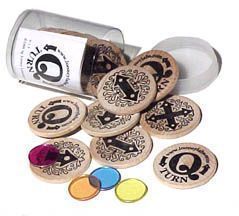
Q-Turn is a fast and unpredictable little game played on a dynamic board made up of 16 wooden nickels. The game is packaged very efficiently, in a small clear plastic tube, along with a rules sheet and four small flat tokens. Q-Turn is thus highly portable, and can be played on any flat surface, from the lunch counter to an airline tray table. The game is played by randomizing the disks and placing them face down on the table in a 4x4 pattern. Tokens are placed at the corners, with the goal being to move your token to the opposite corner and back again before your opponents. As the tokens move across the board, disks are flipped over, revealing arrows that indicate which way a token may move next. Each type of disk allows a different special action, rotating one or all of the disks a quarter turn, thus changing the available paths across the board. A quarter-turn here, and a quarter-turn there, and soon everyone may be headed off in the wrong direction! Microbadge Buy It

What it feels like

Modular Board Abstract Strategy Puzzle

Game intelligence

Learn the game

100% knowledge coverage

Setup

1. Place all 16 wooden disks face-down on the table, mix them up, then arrange them in a 4x4 grid pattern.\n2. Each player chooses a token and selects one of the four corner positions as their starting corner.\n3. All tokens begin off the board, placed next to their chosen corner disk.\n4. The baldest player goes first (or the player with the shortest/least amount of hair if no bald players are present).\n5. Play proceeds counter-clockwise from the starting player.

Turn flow

On your very first turn, simply move your token onto your starting corner disk (no other action is taken). On all subsequent turns, you have one of two options:\n\n**Option A – Rotate in Place:** If you are currently on a One Way Arrow disk, you may choose to re-orient that disk instead of moving, pointing it in any non-diagonal direction you wish.\n\n**Option B – Move:** Follow one of the arrows on your current disk and move your token one space in that direction. You may not move diagonally, off the board, or pass your turn without acting. If the destination space is occupied, you may instead choose to Bounce (stay in place and re-trigger your current disk's special action).\n\nWhenever you move onto a face-down disk, flip it over and rotate it to any aligned (non-diagonal) position of your choice before resolving its action.\n\nAfter moving, resolve the Special Action of the disk you landed on (if any).

Scoring and victory

Race — the first player to complete the round trip (starting corner → opposite corner → starting corner) wins immediately. Target score: Complete the round trip before all other players Scoring sources: Reaching the opposite corner disk, Returning to the starting corner disk

Source: Rulebook

Rules to know

The most useful rules for getting a first game right.

Setup

Place 16 disks face-down in a 4x4 grid after mixing.

Before the game begins, place all 16 wooden disks face-down on the table, mix them up thoroughly, and then arrange them in a 4x4 grid pattern. The randomized face-down placement ensures no player knows the disk types in advance.

Setup

Each player picks a corner and starts their token off the board next to it.

Each player selects one of the four corner positions of the 4x4 grid as their starting corner. Tokens begin off the board, placed adjacent to (but not on) their chosen corner disk. No two players may share the same starting corner.

Setup

The baldest player goes first; shortest/least hair breaks ties.

The player with the most baldness goes first. If no players are bald, the player with the shortest or least amount of hair goes first. This is a humorous but binding rule for determining the starting player.

General

Play proceeds counter-clockwise from the starting player.

In keeping with the counter-clockwise direction of disk rotation used by Q-Turner and Double Arrow disks, the turn order proceeds counter-clockwise around the table from the starting player for the entire game.

Turn structure

On your very first turn, move your token onto your starting corner disk — no action taken.

A player's first turn consists solely of moving their token from off the board onto their starting corner disk. No special action is triggered on this initial placement, even if the starting corner disk is face-up and has a special action.

Turn structure

On subsequent turns, move your token one space following one of the arrows on your disk.

On each turn after your first, you must move your token exactly one space in a direction indicated by one of the arrows on the disk you currently occupy. You may not pass (skip movement). You may not move diagonally. You may not move off the board. After moving, resolve any special action on your new disk.

Restriction

Tokens may never move diagonally.

Movement is strictly orthogonal (up, down, left, right). Tokens may not move diagonally at any time, even if an arrow appears to point diagonally. Disks must also always be oriented so their arrows do not point diagonally.

Restriction

Tokens may not move off the board.

A player cannot follow an arrow that would take their token off the edge of the 4x4 grid. If all arrows on a disk point off the board or to occupied spaces, the bounce rule may apply for occupied spaces; edge-of-board bouncing is not permitted.

Strategy briefing

Anticipating Q-Turner Rotations

When orienting a disk, account for the possibility that another player will land on a Q-Turner before your next turn. If that happens, all revealed disks rotate a quarter turn counter-clockwise. To ensure your disk still points where you want after such a rotation, orient it one quarter turn clockwise from your desired direction — that way, the Q-Turner rotation lands it exactly where you intended.

Choosing Left vs. Right Paths

The most direct path across the board would be diagonal, but diagonal movement is forbidden. When choosing between moving left or right around the diagonal, favor the right side. If a Q-Turner fires and rotates your disk counter-clockwise, a right-pointing disk becomes a forward-pointing disk, still making progress — whereas a left-pointing disk would end up pointing backward.

Using the Double Arrow Defensively

The Double Arrow's optional rotation of one other disk is a powerful tool for disruption. Use it to rotate a disk that a rival is about to use to reach the opposite corner, forcing them to take a detour. Since the rotation is exactly a quarter turn counter-clockwise, you can precisely calculate which direction an opponent's disk will face after your intervention.

Exploiting Bouncing for Repeated Special Actions

If you are sitting on a Double Arrow and an opponent's token blocks your destination, bouncing allows you to repeatedly use the Double Arrow's rotation action each turn, steadily reshaping the board in your favor without having to move. Position yourself on powerful disks when opponents are likely to block your path.

One Way Arrow Flexibility

The One Way Arrow's rotate-in-place option is uniquely powerful because it gives you a turn to adjust your trajectory without moving — useful when all available paths lead in the wrong direction. Save this option for moments when the board has shifted unfavorably due to a Q-Turner firing.

Managing Face-Down Disk Reveals

When you land on a face-down disk, you get to orient it however you wish before resolving its action. If it is a Q-Turner, you must trigger the full board rotation — but you still get to orient it first (though its 4-way nature makes orientation moot). If it is a One Way Arrow or Double Arrow, carefully choose an orientation that benefits your next turn's movement.

Common questions and edge cases

I bounced because my destination was occupied. Do I get to use my current disk's special action?

Yes. Bouncing explicitly allows you to re-use the special action of your current disk as if you had just landed on it for the first time. For example, bouncing on a Q-Turner forces a full board rotation; bouncing on a Double Arrow lets you optionally rotate one other disk.

My only available arrow points off the board. Can I bounce off the edge to stay and re-use my special action?

No. Bouncing is only permitted when the destination space is occupied by another player's token. You cannot bounce off the edge of the board.

When I land on a Q-Turner and rotate all revealed disks, does the Q-Turner itself get rotated?

The Q-Turner is included in 'all revealed disks' and is technically rotated, but since it has arrows pointing in all four directions its orientation is visually unchanged.

Can I use the Double Arrow's action to rotate the Double Arrow disk I'm currently sitting on?

No. The Double Arrow action lets you rotate any one disk OTHER than your own current disk.

I'm on a One Way Arrow. Must I rotate it, or can I move normally instead?

The rotate-in-place option is a choice, not a requirement. If you are on a One Way Arrow at the start of your turn, you may either re-orient the disk instead of moving, OR move your token normally following the arrow. You cannot do both.

My starting corner disk is a Q-Turner. Does landing on it during my first turn trigger a full board rotation?

No. On your very first turn you simply move onto your starting corner disk and no special action is triggered, regardless of the disk type.

I flipped a face-down disk and it turned out to be a Q-Turner. I rotated it to a position I wanted. Does the Q-Turner action still fire?

Yes. After flipping and orienting a face-down disk, you resolve its special action normally. Landing on a Q-Turner always triggers the mandatory rotation of all revealed disks, even if you just flipped it yourself.

When I re-orient a One Way Arrow disk, can I point it diagonally?

No. When re-orienting a One Way Arrow (or any disk), it must be aligned with the grid — pointing strictly up, down, left, or right. Diagonal orientations are never permitted.

Ask About This Game

Similar games